
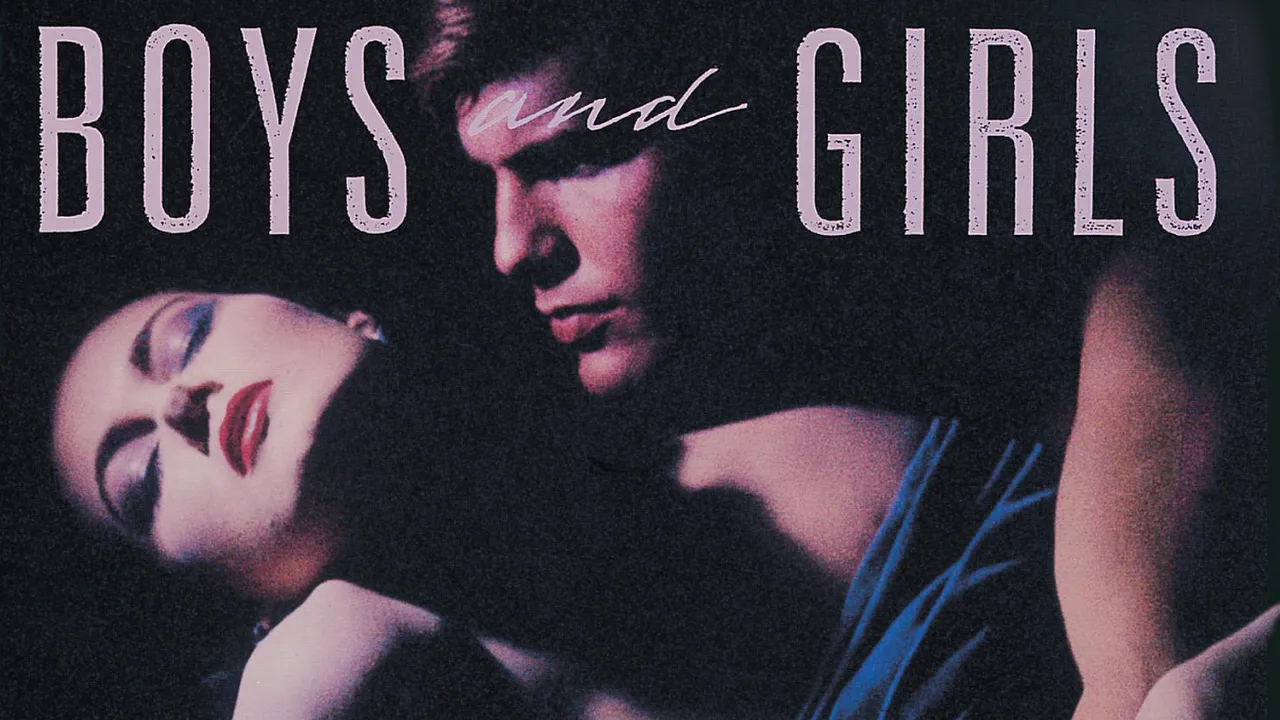
Boys and Girls’ influence spread throughout the ’80s, particularly among artists with prior triumphs and a desire to maintain their currency in a transforming biz. A year after this CD landed on shelves, Peter Gabriel released his tour de force So, which spiked Ferry’s sultry example with the sort of skyscraping choruses that Boys and Girls largely avoids. In a track like “Windswept,” you can hear the germ of Sting’s 1987 potpourri Nothing Like The Sun, with its conception of the studio as a shiny, modern forum for a melange of musical cultures. Both of these multiplatinum platters are looser than Ferry’s, and each was more attractive to elusive markets in the U.S., where Boys and Girls went a paltry Gold. Yet, as ever, Ferry provided the blueprint: He figured out how to be a middle-aged pop singer without either capitulating to irrelevance or chasing the quicksilver energy of youth.
Ferry continued to hone this vaporous aesthetic on 1987’s Bête Noire and 1994’s Mamouna. Yet Boys and Girls has the thrill of invention, with more distinct peaks than its successors. The record’s novel sensibility lets it pull off being stiff and listless at points—an occupational hazard of penning midtempo music and also a signal of Ferry’s mindset. Boys and Girls never insists on hogging your concentration, because this disc deals in ambient qualities of experience: the slow churn of time and how it catches people in its gears, spitting them out at an older age. Ferry, down bad for most of the runtime, seems by its end as if he’s chastely riding in a carriage beside Emily Dickinson. As he croons: “Who’s that crying in the street/Death is the friend I have yet to meet.”
His father died in 1984, and the blue-collar industriousness the songwriter associated with his dad surges through these numbers. “Footsteps in the dark come together / Got to keep on moving or I will die,” he responds to a character called “Mama” on the foreboding, infectious “Don’t Stop The Dance.” The most explicit composition about being a son, “The Chosen One,” contrasts mortality and prosperity. “Gold and silver walk the main street,” Ferry intones in an early verse, but transports us somewhere existential by the outro: “take my spirit, I must follow.” Its muscular, messianic refrain—“the chosen one”—weighs heavily with repetition, like a taunt from his own ego. Ferry, circa 1985, was a craftsman and an obsessive, self-involved and single-minded, which is one way of staving off the worst of grief. Without Roxy Music to mastermind, Bryan Ferry became his primary project: a pop silhouette for a skilled artist to flesh out.
Boys and Girls graced Ferry, England’s favorite diva in a double-breasted suit, with fresh laurels and attention. Yet the record’s commitment to both precision and languidity also suggested how he might operate behind the scenes. One can imagine him as a dance producer, shrouded by the fog of the club, protected from spectators and revelers by his mixing board—after all, in the early Roxy years, he hid behind a synthesizer at the side of the stage. On Boys and Girls, this former art student figured out how to be simultaneously figurative and abstract, fleshy and incorporeal, a balance he would modulate on future releases. He stood front and center—where his fans expected to find him—and happily began to dissolve into the tableau.
Daniel D`Amico for SANREMO.FM