
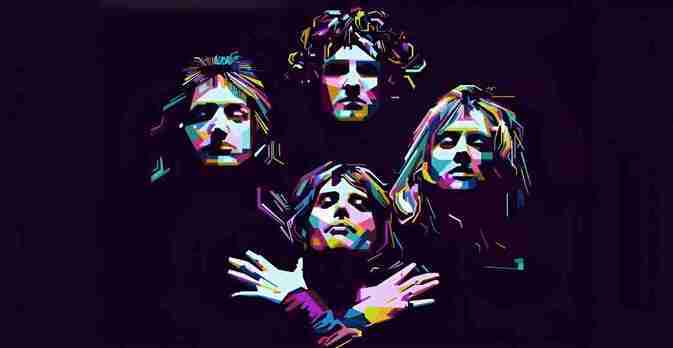
Few artists, if any, have filled the charts with junk in comparable quantities to Queen. With around fifty songs in the British top 40, spread over four decades, their empire of pomposity has conquered and still conquers the public with an invasive style that in many cases is much more pompous than brilliant.
Their hold on the collective imagination, however, knows no sign of weakening. Thirty-odd years after his death, fans are more convinced than ever of Freddie Mercury's absolute, indeed objective, superiority compared to any other singer in history. Not a few place Brian May's pompous and oversaturated style on the Olympus of rock guitarism. Annoying hits like “We Will Rock You” and “We Are The Champions” have entered, thanks to their hammering triumphalism, into the worst repertoire of sporting events, while the excursions synth/disco – for example “Another One Bites The Dust” and “I Want to Break Free” – which at the time had stunned admirers, today are considered by some to be among the peaks of the period, due to a mixture of disillusionment and lack of references. A further revival of popularity then came a few years ago thanks to the musical/biopic “Bohemian Rhapsody“, which contributed to canonizing the band's epic even among younger audiences.
Between baroque and cabaret
Yet Queen wasn't just about ostentation and pandering refrains. On some occasions, their perpetual juggling kitsch and banality has found happy points of balance – if we can even speak of balance, given the brazenly exaggerated nature of many of these visionary impulses.
Here is the horizon of this playlist, which reviews the entire path of the English band, also including some solo episodes. The common thread is the more prog-pop side of their production, which sees them as original and overflowing interpreters of a playful and over the top trend, a little glam and a little Beatles-esque, which also includes 10cc and City Boy, Electric Light Orchestra, Pilot, Jet, Be Bop Deluxe, across the ocean the Sparks, in Japan the Sadistic Mika Band. A territory made up of daring pop structures, dazzling about-faces (hence the expression “flash rock”, recurring throughout the early Seventies), flirtations in the direction of kitsch perpetually poised between irony and overabundance.
In the compilation the vaudeville meets the operetta and the granny music playful and retro in Paul McCartney style, crossing with overflowing hard lashes: a whirlwind of styles and inventions that does not lack the magniloquence of the most trite classics, but combines it with a more playful and imaginatively contradictory flair. An eclectic mix that tempers the pomposity without denying it and combines it with a “lopsided” attitude, giving life to a potentially interesting formula even for those who, although not avid fans of the band, know how to appreciate unconventional pop structures.
Tricks, cymbals and wonders
In this context, Mercury's voice, always theatrical but rarely convincing on an emotional level, finds its effective dimension: the pretense is obvious and it is the soul of the party, so much so that he manages to give meaning and presence to every verse saturated with emphasis. Similarly, Brian May's perpetually doubled lines accentuate the spectacular character of the pieces, bringing artifice to the fore and giving substance to a meticulously constructed structure. When it is not exploited in its most bold and circus-like guise, the piano contributes to the classical component, made even more striking by the inclusion of the harpsichord, as in “The Fairy Feller's Master-Stroke”. Synthesizers, however, are almost absent: for a good part of the production seventy-year-old the band explicitly boasted of the choice not to use electronic keyboards – “No synthesizers!” read the title page of some of their best-selling albums – while the selected songs from “The Game”, “Flash Gordon”, “The Miracle” and “Innuendo” testify to the turnaround in the early Eighties.
Another fulcrum is the harmonic inventiveness, with refined cadences and unexpected changes in tone. The tritone leap in “Bohemian Rhapsody” was recently the focus of an in-depth study by YouTuber David Bennett, but pieces like “Killer Queen” and “The Millionaire Waltz” also showcase the entire repertoire of tricks post-Beatlesianmade up of secondary dominants, chromatic descents and strategic sevenths. Even “The Miracle”, with its barrage of subliminal modulations and the verse structured on a scheme of only three lines, is a clear example of this.
Between flashes and sideshows
Many of the selected pieces, you can see, bear the signature of Freddie Mercury. The author of the tremendous “We Are The Champions” was, of the four members of Queen, the songwriter closer to the spirit of this playlist: gifted with a theatrical and ambitious sensibility, he knew how to mix grandiose elements with melodies that went far beyond the usual sporting event anthems. “We Are The Champions” itself, although bombastic and emphatic to the point of being indigestible for some, shows, thanks to its astute and effective changes of tone, all the expertise of the frontman in managing effective transitions. A look at his solo career confirms this vocation: “Barcelona”, the musical kaleidoscope created together with the soprano Montserrat Caballé, represents a fusion of operatic drama and symphonic pop, while the lush “Mr. Bad Guy” plays on the contrast between plastic keyboards and orchestral colours.
In short: between hymns, marches, choirs and other chart rubbish, Queen have really pulled out a few pearls. When Mercury knows how to put his histrionics at the service of a theatricality that doesn't necessarily ask for applause, when May abandons parade numbers and pursues more oblique lines, something happens. Even in some of the most famous songs, beneath the exaggerated surface you can glimpse a surreal and oblique vein that deserves attention. Listening to these pieces again today, one after the other, is like opening a trunk of theatrical costumes: however unlikely, showy, tacky they may be, it is difficult to remain indifferent to the charm of their witty lack of sobriety.
Antonio Santini for SANREMO.FM