
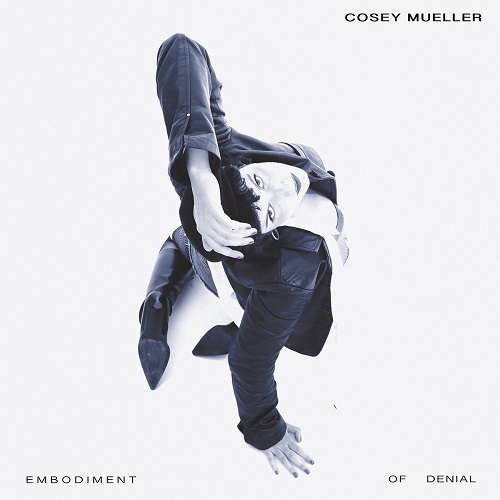
With “Embodiment Of Denial,” Cosey Mueller transforms minimal synth-punk into something that sounds like a neurological diary recorded in the midst of contemporary collapse. It is not an album that seeks the easy provocation, the first-strike one. It's something else: a subtle sabotage, which works slowly, between melodies that seem like corroded slogans, beat mechanics that oscillate between irony and paranoia and analog synthesizers that emerge from the fog like radio signals picked up in the heart of a post-industrial city.
From the first minutes, you can feel the tension. It's continuous: body versus control. The title itself works almost like a manifesto, that is, reject everything that the outside world tries to push on you. But be careful: it's not the usual little speech naive on authenticity. Mueller talks about the concrete struggle of defending one's mental form in an era in which media, politics, work and relationships seem to want to flatten you. Cancel any deviations. And in this sense, “Embodiment Of Denial” is deeply political, without ever becoming a pamphlet.
The album moves along an ambiguous border of electro-punk, minimal-wave and synthetic post-punk. A discussion already addressed in the past, even if here everything is more compact, more physical and above all, more danceable. The influences are immediately recognisable: DAF, Malaria!, Liaisons Dangereuses and that proto-industrial coldness of the early German Eighties. But Cosey Mueller carefully avoids the retro fetishism that often suffocates contemporary synth-wave, because his songs don't sound like vintage reconstructions.
“Contraddict” transforms the groove minimal in a hypnotic spiral, where repetition almost becomes psychological dissociation. The synthetic bass pulsates like an automatic reflex of the nervous system. And the artist's voice, distant, but incredibly expressive, floats above the beat with a tone that alternates sarcasm, vulnerability and controlled coldness. Then there is “Obey”, one of the strangest and most fascinating moments of the album, a track lo-fi which seems simple, almost naive, suspended between primitive rhythms and minimal melodies capable of evoking a sense of cinematic urgency. Like a soundtrack to some dystopia low budget shot between concrete, neon and urban alienation.
The political dimension emerges more clearly in “Der Politiker” and “Media Maniac”. It's not the frontal rage of classic punk. It is another form of disillusionment: ironic, nervous, dancing over the disaster instead of simply denouncing it. Yet the album is never completely nihilistic. Under that synthetic and sharp surface, an almost romantic desire for self-determination continues to pulsate. Mueller knows very well how difficult it is to build an authentic life outside conventional structures, but instead of transforming this tension into victimhood, he converts it into creative energy. It's music that comes from isolation but still seeks connection. Music that laughs bitterly while everything around it loses consistency.
06/23/2026
Daniel D`Amico for SANREMO.FM