
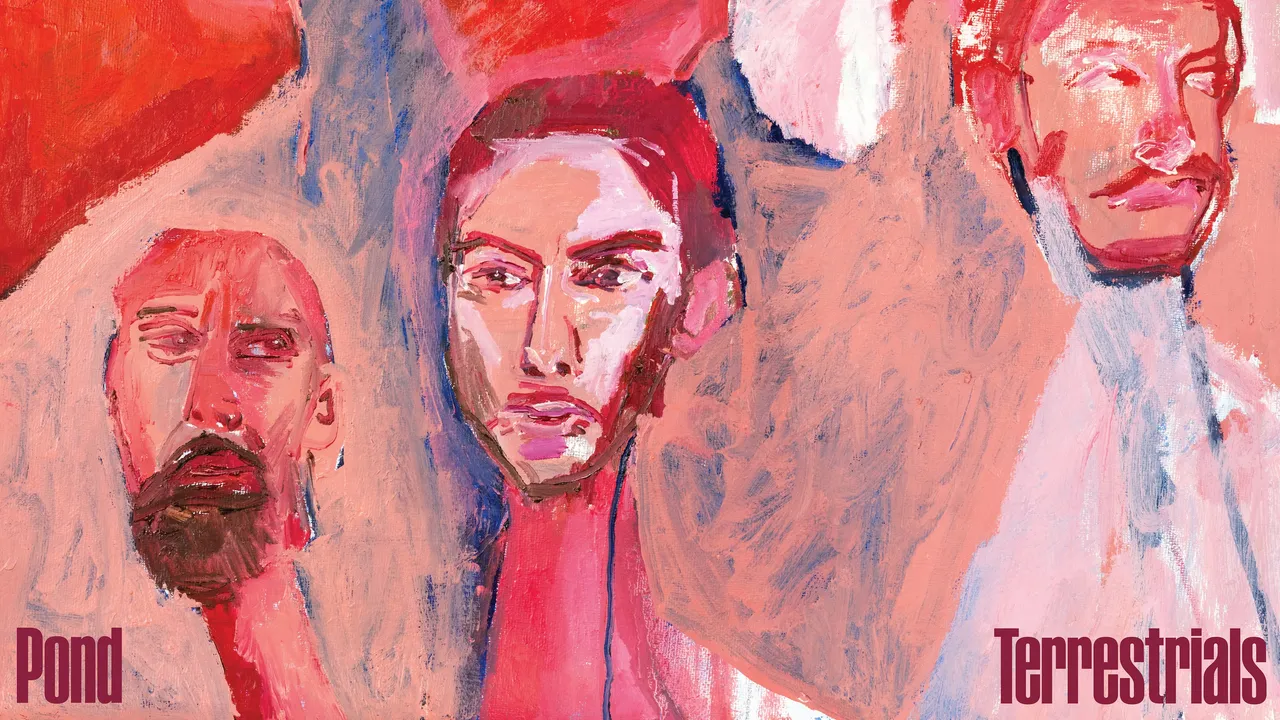
The members of Pond are allergic to staying still. Since 2008, the Australian psych-rock quintet has released 12 albums (11 studio, one live), plus another 15 between Nick Allbrook, Jay Watson, and Joe Ryan’s solo projects. Watson and Ryan have also spent years in the Tame Impala touring orbit (Allbrook, too, from 2008 to 2013). But for all of that motion, Pond occupy a surprisingly stagnant place in modern psychedelia. While peers have pushed the genre toward radio-ready house-pop or dubiously eccentric experiments, Pond remain tethered to the sound that produced their last true breakout. Still their most popular song by over 20 million streams, 2017’s “Paint Me Silver” casts a shadow over the group—their biggest moment, so closely tied to the genre’s jangly, reverb-heavy mid-2010s signatures.
Their latest album, Terrestrials, remains unmistakably Pond. The songs are punchier and more urgent than 2024’s languid Stung!, but the familiar psych-rock crunch-meets-glammy theatrics feels secondary to the record’s larger concerns: environmental collapse, Australian identity, and corporate greed. Those themes are compelling on paper, but they’re expressed through a confusing mix of abstraction and hyper-local specificity, hidden beneath biker rock riffs, and obscured through Allbrook’s wiry, wailing vocal delivery. With so much going on, the ambition alone isn’t enough to make it feel cohesive.
No score yet, be the first to add.
Catastrophe looms in Terrestrials’ near-menacing tone, full of ominous synth pulses and creeping grooves. Pond’s emphasized that they recorded Terrestrials without their signature fuzz pedals, but the exercise lands like that “She’s so crazzzzzzzy! Love her!!” meme: The riffs are still crunchy, the edges still rough, and I’d be damned if the distortion on “Through the Heather” doesn’t sound a whole lot like fuzz. Devious synth arpeggios loop with Halloween-like anticipation on opener “Skyworks,” while the Kevin Parker-produced “The Fatal Shore” carries a hefty four-on-the-floor bass that rumbles like an approaching army. Aside from the acoustic, Counting Crows-adjacent “Roebuck Plains,” the record rarely strays far from Pond’s pre-established musical palette of warbly, jammy walls of sound.
Watson and Allbrook draw on the natural and the man-made to look at the relationship between societal progress and environmental collapse. The tracklist reads like an Intro to Environmental Science syllabus: songs named after minerals, plants, and individual stretches of landscape. The lyrics chronicle life on the plains and the mining of bauxite, the world’s primary source of aluminum. “Casuarina,” named after the She-Oak tree, sticks it to the Australian mining magnate Gina Rinehart, proudly abandoning subtlety and speaking to the lackluster job market (“How’s he gonna get him off Nauru/With this money from Deliveroo/A ticketed nurse in Pakistan/But my degree don’t work in this wide brown land,” Allbrook laments in the second verse). Its rushed tempo and clamoring riffs cut through the record’s otherwise tangled web of references and theories.
Terrestrials is so steeped in local, environmental minutiae that doing the kind of analysis necessary to fully understand every lyric can feel like an extra-credit assignment. It’s not until you do the digging that you realize how clever and weird they’re actually being, like when Allbrook takes on the POV of a mineworker, or names a song after Robert Hughes’ 1986 book on the English convict transportation system that essentially created Australia. Yet the music itself isn’t always rousing enough to inspire that close reading. While the lyrical concerns remain sadly relevant, Terrestrials can’t help but feel stuck in time.