
San Antonio, Texas — All these Christian ladies are trying to do is get inside the Marriott. And yet outside, dark forces abound. On one side of the building, a cluster of women and children in calico are shouting on bullhorns about the “true Jesus.” Across the street, a group in red-cloaked hoods are re-enacting the Handmaid’s Tale to shame them about their anti-abortion agenda. Somewhere on the fringe, people in masks shout about Erika Kirk enabling pedophiles. “I’m not taking that,” says the young woman on the corner next to me as I examine the authentic-Jesus pamphlet. “It’s deception. That’s the devil.”
It’s a crazy world out here but these ladies are purpose-filled and here at the annual Turning Point USA Women’s Leadership Summit for a good time. They won’t let their mood be dampened as they teeter in waves toward the conference center in espadrilles, in cowboy boots and Keds, in sensible wedges and sparkly summer slides, in billowing floral dresses and blouses, cheeks rouged, hair cascading down their backs in barrel curls. They make their way to the corporate safety of the automatic doors, which slide open with a mechanized welcome. Pop music plays as they are at last among thousands of other women who want to be the best, Christ-filled version of themselves.
Nine months after Charlie Kirk’s assassination, Erika Kirk finds herself at the front of Turning Point USA, a non-profit that has become a national movement. Her husband started Turning Point as an 18-year-old high school graduate with the goal of winning the culture war on college campuses. He infused a charged urgency, divisive language, and a grim vision of what life would look like if young people moved away from God. Now with more than $85 million in revenue, his widow has taken over and softened it, made it more capacious and transcendent like the billowing floral blouses she favors.
Up the escalator the ladies go, leaving the protestors behind, making their way through several layers of security. At last, they slip on their Turning Point USA badges which they’ve been told to remove for safety purposes outside in the world. But once inside, this convention is 100 percent fun! There’s a shaved poodle painted in red, white, and blue and places to take selfies with glow lighting and more merch than you could imagine. Women of all ages are here but many are young, pinning themselves with buttons that say “Cute Girls are Conservative” and “Pretty Girls Don’t Vote for Socialists.” They can buy baby-Ts that read “Proverbs Over Algorithms,” or some of Erika Kirk’s own brand of biblical streetwear, with sayings like “Make Heaven Crowded.” This isn’t just a conference, it’s a lifestyle. “It’s not political, it’s biblical,” is the catch phrase repeated throughout the weekend. These are cute-servatives, a faith-based sorority that is equally at home at a Brandy Melville store as a suburban megachurch.
Inside the vast conference hall, its concert-dark, with pink and purple lights overhead, and at the front of the room, the stage is luminescent and white. A girl with sausage curls wears an American flag around her body, as she dances to Justin Bieber and Shawn Mendes and Taylor Swift. There’s a sort of mosh pit at the front, made up of members from the Turning Point USA hype crew, a tight cluster of young women who have been helping build the energy over the last hour as people stream in to secure seats.

Dani Bernecker and Hazel Roberts, two attendees of the Turning Point Women’s Leadership Summit.
Joel Angel Juarez/REUTERS
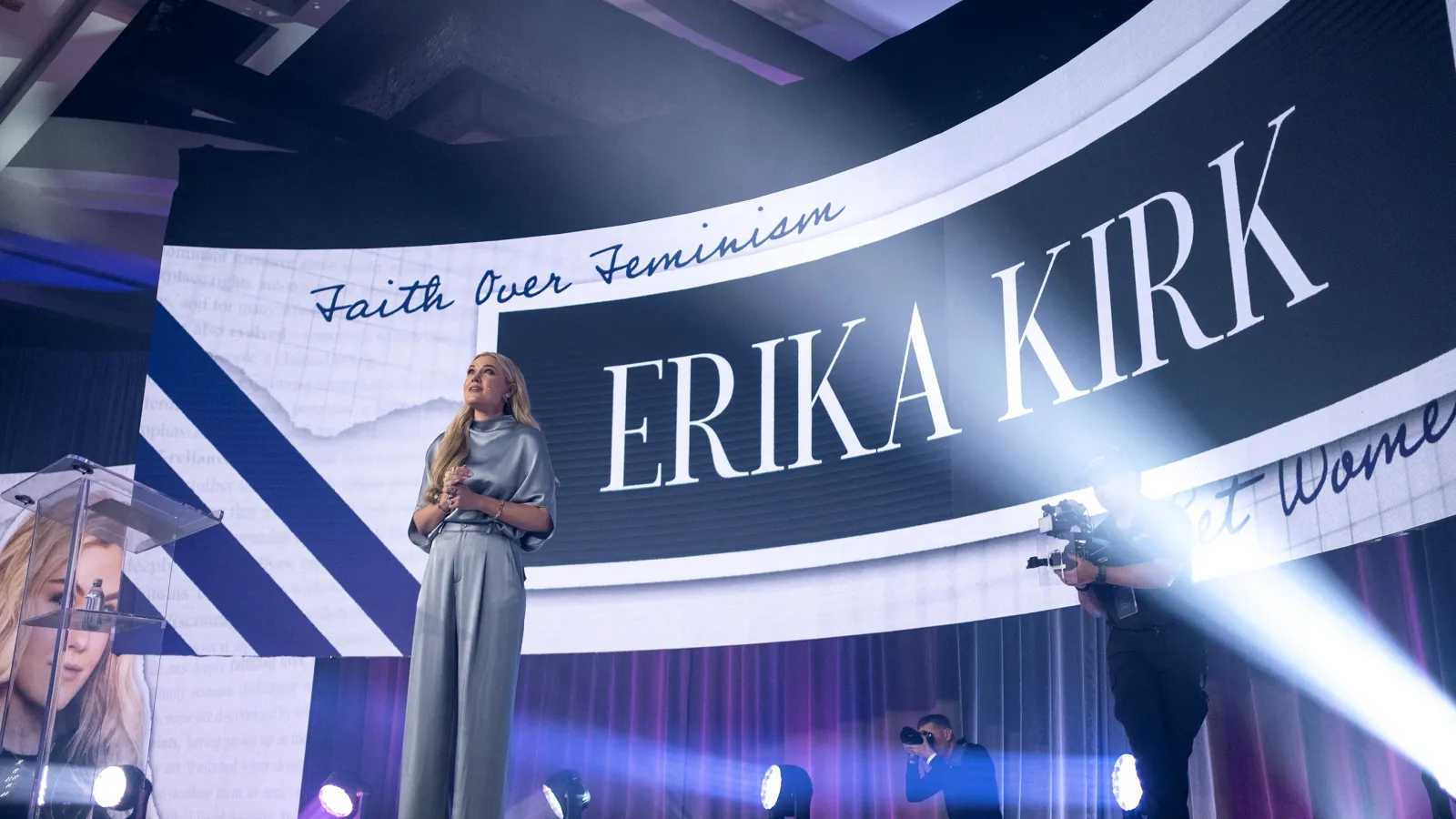
By the time Erika Kirk walks onto the stage at 5 o’clock, every seat is full, every wall lined with people. Three thousand women watch as a jumbotron plays her walk-on video, which situates her in history: “Before America was a nation, it had women of faith who carried their conviction across a fragile new nation. They taught their children that freedom was not a gift from government but a blessing from God. When the world demanded more from America, America demanded more from its women.”
Ear-drum shattering screams greet Erika as she enters the stage in a soft grey pantsuit. She is silken and sophisticated, no pioneer dresses for her. She tells a devastating anecdote about her daughter imitating her late father with his microphone. I hear soft moans from the women seated around me — her heartbreak is unimaginable, the grief in the room palpable. Her husband, Erika tells us tenderly, sometimes stumbling on the words of her speech, was a visionary for creating this conference a decade ago. “He could see young women being sold a vision of life that looked empowering on the surface but left many of them increasingly dissatisfied underneath.”
Over the course of the next 17 minutes, Kirk’s speech is rhetorically powerful, as she moves from her husband’s prescient vision to the desires of women to the horrors of what she has endured — both in the assassination of her husband and the fallout of madness and conspiracy that has been the aftermath. Kirk, once Miss Arizona 2012, is by turns polished and stoic, angry and sad. Her nuance made her a household name last year when she forgave her husband’s assassin during a televised memorial service watched by over 100 million people.
But unlike her husband, Erika doesn’t focus too much on the politics and problems that plague society. Maybe she’s seen too much. Instead, she illustrates her vision of what life and the future could be when one lets go of worldly judgement and surrenders to God. Erika tells the crowd that they are all there because they have a higher purpose than the earthly illusions of career and ambition. It is a “deeper, more thoughtful question, a moral and spiritual question: what life’s vision will you pursue?”
There’s an echo of JFK here, of calling on a generation to give, not get. Kirk is masterful. If her husband called out the darkness and the divides of this nation, Erika is uniting her audience in warmth and purpose. In her telling, the feminist movement has failed women by denigrating motherhood and men, and elevating working for others at all costs. “Feminism is a competing force against manhood,” she tells them. “Rather than something that is complimentary.” “Amen,” says the woman behind me. It is a spiritually distinct version of leaning in — prioritizing faith and family and pushing back against both the femi-nazis and the corporate overlords.
But just as she paints her vision of a worthy life for the audience — one that includes work, children, suffering, tragedy, legacy, and final judgment — she is interrupted. From the VIP section, of all places, a single shrill voice calls out: “Erika Kirk protects pedophiles.” Kirk looks over, with sadness and a touch of disgust. Quickly, the wiry, young female protestor is carted out as the audience stands and claps away her darkness. Erika wishes her well because you know, “Eternity is long.”
Like any good conference, there was plenty of merch to be found.
Claire Hoffman
WHILE ERIKA IS THE MOST WELL-KNOWN OUTSIDE the conference, inside the Marriott it is Alex Clark who is the real de facto MC for the weekend. (Kirk, I was told when I asked for an interview, flew out after giving her speech). Clark, a petite, silken-harried brunette, hosts the Turning Point podcast, Cultural Apothecary. She has hundreds of thousands of subscribers devoted to her and her quixotic combination of wellness and conservative Christianity.
When she walks to the podium at the end of opening night, Clark harkens back to last year, when Charlie Kirk had been on that stage with them. She praises the founder, saying working for him for seven years was the honor of her life. But she quickly adds complexity, asking people if they remembered a Q&A with Erika and Charlie that year that got a little “spicy.” She played a clip showing Charlie, with his comic book good looks and definitive delivery, asking the single women in the audience: “How many of you, every single day, it’s your purpose for being is finding a husband, then?” Following a muted response from the audience, he said sternly: “Every hand should go up.” He continued with a gloomy barrage of statistics, telling them that single women over 30 had only a 50 percent chance of getting married. Erika interrupts him to try to tone him down, saying “God is good” and things will work out. Charlie says, “If you just want happy talk, that’s fine.” Clark freezes the video there.
Clark says she understood where he was coming from but that it had hurt — she was a single woman in her thirties. Sitting in the audience had made her face some tough truths. She says the stats are worse than Charlie said — that one in three Gen-Zers will never get married and one in four will never have children. But Clark is there to give the crowd a more nuanced view of being a woman, even a single woman. “Your marital status is not God’s report card on your life,” she says. Living solely to find a husband and living solely for your career are both mistakes. “Build a beautiful life,” she tells them. What follows from Clark are lessons for all the girls in the audience living in their “single season.” She enumerates the work you can get done whilst being alone — advice that ranges from living your best life, getting out of debt, buying all the throw pillows you want, going to Pilates, as well as reading parenting books, researching child health and education, and also repenting and volunteering.
Her last piece of advice: don’t post a guy until you’re engaged. When she says this, my old ears assume it’s slang for sex, but she actually means posting your relationship status to social media. Then she says she has an announcement. Darkness, explosive cheers, and out walks her new fiancé. “Hi CUTEservatives!” says Vance Voetberg, who writes a holistic-health Substack for “gym bros and grandmas” called Running on Butter.
Holding up a giant pear-shaped diamond on her hand as she twirls on the stage, Clark reveals that she had lived the ultimate success story: She had built a career, prepared herself for the sanctity of marriage and family, had a little fun, and now here she is in the natural happy ending: with a man.
Don’t get me wrong — I applauded along with everyone else for Clark. And later, her fiancé was on my flight to Phoenix. He seemed like a catch, helping lots of older ladies get their bags from the overhead bins. Even though I’m a feminist, I too love a happy ending.
THROUGHOUT THE CONFERENCE, A WOMAN kept catching my eye — she was statuesque in a bright Barbie-pink brocade suit, with long voluminous blonde curls and a full face of makeup. At her side was her daughter, Ella, 14, also in a pink suit. When I finally approached Nichole Jack Johnson, I learned she runs a real estate firm, a concrete company, a wellness clinic in Central Texas as well as a nonprofit. She has two adopted daughters and a son, and she told me she hesitated coming to the conference. “I was a big Charlie Kirk fan,” she explains, but she felt that she knew less about Erika. Many of her friends — conservative Christian friends — do not like Erika Kirk. But she felt called and she loved the range of Christian womanhood being embodied on the main stage.
“I can still be powerful and submit to my husband,” says Johnson. She went on to explain to me in well-thought out detail how she can both adhere to the woman described in Proverbs who works hard, takes care of her husband and children, and puts God before all else. This, she says, is only possible because her husband is a good and godly man. “But he’s a husband who has submitted to God. I submit to the God in my husband,” she explains. “I’ve also always had a job, you know what I mean? So the pushback that I hear on the submission — I agree that’s the hard part. Like, I believe in submission, but I also believe in the pushback.” As a conservative Christian “boss-babe,” she says she felt like there was a place for her in these halls. “I feel like the stereotype of the conservative Christian woman is like barefoot and pregnant, you know what I mean? And that’s just — I’m sure that’s some women, but that’s never been me.”
During the weekend, I met women like Johnson who felt that Erika Kirk’s version of a womanhood had a space for them. Josephine Gleeson, a 19-year-old engineering student with long blonde hair and high-waisted vintage Wranglers came to the conference with her mother. “I thought it was really encouraging because a lot of their messages were about what a blessing it is to be a mother and, you know, start a family at a young age. But for someone, for a girl like me who… I’m in school, I’m not dating anybody, I’m not engaged — so it was really encouraging that these godly women were building careers and doing really powerful things. It was just encouraging that they weren’t saying that your only option is to get married young, you know?”
Inside the “Daughters of the King” breakout session, a lineup of female pastors talk about the dangers of feminism and the importance of spreading the word. Katy Perry’s mother, Mary Hudson, wearing bedazzled shoes, shares anecdotes of her daughter being biblically prophesied by a preacher when Katy was a kid. “When she was nine, he said to her, ‘You will sing for kings and presidents, and your voice will break the spell of witchcraft.’” The crowd gasps at this miracle of prophecy, but Mary adds a little salt to it. “So, we’re still waiting for that.” I think she meant the witchcraft — such is a mother’s love, I guess.
During the Q&A at the end of the session, a serious young woman asks very quietly if it’s biblically correct for a woman to be a pastor. Every woman onstage works in some capacity as a preacher, and every woman who has presented at the conference has some kind of a career, so it’s close to a hostile question, implying that it’s ungodly for women to preach. Shayla Perez, a Christian influencer and preacher with micro bangs and a long, tight plaid dress, takes the microphone. She offers to meet the young woman outside later to explain her theological justification for her work but in the meantime, this is a secondary issue, she says. It’s a distraction.
“We are not focusing on the primary. Babies are being aborted in the womb. Males are becoming females. We have women who believe that their career choices are their only form of value. There are other women right now who will be converted to Islam. What’s going on in the church is happening right under our nose, and we are arguing about stuff that is totally secondary.”
Students for Life’s booth in the sponsors hall at the event.
Claire Hoffman
Saturday morning, the halls were tight with purposeful ladies, trying to squeeze into breakout sessions that all seemed to be at capacity. “Are you going to leadership or wheat?” was the chorus from a line that snaked around the convention hall. “Leadership!” “Wheat!” Turns out many could go to neither: both “Leading with Faith: A Conversation on Purpose, Leadership, and Calling with Michelle Bachmann,” and “The Truth About Wheat and Disease with Sue Becker,” were over capacity, and concerns of a fire marshal were invoked. Women disperse in the lobby, looking disappointed. I joined a small group headed to “A Plan for the Unplanned,” which I was surprised to find had plenty of room. When Phoebe Vidacak, 25, took the stage in a forest green pantsuit and an earpiece, the vibe was textbook girl boss. Vidacak was in grad school in Australia when she was approached to help co-found Plana, a 501c3 faith-based wellness app for women who find themselves with an unplanned pregnancy. “What does it take to make choosing life for the next generation easier?” Vidacak asks as she strides across the stage. She describes her origin story, meeting a tech VC who helped her think of how to bring life-affirming care to young women who are dealing with unplanned pregnancies. This easily felt like a talk that could’ve been given on the TED main stage. “I just love systems and design. And how we can use technology and systems to just make everyone’s life a lot easier.” The crowd nods along excitedly.
But for all the slick branding and polish — the celebration of women in the workforce, the spiritual version of women having it all — there were still some ideas that felt more fringe. There was plenty of talk denouncing feminism, cancel culture, woke-ism and trans people woven throughout the weekend. The things that are aspirational inside here are easier to swallow than the things that are reviled and judged. Every movement has its wild side and there was plenty of that on display. The fieriest talk came from two Australian sisters-in-law, who each took the stage separately and had lots of denouncements to share. While I felt myself nodding along when Millicent Sedra said that women pushing dogs in strollers was the sign of Lucifer on earth, I had a harder time following Noleen’s logic that feminism was actually a Satanic cult created by the Devil to kill babies. Or that New York City Mayor Zohran Mamdani, because he is Muslim, was lying to trans people who he secretly wanted to push off a building. I had not read that coverage.
Health and wellness were a big piece of the convention, from the vibrating plates and red-light therapies for sale in the sponsors hall to the speakers on the inside talking about the dangers of vaccinations and toxins in the food supply. Having grown up in a “new age” community, this was familiar terrain for me. There was a lady who talked about butter and a doctor who talked about supplements. But I was surprised when Zen Honeycutt ended her speech by talking about her 22-year-old son killing himself last year. She placed the blame of his suicide on “the toxic burden in his body from the vaccines and the food.” She told the audience of young women that she was sorry he couldn’t have been there. “He never got to date a fine young woman like I’m sure most of you are. He wanted an unvaccinated vegan virgin.” I noticed a lot of women exchanging glances — that felt a bit less aspirational for this crowd.
As women tried on preservative-free blush and took an online quiz to figure out which biblical figure they were most alike, you could feel the morphing of this movement, expanding to fit the next generation of young conservative Christian women. In religious movements, next generation leaders who take over from charismatic founders usually only succeed if they expand and widen the doctrine. These women would follow Erika Kirk’s advice to be focused in their faith even as they lived life to the fullest in all the ways they could choose.
“In all of this you have a choice in what path you take,” Erika said after the heckler was dragged out of the convention center, her delivery full Steel Magnolia. Biblical truth would bolster them against societal noise, she explained. “You can be a woman of the world — as we just saw — or you can be a woman of the word. That choice is yours … Every woman in this room is building something. We are all at different points in our life, different seasons. But you’re building something — your habits, your family, your future, your values, your character — you’re building that. So again, I’ll ask you what type of woman you’ll be?” She paused and then pivoted from her expansive terrain of choice to her husband’s favorite directive for young women. “Have more babies than you can afford.”