
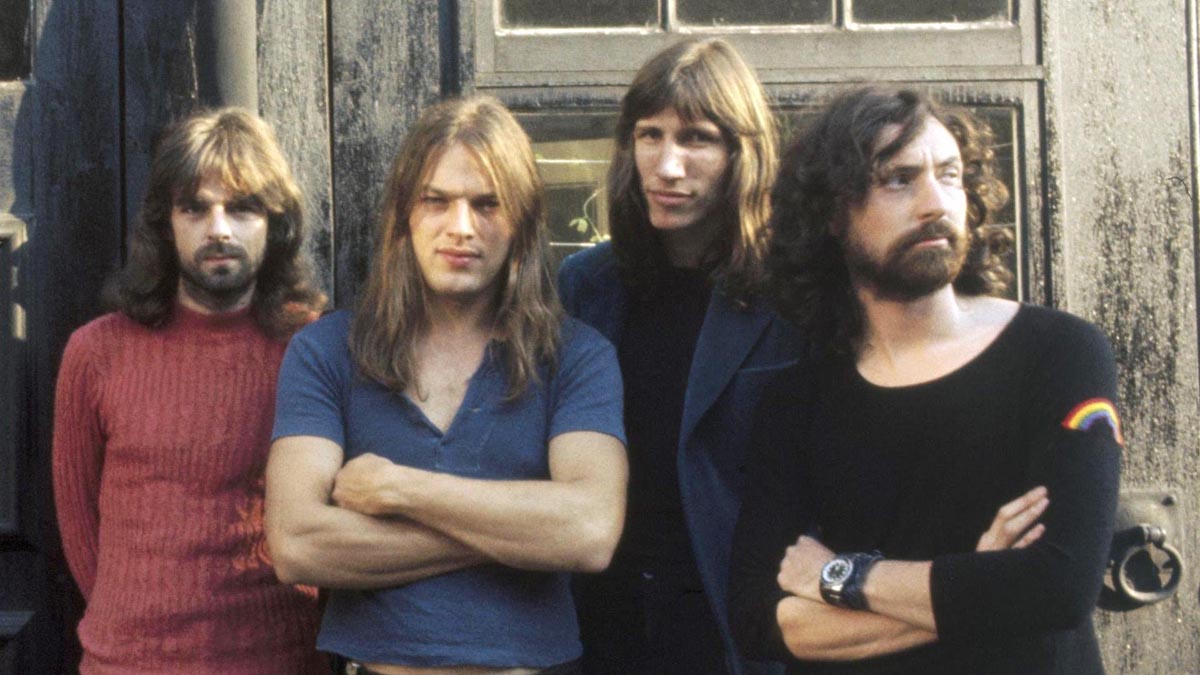
Starting on January 23, 1977 from the Westfalenhalle in Dortmund, the “In The Flesh Tour” represented one of the most important and at the same time most problematic moments in Pink Floyd's history. It was in fact the only tour during which the group performed “Animals” in full, but it went down in history above all for the tensions that emerged between Roger Waters, the rest of the band and an increasingly large audience. From those frictions the idea of ”The Wall” was born.
After a first European leg that ended at the end of March, the tour resumed on April 22 at the Miami Baseball Stadium. On stage, alongside Roger Waters, David Gilmour, Richard Wright and Nick Mason, there were also Dick Parry on saxophones and keyboards and Snowy White on guitar and bass. The setlist remained essentially unchanged throughout the tour: the complete performance of “Animals” and “Wish You Were Here”, with the addition of classics such as “Money” or “Us And Them” from “The Dark Side Of The Moon” in the encores.
Behind the success of the shows, however, there was a growing malaise. Waters experienced the transformation of concerts into mass events with increasing impatience and struggled to recognize himself in the relationship that had been created between the group and some of the spectators. That discomfort reached its peak on July 6, 1977, during the tour's final date at Montreal's Olympic Stadium.
The evening proved problematic in several respects. David Gilmour, dissatisfied with the performance, refused to participate in the final encore, an improvised blues jam that went down in history as “Drift Away Blues”. In his place the solos were entrusted to Snowy White. But the episode destined to become legendary occurred shortly before, during the performance of “Pigs (Three Different Ones)”.
Exasperated by the behavior of some spectators in the front rows, Waters had a heated confrontation with a fan who was trying to reach the stage and ended up spitting on him. Years later, interviewed by Howard Stern, he explained without mincing words the reason for the gesture: “Because he was climbing onto the front of the fucking stage!”.
That moment had profound consequences. Not only for the audience present that evening, but above all for Waters himself, who would later identify the conceptual origin of “The Wall” in that episode. Recalling what happened in Montreal, the musician explained: “It was one of those moments when life changes, it made me think about what level of alienation I had reached. Suddenly a light bulb went on in me, 'Do a rock concert with the construction of a wall between the band and the audience, as a physical expression of the alienation that led me to spit on that guy'”.
The reflection had its roots in a malaise that had been dragging on for years. In a 1979 radio interview, shortly after the album's release, Waters recounted: “The idea for 'The Wall' came from 10 years of touring with rock shows. Particularly in the later years, I think of '75 and '77, in big stadiums, when we played to very large audiences, some of which were our old audiences, who came to hear what we wanted to play, but most of them were just there for the beer As a result it became a rather alienating experience to do concerts (…) I became very aware of a wall between us and our audience.”
The other protagonists also remember Montréal as one of the most difficult evenings in the group's history. In 1982 David Gilmour declared: “I thought it was a real shame to end a six-month tour with a terrible show.” Snowy White, interviewed in 2020 by Rolling Stone, confirmed the atmosphere that evening: “For some reason there were no good vibes. That was the show where I looked to my left and saw Roger spitting at someone in the audience. I thought, 'What is he doing? It's not much…' I remember that.”
Almost forty years after those events, Montréal has once again become intertwined with the story of “The Wall”. In 2017 Roger Waters collaborated with the Montreal Opera on the creation of “Another Brick in the Wall: The Opera”, a lyrical transposition of the album developed together with the composer Julien Bilodeau, the executive director Pierre Dufour and the director Dominic Champagne.
Waters was initially highly sceptical. “I wrote them a very kind but very firm email in which I said that in my experience most collaborations between popular music in general, but particularly rock'n'roll, and symphony orchestras had turned into disasters and I thought it was a very bad idea.” His opinion changed after a meeting in New York: “I received a fantastic letter in response from Pierre Dufour. And he was so eloquent in defense of their idea that I decided to meet them.” After viewing the first operatic versions of “Comfortably Numb” and “Another Brick In The Wall, Part 2”, the musician was finally convinced: “We started talking and five hours later we were still there talking. After that meeting I said 'You know what? Alright, you convinced me. Let's do it.'”
The work confirmed the extraordinary vitality of a work born from one of the most turbulent phases of Pink Floyd's career. Reflecting on the album's long-lasting success, Waters observed: “It's been moving people since 1979. It struck the right chord and I think it's really great that Dominique and Julian have picked up this sort of baton and brought it into a different genre in the world of opera. And that's very flattering.”
What should have been the celebratory tour of “Animals” thus turned into the experience that changed the perspective of its main author forever. In fact, from the chaos and frustration of Montreal was born the idea destined to become one of the most famous concept albums in the history of rock.
Daniel D`Amico for SANREMO.FM