
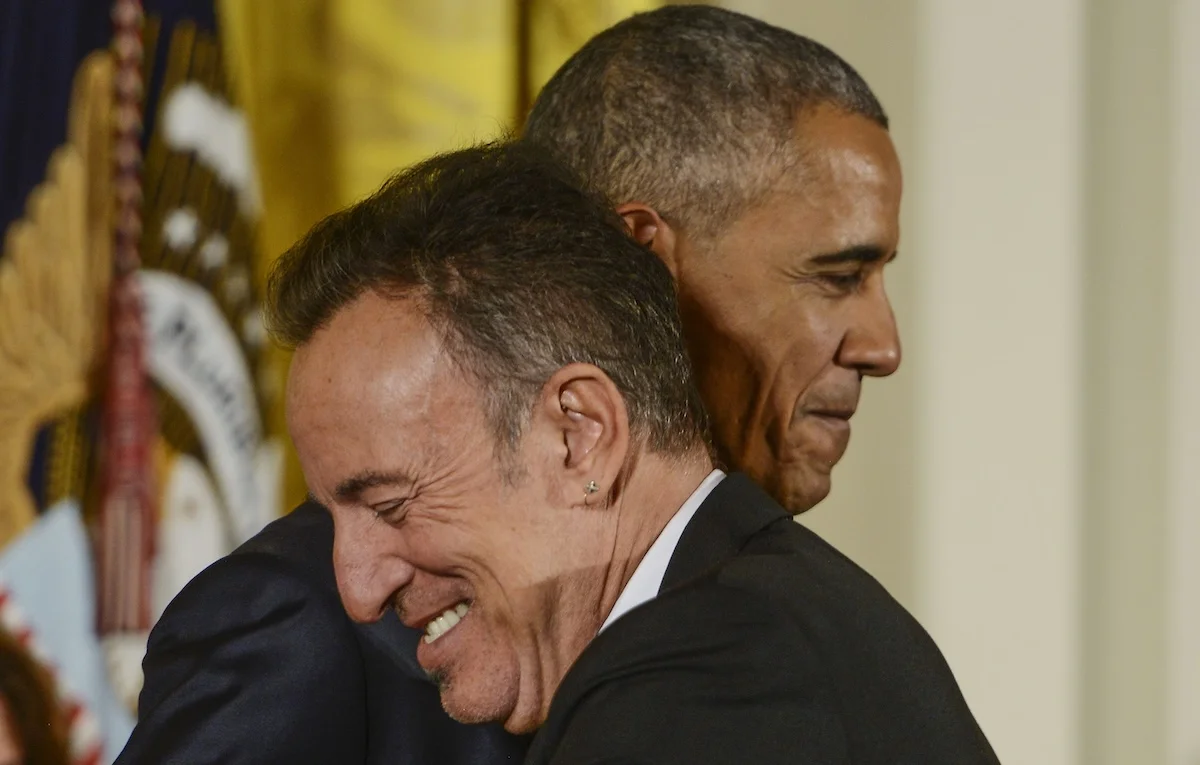
Even in the darkest moments, the songs showed the United States the way forward. A writing by Barack Obama
During the first presidential campaign I became a bit obsessed – and perhaps even became superstitious – with some small rituals to do on the days when there was a debate. I had to do some exercise and always order the same dinner. A half hour before the event I put aside the notes and lists of topics that the staff had prepared, put on my headphones and listened to some music.
At first I heard jazz classics like Freddie Freeloader by Miles Davis and My Favorite Things by John Coltrane. I then discovered that it was rap that put me in the right frame of mind. A couple of songs about taking chances and taking it all on the line – My 1st Song by Jay-Z and Lose Yourself by Eminem – were always in rotation perhaps because they seemed suited to my condition as an outsider. Sitting alone in the back of the Secret Service SUV headed to the debate site, I moved my head in time to the music and felt the pomposity and artificiality of the context melt away. I went back to the things that were essential to me: the friends and family who had formed me; the values and ideals that guided me; the forgotten voices of people scattered across the country that I hoped to represent one day.
Music has always had the ability to speak to us and for us, like nothing else. And that's why one of the best ways to understand the last 250 years of American life is to listen to the music that has defined our great nation.
When enslaved people were first forcibly brought to our shores hundreds of years ago, the music in their hearts gave them the strength and courage to face their fate. Spirituals were not pure entertainment. They were, as WEB Du Bois would later write, “the slave's articulated message to the world,” a way to reclaim the humanity that others sought to deny.
That same spirit helped animate the women's suffrage movement. The demonstration songs written on the melodies of Yankee Doodle And America (My Country, 'Tis of Thee) they became an integral part of marches and pickets and, since everyone already knew the melodies, the organizers didn't even have to print the scores, it was enough to distribute the new lyrics.
Years later, riding freight trains during the Great Depression, Woody Guthrie heard the songs sung by those fleeing the Dust Bowl and immigrant workers. He wrote This Land Is Your Land in response to God Bless America by Irving Berlin, arguing that this country belonged to the poor and marginalized as much as the privileged and wealthy.
It is a tradition that found its fullest expression during the Civil Rights Movement, which was among other things a movement of people singing. The notes of We Shall Overcome and other gospels echoed in prisons and church basements, creating a bond that no truncheon or jet of water could break. And when, during the March on Washington, Mahalia Jackson shouted to Martin Luther King Jr. “Tell him about the dream, Martin!”, she was doing what musicians have always done in their best moments: get to the truth and then wait for the rest of us to catch up.
Throughout the 1960s and 1970s popular music continued to push for social change, asking the questions that needed to be asked. During the Vietnam War protest songs such as Fortunate Son, Blowin' in the Wind And What's Going On they became like the air Americans breathed. At the same time, Okie From Muskogee by Merle Haggard gave voice to working-class Americans who felt like the protest movement had nothing to say to them, or about them, reminding us that in a nation as large and turbulent as America we can never assume that everyone is singing the same tune.
Years later, young black and Latino kids in the Bronx used record players to reinvent popular music once again. Like all the best music, hip hop wasn't just escapism, it was journalism set to a beat, with songs like The Message of Grandmaster Flash which described a reality that much of the country ignored. In the decades that followed, this new musical genre created by people demanding dignity and respect would become the most popular music in the world.
Of course, none of these forms of expression existed in isolation from the world. The reason why American popular music has always been rich and evocative, intense and alive is that it reflects the mixed-race and polyglot character of our society by mixing everything from African rhythms to Irish folk, from the melodies heard in concert halls to the blues played in juke joints. This is why American music continues to constantly renew itself and this is why, at its best, it captures audiences beyond borders, because it contains elements from every corner of the world.
In part because it experiments with drawing from so many different traditions, American music has often spoken, even before politics, of our most pressing issues, our conflicts, and our contradictions. And this is not because musicians are wiser than politicians, although many of them are, but because music follows different rules.
Music doesn't have to win over the majority of voters. It does not have to appeal to a lowest common denominator or present a ten-point program. It just has to be true enough for people to relate to it. It just needs to remind people that they are not alone with their fears and their problems, with their hopes and their dreams. Music when it's great has the ability to make us feel seen. And it does something even greater: it helps us see others, it opens hearts and moral imagination. And so spirituals preached emancipation before the Proclamation was even signed, rock 'n' roll encouraged integration before the passage of the Civil Rights Act, protest songs represented the injustice of Vietnam long before the government could admit it.
Again and again, music has shown us the way. And America eventually followed.
At the White House, Michelle and I spent a few evenings honoring and celebrating the music that has shaped America, from classical to country, from blues to Broadway, from gospel to Motown, from Latin to jazz. And when we designed the Obama Presidential Center, which opens in June on Chicago's South Side, we included a recording studio and performance space so that the next generation of singers can hold this country up to its beauty and flaws and lead us to a better place.
America has always been worth singing about, and those songs are a form of faith. Faith that our unlikely experiment in self-government is not yet over. Faith that America is what we make of it. The songs will change, but my greatest hope is that faith in our democracy remains unchanged and that together we can continue the magnificent task of making America more like it should be.
Barack Obama was the 44th president of the United States. The Obama Presidential Center will open to the public on Chicago's South Side in June. From Rolling Stone US.