
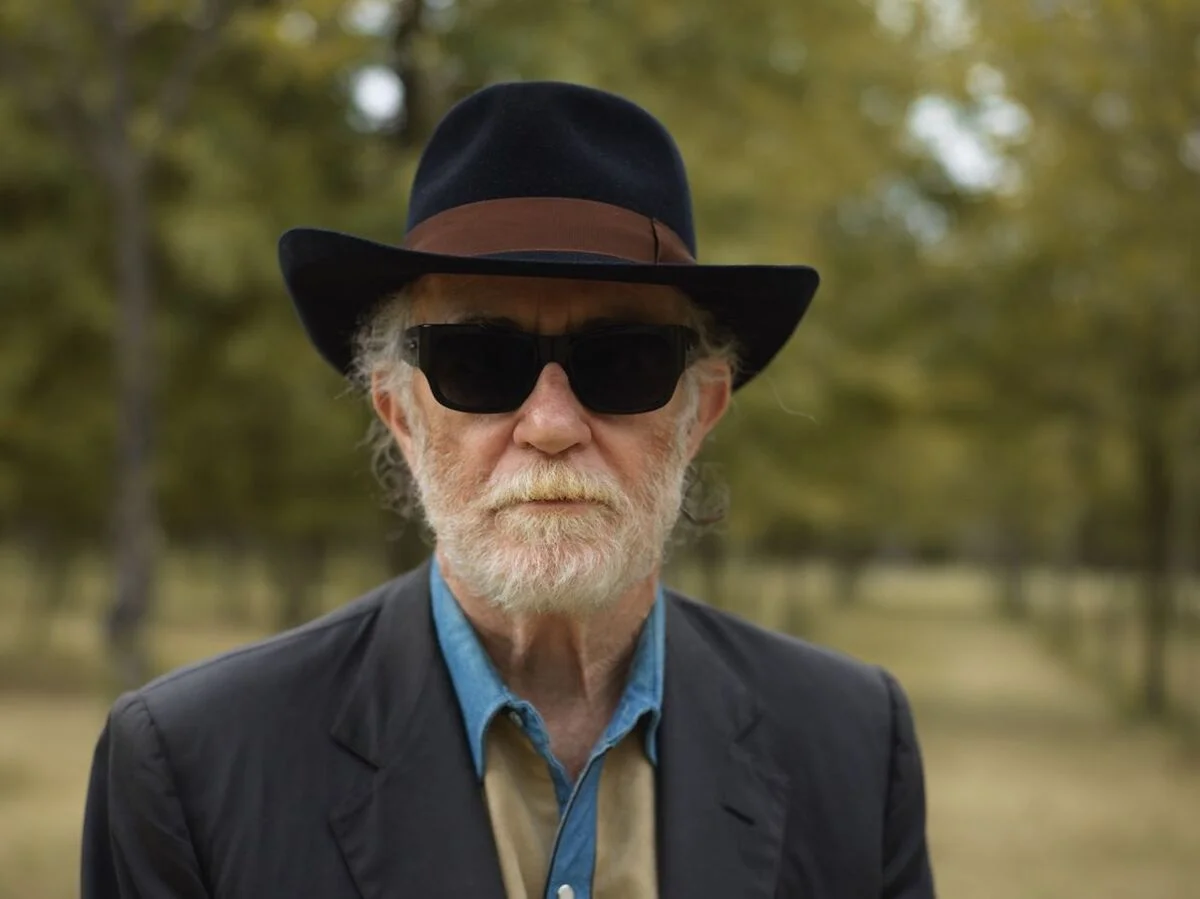
At the Out Off Theater in Milan Francesco De Gregori arrives in an excellent mood, but clarifies: «Let us stay». In less than an hour of meeting with journalists he expressed his increasingly clear rejection of the monumentalisation of music, of concert-events, of stadium gigantism and also of certain liturgies of contemporary musical storytelling. But first he presented the project Nevergreen (Perfect Strangers)which was born from a residency of twenty concerts held at the Out Off between October and November 2024 in front of just 200 people per evening. From there began the docufilm directed by Stefano Pistolini broadcast on June 4th in prime time on Rai 3 (our review at this link), a live album due out on October 16th and a new long theatrical residency between Rome and Milan scheduled for autumn 2026.
But more than a nostalgia operation, it almost seems like a sabotage of nostalgia itself. In fact, De Gregori openly claims the desire to bring back to the center the lesser-known songs of his repertoire, those that never became karaoke classics. And when someone asks him for the lineup, he replies tersely that they won't be there Rimmel, General or The cannon woman. But there will be «Goodnight little flowerI'll do it to close, so don't ask me for the others.”
The target, however, is another: «These residencies are a counterpoint to the gigantism of the concerts. We always talk about those who fill stadiums and arenas. Sold out is a terrible word for me, it annoys me. Like the word biopic.” Then he broadens the discussion to the entire music industry to try to give space to those with smaller numbers: «There are a lot of people who make music in Italy, maybe it can involve 100 or 150 people, but it should be encouraged. I also say it to the record companies, I also say it to Sony: we must not forget that music is also made starting from the bottom. I started in a very small place and if it hadn't been there I wouldn't be here.”
But no romanticism as a survivor of songwriting, because he makes a very concrete economic argument: «There are nine of us on stage, so the set-up is quite expensive. The more you do a concert in a small place, the less the revenue. My ticket costs quite a bit, but if we made it cheaper we wouldn't be able to do the concert. There are economic laws, there is no escape from there.” Yet he continues to prefer small theaters to arenas: «Here in Milan, in this 200-seat theatre, there is a physical closeness with those who have come to hear which is completely different from stadiums and arenas. Not the stadium for me. Enough people would come, the venues have done well, but I don't make a small theater just to sell out: I do it because I enjoy it.”
At a certain point he also talks about the progressive disappearance of clubs: «Clubs are also disappearing, but I try to keep them alive with lower fees and different expenses compared to those of a sports hall. I have never been aligned with the mainstream, never in Sanremo or on TV. I can afford it and I'm just an artist, taking into account the music industry without riding it or suffering it.”
When describing Stefano Pistolini's docufilm, De Gregori almost seems to want to distance himself from all the contemporary language of music documentaries: «It's not a biopic. Biopics represent music through the artist's account of himself: friends, grandparents, parents, images of the concert in between. That thing has always bothered me.” The idea was different: «I wanted to represent a musician at work, from rehearsals to concerts. In a month we performed 70 songs, so the important aspect is the rehearsals.” Elisa, Jovanotti, Zucchero, Ligabue also appear on the stage of the film. But even here the tone is very far from celebration: «They accept the game of improvisation and the uncoated. It's a grunge film, to use a term close to music.”
Speaking of mainstream, the Sanremo theme inevitably returns. And there comes one of the harshest passages of the conference: «I'll tell you the truth about De Gregori in Sanremo. I was 16 or 17 years old, I already dreamed of being a singer-songwriter, and that evening Luigi Tenco killed himself. That evening I swore to myself that I would never go to the Sanremo Festival under any conditions.”
Even on the present of Italian music the judgment is severe: «The question is: if I were twenty years old and I wrote Rimmelwould they make room for me? The answer is no. The song as it was constructed then, which strove to have a chorus that wasn't totally stupid, is not rewarded by the market today. If I were twenty years old and writing Yesterday I would have big problems.” Then he adds: «Even people in the industry should get involved to promote something that isn't already online».
De Gregori also talks about algorithms and artificial intelligence. «The Pope's encyclical on AI, which I just read, does not speak badly of the algorithm, but says that it must be tempered with human wisdom. We don't always have to listen to him and let ourselves be governed.” And when they ask him about his absence from writing in recent years, the answer is of the utmost honesty: «The war gave me no ideas, because I haven't felt inspiration boiling inside me for ten years. With the technique I could write a song in an afternoon, but without inspiration I won't do it.” Then he clarifies: «I experience what happens with pain. You don't need to experience the war directly to notice the pain.”
Even on the political role of artists he avoids any moral posturing. The reference is Bruce Springsteen and his recent attacks on Donald Trump. De Gregori remains distant from these positions: «I find it embarrassing when an entertainer wants to take sides in such a clear and apodictic manner on international issues. The proclamation thrown off a stage leaves me quite indifferent.” And again: «Artists who want to raise public awareness, why? Aren't they sensitive enough on their own? Should we tell him that Springsteen is against Trump?” And he quotes Dylan and Walt Whitman: «Bob Dylan doesn't seem to me to make big proclamations, but they must be Bob Dylan's dicks. I don't feel superior to anyone to say what position to take on Gaza or Iran. I have confused ideas and it seems honest to me to have confused ideas. To quote Walt Whitman: I contain multitudes. My thoughts are not totalitarian and I don't feel capable of giving lessons. Nor do I feel like taking them from a singer or a man from the cinema.”
Before closing, De Gregori explained the relationship with the audience he seeks in these intimate live shows: «I feel better in clubs: the audience is close, crowded, every now and then they even go out to smoke, missing out on a few songs. In the theatre, however, they are very composed and then gradually dissolve. But I remain tied to the clubs, to the slightly dirty dressing room with the signature of those who came before.” Finally, before saying goodbye, he smiles: «When I stop performing I won't make public announcements. I will simply disappear.”