
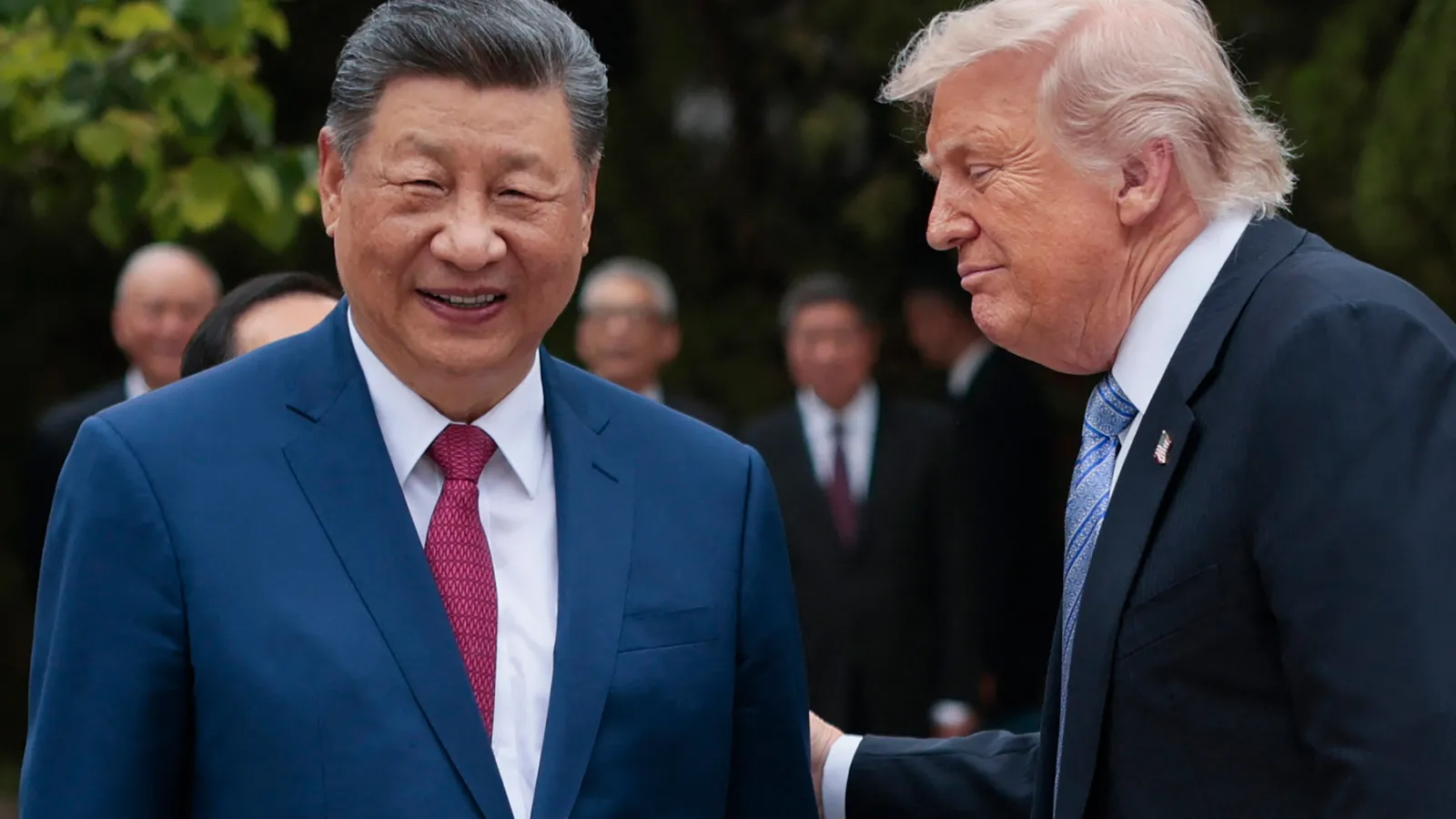
President Donald Trump had a wonderful time on his big trip to China. After all, what's not to like?
In a series of meetings with Chinese leader Xi Jinping, Trump delivered a stunning highlight reel of flawless international diplomacy, breathlessly praising the competing global superpower at every turn while largely brushing off contentious issues like trade, cybersecurity concerns, Taiwan's right to self determination, and China's support for Iran. The art of the deal in action.
The Chinese, for their part, have proven that they know exactly what the president likes. Xi kicked off Trump's visit with a rapturous welcoming committee outside of Air Force One, cheering for Trump as he strolled down a very literal red carpet.
The next day, the Chinese kept that vibe going with a surreal public spectacle that included dozens of schoolchildren jumping up and down, cheering ecstatically for the president, who grinned his head off as he passed.
“I was particularly impressed by those children,” Trump said during remarks at the bilateral meeting. “They were happy, they were beautiful.”
After the warm welcome, Trump and Xi settled into their talks. The White House characterized the negotiations as a “good meeting,” with productive dialogues on international trade and the war in Iran. Trump managed to get in a few lines about the issues that he really cares about: fast food restaurants. “Chinese restaurants in America today outnumber the five largest fast foods in the United States — all combined,” the president marveled. “That's a pretty big statement.”
He's right, of course: many Chinese people do love blue jeans and basketball — and in turn, Americans love their food.
In some ways, Trump's behavior is not unusual for a head of state or foreign dignitary. There's always a certain amount of pomp and circumstance that come with a major diplomatic visit, and playing nice with rivals and allies alike is part of the job. You could even make the case that it's one part of being president where Trump succeeds — for better or worse, the man loves to have a good time.
But what's vaguely concerning is that Trump's China trip is another example of how the person leading our nation is uniquely susceptible to flattery and spectacle. You don't have to be a China hawk to feel uncomfortable by this. Xi Jinping is the leader of the most powerful foreign nation in the world, and while Trump's cheerful demeanor certainly seems to keep everyone at ease, it raises questions about whether he's capable of correctly threading the many needles of international relations.
The end of Trump's tour through the Chinese century also reinforced this. On Friday morning, Trump released a surreal statement exoneration Xi for his supposed comments on the decline of the US — something that would normally be a major sticking point for an egomaniacal leader like Trump — and basically deflecting the reasonable line of criticism onto the Biden administration.
“When President Xi very elegantly referred to the United States as perhaps being a declining nation, he was referring to the tremendous damage we suffered during the four years of Sleepy Joe Biden,” Trump wrote. The president earlier on Friday lauded Xi as “an incredible guy.”
Xi's personality blitz, then, appears to have been incredibly successful. This has cropped up in basically every public statement that's come out of the White House since. Here's Trump aboard Air Force 1 being asked if he thinks Xi is a dictator.
Immediate pivot to Biden, no answer to the question. And sure, “Do you think [insert leader of major U.S. rival] is a dictator” is not exactly the most incisive or useful question in the White House Press Corp's repertoire. Its answer is basically irrelevant to the greater goals of the United States and really only serves to let any given US official calibrate how much of a hawk or where they want to appear to be. Still, responding by bashing an American president isn't ideal. Trump's answer also included a very funny mistake about who was actually in charge of the Iran nuclear deal, which, when it was pushed through by President Obama, not Biden, was one of the most successful points of US diplomacy in decades.
Still, there was another more relevant question in that gaggle as well: How is Trump handling China's repeated cyber attacks against US assets? “I did [talk to him about it],” Trump said. “He talked about attacks we did in China. What they do, we do, too.”
Again, this is an honest answer — we do spy a ton on China. But it's not exactly one that makes an impartial viewer feel confident about the president's ability to trade in actual leverage with a rival power (particularly when Trump also gave a relatively noncommittal response on whether he intends to follow through on the congressionally approved defense arrangement with Taiwan).
Trump's breezy posture and chumminess with Xi is aggravating even some of his staunch rivals. Here's Sean Hannity, becoming visibly annoyed when Trump refuses to actually engage with the realistic position China holds in regard to the Iran war, instead dismissing their influence over Iran by reasoning that at least “they're not coming in with guns.”
As we've seen in the past, Trump's mood can turn on a dime, turning routine negotiations into tense debates and creating impasses on issues where a smarter leader would find a compromise. It's funny, sure, to watch our big galoot of a president and members of his administration goggle at the trappings of Chinese power (Trump's first Truth Social message after leaving on Friday was about the fact that they have a ballroom). But it only reinforces the creeping suspicion that in one of the most important diplomatic relationships in history, the only adults in the room are sitting on the opposite side of the table.