
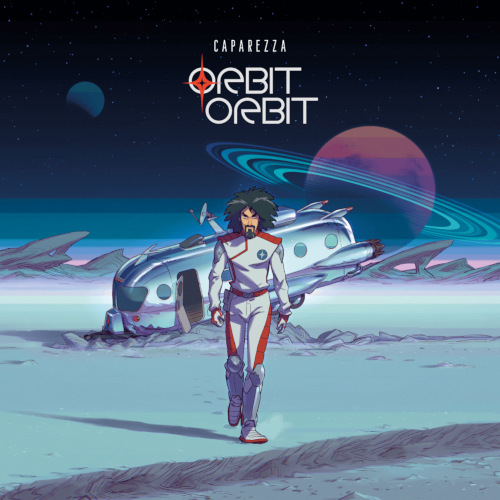
“Orbit Orbit” is a comic-disc. […] The link between music and sequential art has so many illustrious examples that one might think that the two languages are somehow related. […] I started from the need to tell myself through the drawn strips rather than through music, as I was used to doing.[…] You understand well that this tango between notes and drawings really required a lot of time and concentration for the two media to dance without stepping on each other's toes, given the urgency of having both come out together, literally: on the same day.
(From the final pages of the graphic novel)
Ninth album, ninth art: the comic-record that talks about hearing loss
“Orbit Orbit” is Caparezza's ninth studio album, released four full years after “Exuvia” (2021), which perhaps was the arrival at a new, complete maturity in writing thanks to an effective balance between the various souls of his atypical approach to hip-hop. The rapper was mistreated by the so-called scene at the time of MikiMix and so, even after the change of name, art and style, he always kept one foot outside, open to contamination from different and more or less parallel worlds. For example, in “Museica” (2014) he was inspired by the masterpieces of figurative art. Here he turns to the world of comics, a great passion of his.
It is the third album which, despite all the creative additions and changes involved, we can consider autobiographical: after “Prisoner 709” had introduced listeners to the creative and personal crisis, also due to tinnitus problems, and after “Exuvia” had identified a way out of this period of anguish and difficulty, “Orbit Orbit” describes another way to overcome further health problems, in this case a hearing impairment called hearing loss: through imagination and, indeed, comics.
 Initially “Orbit Orbit” was supposed to be just a soundtrack for reading the graphic novels self-titled, then evolved into a companion album to the comic, with 14 songs in 61 minutes. Reading is recommended to better understand the ideas underlying the entire project and appreciate the intertwined references.
It is not the first time that Caparezza, who has always required a very in-depth approach from his listeners, associates an album with a publication to read: it already happened in 2008 with “The dimensions of my chaos”, the first book by him which contained a transposition into phononovel of the album. This time the graphic novelsgone immediately sold out in the days of presentation at the “Lucca Comics & Games” comics fair, it seems to have a much stronger connection with the musical product.
The journey of the imagination: an “old” cosmonaut rediscovers pathos
The fugue that concluded “Exuvia” is the starting point for “Fluttuo, orbito”, which also introduces the strong electronic component of the album, where synths are frequent and the inspiration of artists such as Kraftwerk or Vangelis is clear, but also that of grandeur by Hans Zimmer.
He is, admittedly, a Caparezza who remains outside the present, the political, the everyday to observe everything with the eyes of the imagination, floating without gravity. The cosmic journey as a context of freedom and discovery, but not without unexpected difficulties: ideas are evanescent, doubtful, obsessive (“The planet of ideas”), a new prison to escape through a push towards the new (“I am the journey”).
With the typical lyrics full of more or less pop references, here unbalanced towards the world of comics, he builds the meaning framework of the work with the first songs.
The musical appearance of this first section, however, does not seem up to par: the idea of transposing the cosmic journey into music using vocoders, arpeggiators and synths is a cliche. The choruses which are not particularly effective do not help, as well as a song which has never been his strong point and which is used here perhaps with too much enthusiasm.
Better when Caparezza combines synths with a theatrical and cinematic style in “Darktar”, with a chorus chorus and ending that recalls the big band jazz of Fire! Orchestra: a bit of the eccentric cabaret of the past is rediscovered, albeit recontextualised.
It's impossible not to melt before the melancholic declaration of love for the comics of “A Comic Book Saved My Life”, a new song with an open heart like “China Town” was. When he talks about his personal drama, with sincerity, he still proves to be a champion:
It's Exuvia day, I do audiometry
My hope burns, like Elijah's chariot
The answer is that I'm going deaf
I'm in Rome for Media Day, but I'd like to get away
My interviews on the saddest days, too bad
I respond calmly to all journalists, theater
The damn boos weren't enough, screw the records
I don't want to forget the voices I love
I wake up with macabre thoughts, panting and sweating
In bed I imagine a rope on the highest branch
In contrast to this moment of introspection and pain, Enzo Del Re's theatrical cover “Il banditore”, full of onomatopoeias, ideally introduces the second part.
Videogame electronics return (“Autovorbit”), Eighties-style synth-pop (“Curiosity”, with somewhat didactic audio by astronaut Maurizio Chieli), sample of classical Italian singers (Morandi in “The Eyes of the Mind”, which also mentions Sangue Misto) but there is little that those who know him have not already heard before and that deserve a lot of attention.
It is still when the rapper discovers himself most fragile that he is most convincing: when the mask of the curly-haired acrobat is put down his ability as a contemporary singer-songwriter is (re)discovered, as confirmed by another capital song, “Like electronic music”. Here, between synth drools and English choirs, he is explicit about the weight of the passing years: “The adjective that best suits is old”. The rapper is grey, bent on the nostalgia of his dead friends, on the anguishing melancholy of his own body which turns out to be fragile: it is an image that confirms Michele Salvemini, now only Caparezza by continuity, a stranger to the hip-hop scene in dealing with a painful and inevitable theme.
He had certainly already done it, see “La certain” on the previous “Exuvia”, but this time he is particularly severe against himself:
And this young man takes a photo of me
Just because his dad has all my albums
[…]
What's the point of rapping at my age?
[…]
And maybe I've always been old
The singer-songwriter vein also prevails in “Pathosfera”, with acoustic guitar and voice, another sad, deeply emotional self-portrait. The trilogy that this “Orbit Orbit” closes is a way of embracing one's own emotionality, one's own pathos:
Mom, the pathos is coming back to the surface
It digs inside me which seems like a woodworm, a mole
And dance, inside my belly, butterfly
Little by little he is giving blood back to a ghost
I want to return to the Pathosphere
Spending days in the Pathosphere
Even if the hits in the Pathosphere
They go “Thud! Thud! Thud! Thud! Thud!”
The prog-rock for synthesizers of “Cosmonaufrago”, reinforced by the operatic “Perlificat”, is a return to already explored languages that blend with difficulty with the more introspective aspects.
It is futile to ask whether “Orbit Orbit” will be adored by fans: Caparezza can boast very loyal ones, enthusiastic regardless. To this writer it seems like an album that alternates excellent moments, even among the best of the entire discography, and less convincing ones, which look to the past without creative impetus or, worse, exploit clichés of space-inspired music.
The need to carry out the story, once again with a concept albumforces changes in style and register, which are not always coherent and homogeneous on a creative level: some episodes are splendid confessions by a musician over fifty, but elsewhere the objective seems to advance the plot. One might also wonder if a trilogy about one's personal crisis isn't a bit self-indulgent, a sin that is not difficult to attribute to the rapper.
For all this, the album is not up to “Exuvia” or other peaks of his career and, every now and then, “the adjective that best fits is old”.
08/11/2025
Antonio Santini for SANREMO.FM