
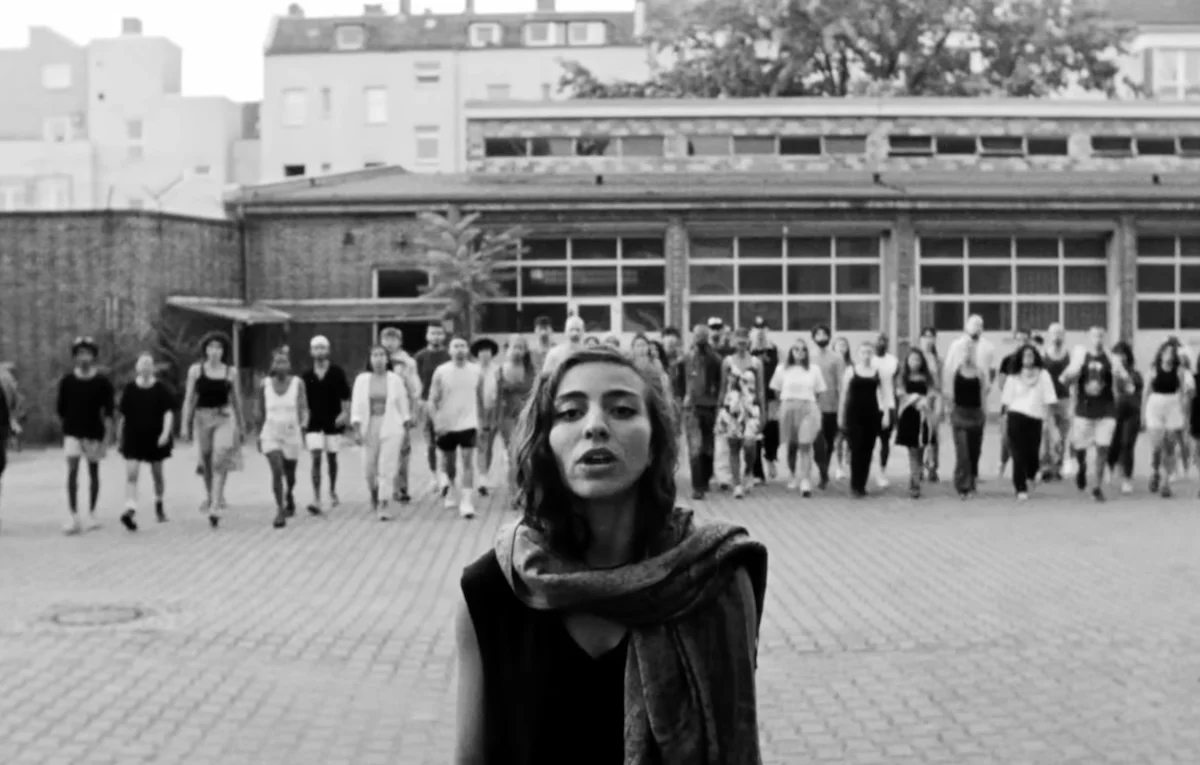
It appeared out of nowhere, something strong and true in the nothingness of social media. Impossible to ignore that video shot in black and white. A rapper walks in the courtyard of Monopol, the former distillery in Berlin's Reinickendorf district transformed into a cultural center. He looks into the room and spits words that in the English girth are a punch in the stomach: “Uproot our roots, demolish our homes, criminalize our existence, falsify our origins, separate us from our loved ones and massacre our children.” He's angry with us. It's the strongest thing I've seen and heard in recent times.
Her name is Siba, the producer who took care of the base and shot the video is Monkyman (Felix Spitta), the song is called Dounana“without us”. Zero fashion, zero poses. Hardcore rap, but Arabic. A repetitive rock base, threatening rather than evil, not cool at all, few colors but dark and clear. And words that weigh and advance as if in an unstoppable march, a verbal revolt against colonialism and something more. Dounana was released in 2024, the video towards the end of that year, but due to the strange games of virality and the complicity of the international political situation it began to circulate on Instagram and
The video was shot in Berlin in summer 2024 in a single take. An online casting call was launched to find people from the global South diaspora, of all nationalities, BIPOC (an acronym for Black, Indigenous, People Of Color) and members of the city's Arab communities. Hundreds responded and around seventy showed up. Around the singer, the children of the diaspora make up a silent but angry fourth Arab state. They appear and disappear from a single take as Siba sings that “you take our blood for granted and demonize our revolutionaries, steal our knowledge, keep our people in ignorance and torture our spirits and deny us rights. You colonize our countries and appoint our rulers, appropriate our property and burn our trees.” It is difficult to remain indifferent even if you are convinced that fueling colonialist guilt represents a shortcut to understanding history and that certain revolutionaries were demons.
When people discover the video, they act. Some comments left in Arabic, English, Russian, Italian, Spanish, German: «a powerful piece about identity and resistance», «challenges the colonial narrative and sheds light on ongoing injustice and questions the silence of the world», «one of the most powerful pieces I have heard in recent times», «sums up the history of Palestine», «it is not just a song, it is resistance», «the voice as a weapon, in a good way», «dignity, courage, love», «perhaps the most powerful song of all time», “If the children and grandchildren of the colonized and brutalized world over generations could choose one anthem, perhaps this would be it.” It's music that shakes, finally. It may be hyperbole, but we understand why someone writes that “after hearing it I am no longer the same person”.
It's not just the official video. The song is edited over images of Gaza and West Bank settlers. Someone uploaded a Lego version of a reel to Instagram, with Trump and Netanyahu at the head of the evil empire and armies of murderous toy soldiers at their service. It's true that in the official video there are boys wearing keffiyehs, but in the text there is not a single mention of Gaza or Palestine or Iran, nor of other places in the Middle East, Asia or Africa. It is obvious, however, that this accusation of the dehumanization of others and of the Western mentality makes them all feel fraternal. Siba is speaking to you and because he does so with this force there is no way you can ignore this pan-Arab anti-colonialist anthem: “Bomb our roofs, paint us as liars and look at our sufferings and belittle our agony. Ignore our tears and close our eyes, mutilate our faces and deny our feelings.”
Her name is Siba Alkhiami, it seems she has Syrian origins and lives in Berlin, there is little information. He wrote that any proceeds collected will be donated generally to humanitarian aid initiatives in the South of the world. «Dounana» said Siba «tells the story of the crimes that the colonial West has committed, and continues to commit, against humanity, the communities of the Global South and the inhabitants of the Earth. The video aims to amplify the voices of our communities and show our faces as we stand together against colonialism. The single was released a year and a half ago, but the anger is still there. When will this horror end?
After a year and a half Dounana only 80 thousand streams on Spotify and Siba has 20 thousand monthly listeners and in fact the song expresses all its potential in the video. In any case, who cares about numbers, Dounana he speaks to us with a rare force because he says something simple and undeniable, something that shouldn't even be said: they exist. “Destroy our dreams, objectify our bodies and darken our skies and kill peace. We will stand firm and love lives within us.” Then Siba goes further, he looks you in the eyes, he asks a simple but unsettling question, a question that overturns the game of identity: “Who would you be without us?”. It forces you to try to give an answer. His is ruthless and implacable like the song: “You wouldn't exist without us, you wouldn't exist without us”.