
The partnership between Lucio Battisti and Giulio Rapetti alias Mogol has been built over the years also through curious episodes and unlikely gestations of songs that later made history. One of these is undoubtedly the one that led to the birth of “Emozioni”, the song published on 15 October 1970, generally considered one of the peaks of their collaboration, with its intimate story with a universal inspiration. An inner journey suspended between melancholy, amazement and solitude, told through a text of extraordinary evocative power which, over time, has entered the Italian collective imagination. Certainly, its genesis was special, which also had significant repercussions on the final outcome.
I'll give you Brazil
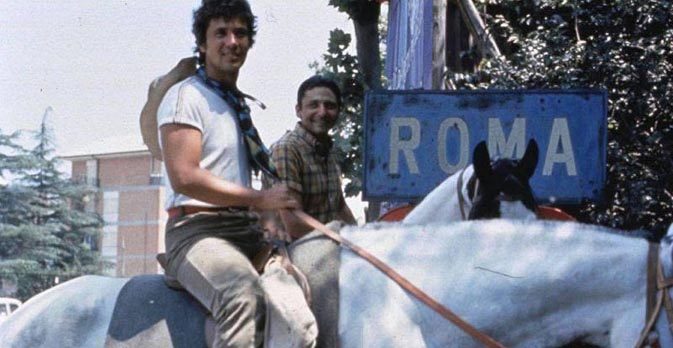
On June 21, 1970, on the day of the World Cup final between Italy and Brazil, while the entire country is glued to the television screen, Lucio Battisti and Mogol choose a completely different path: they leave Milan on horseback headed for Rome, in search of authentic contact with nature and with themselves. Battisti himself will tell the story of its spirit on the pages of Sorrisi e Canzoni: “The spirit is to prove to ourselves that we can do it”, he explains, “and to enjoy, without worries, a true contact with nature, to cure ourselves a little of the illnesses of our life of work, of hurry, of anguished race against time”.
It is an experience that perfectly reflects the character of the singer-songwriter, already intolerant of clichés and attempts to pigeonhole him into any definition. During the journey he prefers to sleep outdoors, tackle paths, woods and beaches, so much so that, as he will remember, “sometimes, but it is rare, we come across a strip of asphalt…”. The inspiration for “Emozioni” was born from that long ride. Having returned from the trip, Battisti translates those sensations into music, explaining that he wants to tell “that intimate tension, those abrupt passages, suspended in the air, to better express the sense of discovery, of amazement, of freedom that Giulio and I felt as we ventured across meadows, hills and rivers, as if we were seeing nature for the first time”. As usual, he records the melody on a tape and delivers it to Mogol: first the music is born, then the words will come.
The text takes shape in two distinct moments. A first part was born suddenly in Mogol's country house in Molteno, while the second arrived during a car trip with the family. At the wheel, unable to take notes, the lyricist is forced to mentally repeat the verses so as not to forget them, until, once he reaches his destination, he finally puts them on paper. From that unusual gestation was born a text with an irregular rhythm and very powerful images, destined to enter the history of Italian song. According to the story of Pietruccio Montalbetti of Dik Dik, however, the first draft did not entirely convince Battisti. In fact, the musician would have observed: “The beginning is perfect, but then it gets lost in usual words. I would like you to change the meaning and try to give a real emotion”. A suggestion that contributed to directing Mogol towards that definitive version destined to become one of the most famous texts in Italian music.
An atypical text
The result was a song that escaped the traditional patterns of songwriting. More than telling a linear story, “Emotions” proceeds through images and fragments, building a real journey into interiority. THE'incipitwith the heron flying above the river and the desire to “find yourself flying”, conveys a sense of freedom and fusion with nature. But that serenity is immediately shattered by the famous “subtle displeasure”, a seemingly impossible expression that summarizes the moment in which happiness gives way to an inexplicable melancholy.
The entire text is built on images that remain in the collective imagination: the attempt to “shake hands to stop something that is inside me, but isn't there in your mind” tells of the impossibility of truly communicating one's inner world; “driving like a madman with the headlights off in the night to see if it is so difficult to die” is not an invitation to self-destruction, but the extreme representation of existential discomfort and the search for a limit capable of making one still feel alive. Even the famous final verse, “You call them emotions if you want”, seems to suggest that the word “emotions” is almost insufficient to contain the complexity of the sensations experienced by the protagonist.
Battisti's music embellishes the story. The delicate guitar introduction, the strings conducted by Gian Piero Reverberi and a refined but never intrusive arrangement accompany every emotional nuance of the story. The piece grows extremely naturally, alternating moments of suspension and orchestral openings without losing its collected dimension. The recording also became legendary, and not only for the stellar cast that took part in it, in the Ricordi studios in Milan in via dei Cinquecento, Corvetto district, a former parish cinema transformed into an artisanal recording studio: Battisti on vocals and guitar, Franco Mussida on second guitar, Damiano Dattoli on bass, Franz Di Cioccio on drums, Flavio Premoli on keyboards and tambourine. Around them an orchestra of over fifty elements directed by Gian Piero Reverberi. According to the testimonies of the protagonists, the published version was essentially the first complete performance, so intense that it left Battisti and those present deeply moved.
In London with Pete Townshend of The Who
Published on 15 October 1970 as the A side of the 45 rpm single which contained “Anna” on the back, “Emozioni” quickly became one of the symbols of the repertoire Baptist. The single reached first place in the Italian charts and contributed to definitively consolidating the artistic partnership between Battisti and Mogol.
The song also had an international version, “Emotions”, created as part of the project with which the singer-songwriter attempted to enter foreign markets. Also famous was the episode told by Mogol of listening to Pete Townshend of the Who, who was enthusiastic about it. “We met him by chance – said Mogol – Lucio had recognized him, he pointed him out to me. We made him listen to 'Emozioni', I thought it was slow by Anglo-Saxon standards and that he wouldn't like it. And instead Townshend said: 'Wait a minute', and when he returned there was a crowd of publishing employees, all very young, whom he asked to listen, and while Lucio sang he read the English version from a piece of paper… He said, 'She's amazing.'”
Despite the interest aroused abroad, however, Battisti gave up on developing a true international career, refusing contractual conditions that he considered penalizing. A real shame, considering the interest that the singer-songwriter from Poggio Bustone had aroused across the Channel, starting with that of his well-known fan David Bowie, with whom he also had the opportunity to write a song. But that's definitely another story.
Daniel D`Amico for SANREMO.FM