
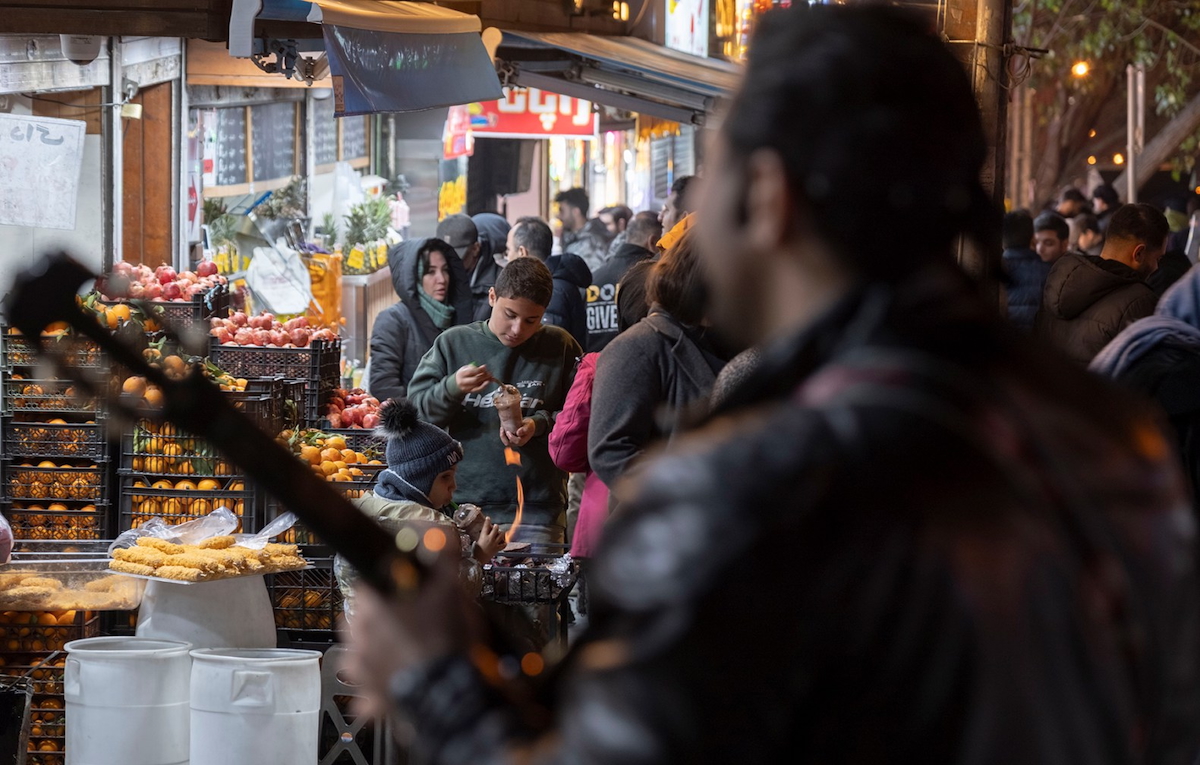
RA and his friends had USB sticks in their pockets when they met during Tehran's protests and internet blockade last month. Above were simple audio files, except for her, a fourth-year classical music student, they were everything. She and her friends met in cafes, passed downloaded files, passed songs from one hand to the other. «You can't stay away from music», says RA «We have to listen to it».
Once, sitting in a cafe, she heard different music from the speakers than usual, more dated, played by Iranian musicians from decades ago. Rooted in a simpler time, it offered her a kind of escape into the past, a place where RA and her friends can take refuge at least in their minds (to protect the people and their families only the interviewees' initials are used in this article).
Protests in Tehran erupted in late December 2025 after the riyāl has fallen to an all-time low in the midst of runaway inflation and serious economic problems. Authorities imposed a week-long nationwide internet blockade, although internet outages still persist. The blackout cut off all communications between families, friends and acquaintances, leaving 81 million people without contact with the outside world. In this context, music has returned to being a good to be physically transported.
It is a lack, that of music, that RA felt deeply. As a student, watching great musicians' performances on YouTube is important to her. «It serves to draw inspiration, different ideas, analyze how they perform the songs». Without the Internet he continued to study, “but not at the same level”. He also changed his listening habits, only having access to music he had previously downloaded. She could not, nor did she want to ignore what was happening around her: “I didn't want to isolate myself while there was this great disconnection in the country and not by our choice.”
During the lockdown, music began to circulate through informal networks. Friends exchanged files, songs passed in cafes became a reminder of a simpler time, concerts took place in silence. «Thanks to my friends I started listening to protest music», says RA «Before I was a shy student who mostly listened to classical music, now I'm also listening to rock, I want to raise my voice, make people understand what I feel».
Her friends asked her to perform a protest song they had composed during the blackout, but any attempt to release it would require anonymity and permissions to perform were denied. «My musician friends fell into depression, they no longer had the desire to perform or even just practice the instrument». They continued to listen, but had stopped playing.
The blockade also affected BR, who lives in Vienna, but who had returned to Iran for three months at the time. “Normal life was interrupted,” he says. «We even use the Internet to orient ourselves. I can't imagine meeting a friend or finding a safe place without having access to the Internet.” When the connection disappeared, he also had no way of finding out that his return flight to Vienna had been cancelled. He too found refuge in music. “I went back to the songs my girlfriend and I used to send each other.” Without streaming platforms, he relied on files saved in Telegram chats and archives.
Just like RA's friends, he found himself hearing more melancholy songs. «I was looking for a sort of meditation on pain». In those days of uncertainty, the music brought to mind the taste of a lemon cake that his girlfriend, who remained in Vienna, had prepared for him before he left for Iran. The taste was sour, the memory sweet. However, after leaving Iran, he stopped listening to those songs. «Now they are linked to new memories and I try not to feel them anymore».
When there were protests in previous years, the music was powerful and full of slogans. Not this time, says BR Before the blackout, there was a song that was in constant circulation. “A woman was listening to Shervin Hajipour at full volume.” The song, associated with Donna, Vita, Libertà the protest movement that emerged in Iran in 2022 after the death of Mahsa Amini, expressed pain and called for peace and freedom.
AR, an Iranian economist and music enthusiast living in Germany, was also in Iran when the internet blackout occurred. As an RA, he relied on the files he had downloaded. Like BR, he noticed that people started hearing the same songs over and over again, the more introspective ones, which somehow offered comfort. “You listened to the ones you had, and then again, and then those again.” In the rare moments when the connection returned, AR's mother posted protest songs on Instagram Stories. “It wasn't just a way of saying he was still there, it also served to show that music fueled the need for change.”
Rana Farhan, a successful Iranian musician who left the country in 1989 and has lived in the United States ever since, describes a different kind of fracture. “Leaving was the only way I could continue working as an artist, but the distance did not erase the sense of responsibility.” His music remains tied to Iran, even as he processes events without the danger that comes from physically being there. «These stories belong to many people. By telling our story, we also tell theirs.”
Farhan followed the blockade from New York knowing that he enjoyed a freedom that his compatriots did not have. «We can't pretend nothing happened. As an artist you feel insignificant. The tragedy is so great that you ask yourself: what am I doing sitting here singing?”. This tension redefined his approach. “Music heals,” adds Farhan, “but you can't lose hope. Everyone is in a different place and has different responsibilities. We do what we can. We have to do it.” One song in particular resurfaced for her during this time: Chooniea piece she had written years earlier and which suddenly seemed relevant to her. “It's very simple,” he says. “He just asks: 'How are you? I think about you day and night.' That's exactly what's happening now.”
Music stirred something inside RA For BR, it became a refuge when all lines of communication were cut. AR started listening to music intimately and repetitively. For Farhan, distance has sharpened his awareness of what you can and can't do when you're safe. For others, music has replaced time and hope. Hoping that someone on the other side was listening, and that things would get better.
Across cities and borders, music passed from hand to hand, via old files, shared playlists, and memory, like a beacon of resistance and hope. In a country where you can't always communicate with your family or speak freely, music has become a way to ask a question when nothing else is possible: “In these hard and troubled times / Are you okay? / Day and night, my love / Are you in my thoughts / And in this dark night / Are you okay?”.
From Rolling Stone US.