
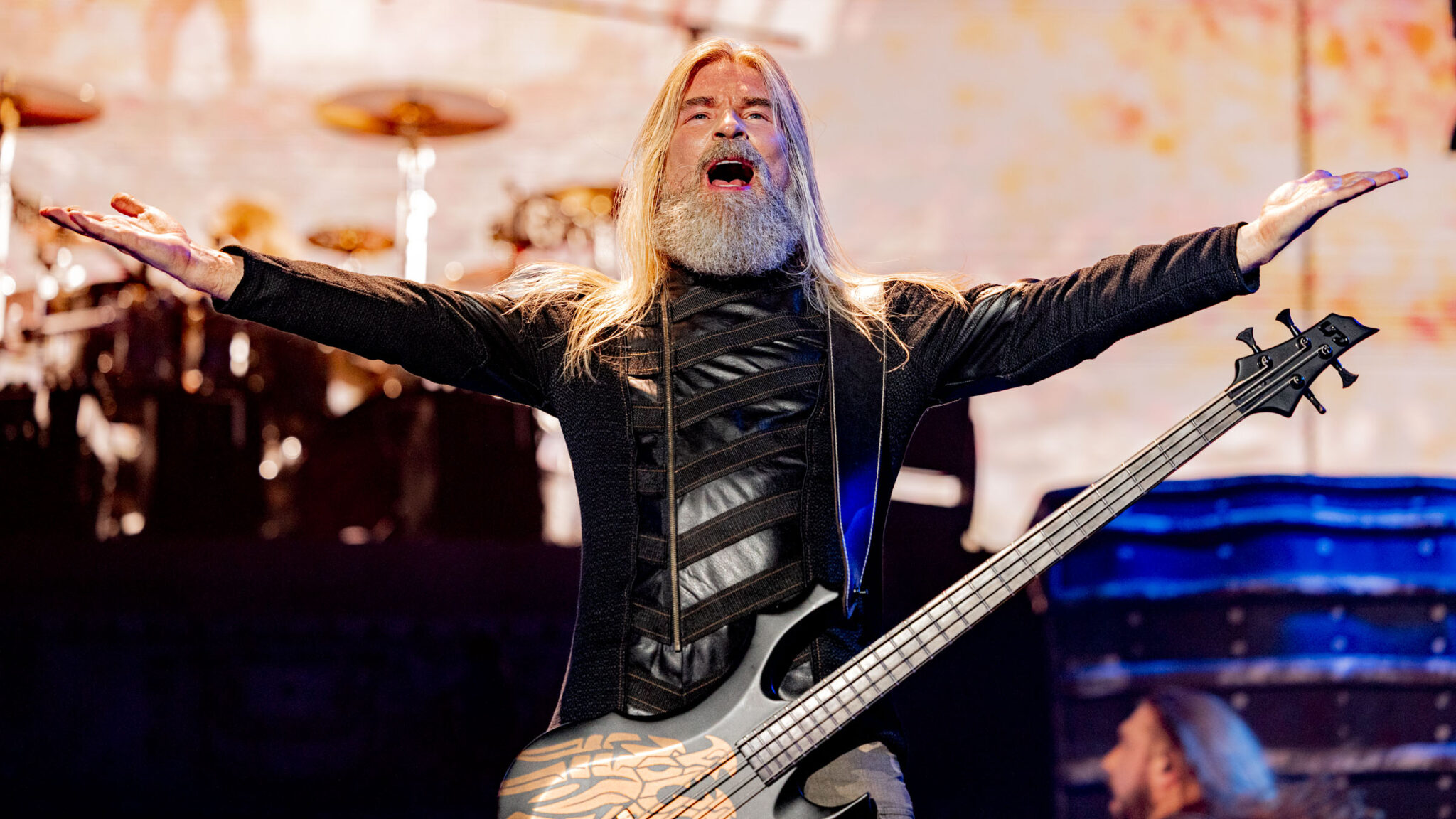
The story can be passed down in many ways. There are those who study it in books, those who tell it through documentaries and those who, however, transform it into music. Sabaton have been following this path for over twenty years, building an identity that goes far beyond simple war imagery. Their songs talk about battles, men and decisions that have marked the course of events, but they always leave the listener to draw their own conclusions.
A few hours before the epic and pyrotechnic final performance of the Graspop Metal Meeting 2026, we had the pleasure of meeting Pär Sundström.
Below is the full interview:
The Sabatons have always told stories of great military exploits and legendary figures. However, every war also leaves invisible scars. On the occasion of “Mental Health Awareness Month”, I ask you if, in your opinion, today there is a greater awareness of the psychological impact that conflicts, missions and traumas can have on soldiers. Do you believe there still exists a culture that leads many of them to suffer in silence?
I believe that there are still too many wars, too much suffering and too many problems in the world.
Over the years we have learned many things, but in other respects we have remained stagnant. The reasons why we continue to fight are more or less the same as in the past and, unfortunately, from this point of view we have not made great progress.
We tell these stories in our songs and we would like this to end as soon as possible. Unfortunately, however, it doesn't seem like the world is going in that direction.
I'll ask you a slightly different question. If you could erase a song from your discography, and even from your memory, to rediscover it like a simple fan would, which one would you choose?
So, right off the bat I would tell you “To Hell and Back”.
I still remember when Joakim first told us about the idea for the song. We were all at Hannes' house and our reaction was immediate: “Wow, this song has an incredible vibe. It's exactly what Sabaton should be.”
Are there any other memories related to that period that have particularly impressed you?
Yes, we had fun joking about the song and the western atmosphere it gave us. We always said, “It looks like Ennio Morricone meets heavy metal,” and it was a potentially fantastic idea.

So you appreciate Morricone?
I don't know all of his production, but I really like some of his compositions. He was undoubtedly one of the greatest ever and influenced a huge number of musicians, as well as directors.
Today in metal there is almost a current made up of bands that draw inspiration from history: from Iron Maiden, of course, up to more recent groups like Kanonenfieber, who will be performing today. You are undoubtedly one of the most representative realities of this trend.
Each band recounts wars and historical events with a different perspective. If there was a sort of “historic metal alliance”, would Sabaton see themselves as the ambassadors of this movement or would they prefer to remain an independent reality? Would you like to share a tour with these bands, bringing the “triad” to the stage?
I would be very intrigued by the idea of touring with these bands.
Iron Maiden are certainly among the bands that helped popularize these topics in metal, but they were certainly not the first.
In fact, ever since man began playing an instrument, he has told stories of battle through music. Thousands of years ago someone did it accompanied by percussion instruments; then others were invented, but the principle remained the same. In all cultures, music has always been a way to pass down stories.
This is why I don't think that what we do is anything new, we simply use the tools of our time to tell those stories.
We weren't the first in metal either, and Iron Maiden probably weren't either, even though they're the first name that comes to mind. The difference is that Iron Maiden tackles a lot of topics, while we focus almost exclusively on military history. I don't even know if we can talk about a real subgenre, but if we look at popularity, we are probably the reference band in this area, excluding Iron Maiden, who however have a broader repertoire in terms of the themes covered.
I know well the reasons that led us to make this type of music and, precisely for this reason, I also understand why other bands, like Kanonenfieber, have chosen the same path. It's something that makes me very happy.
In the end, though, our goal remains to play heavy metal. We had to decide what to talk about and we chose history because it seemed like the most interesting topic.
If those who listen to our songs also end up learning something, so much the better. And it really happens, many people have approached the story thanks to Sabaton. We created the “Sabaton History” channel, we make documentaries and we know that there are teachers, in different countries, who use our songs during lessons.
For the same reason they could also do it with Kanonenfieber, with Iron Maiden or with any other band that tells the story.

The war has approached Europe, this is undeniable.
I believe, however, that a lot depends on the country you live in. If you were American, you would probably have a different perception of the situation, because the United States continued to be involved in conflicts even when, in Europe, war seemed far away.
As a Swede I can say that we haven't seen a conflict so close to our borders for a very long time. Has anything changed? Yes, but above all in the way the media talks about the war.
Fans, however, continue to want to listen to these stories and the difference lies above all in the attention that the media reserves for these topics today. More and more journalists ask us why we continue to talk about war, but I would rather ask myself why we shouldn't do it.
Personally, I don't think it necessarily has to be that way.
This is not our goal. We don't want to tell people what to think or how to behave: our job is to tell stories.
Anyone who listens to our songs is free to draw their own conclusions. It is not up to us to establish who was on the right side and who was on the wrong side because we tell facts: people who carried out certain actions and events that really happened. Then everyone is free to interpret them as they see fit.
History, moreover, is never completely white or completely black. In every conflict there are at least two points of view and each party is convinced that they are right. I think it's important to take this complexity into account, so we're not here to tell people who to vote for, how to dress, or how to live.
If there's one thing we feel like saying, it's just this: stop fighting. That would be a truly beautiful thing.
If someone had told you, when you were a kid, that Sabaton would one day appear in a video game, would you have believed them?
I have always been a huge fan of video games. I practically grew up there and I still continue to follow with great interest everything related to their development and the gaming industry. When I was younger, I never imagined that Sabaton would one day end up in a video game.
Many years ago we came into contact with the developers of “World of Warships” and started discussing possible ways to insert the band into the game. In fact, the first contact was about “World of Tanks”, their other title.
Subsequently, the collaboration for “Bismarck” with “World of Warships” was born and we resumed that discussion, evaluating the possibility of integrating some content dedicated to Sabaton into the game. Unfortunately, development times were very long and the project remained on hold. We told ourselves that sooner or later we would take it again and, a few years later, that's exactly what happened.
I remember that before the release of “Bismarck”, we asked fans what topic they would like to hear us address. The answer was almost unanimous: “Bismarck”.
After the publication of the song we asked the same question again and, this time, the choice fell on “Yamato”.
At that point we said to ourselves: “Okay… sooner or later we'll do that too.”

In this regard, I would like to ask you another question: with “Bismarck” and “Yamato” you told the story of two of the most iconic warships ever built. If one day you were to complete a sort of unofficial trilogy, which ship would, in your opinion, deserve to be the protagonist of the final chapter?
There are several that would have an interesting story to tell. Maybe I would say the aircraft carrier USS Enterprise.
You just mentioned “Yamato” and I would like to focus on the video clip, which is striking for its realism, especially if you consider that it was shot in the studio. What was your first reaction when you saw the reconstruction of the ship's bridge with all the systems created to simulate navigation?
The production team preferred to physically recreate the sensation of being on board the battleship, rather than relying completely on computer graphics. How important was this approach to best tell the story of Yamato?
I believe that the sudden drop in temperature during filming in Serbia contributed a lot to the final result, it made everything much more complicated, but perhaps it was precisely this that made the video clip more convincing.
We shot the scenes outdoors because we needed such a large quantity of water that it would have been impossible to work inside the studio. Some sequences, therefore, necessarily had to be created outside. Everyone reassured us: according to the forecast it would be more than twenty degrees and we thought we wouldn't have any problems, but on the morning of filming, there were just six.
The water was freezing and there was no possibility of heating it, given the quantity needed. Furthermore, a very strong wind was blowing, which made everything even more difficult.
We were completely soaked and trying to stay balanced as the structure swayed under our feet, continually causing us to lose our footing. It was a really challenging experience. We had to limit each shot to a few seconds, because holding out in that water was really painful. We would wander around for a few moments, then stop everything and run into the sauna to warm up. After recovering, we would return to the set, record another short sequence and then start all over again.
It was an extremely hard experience, but I think that effort shines through in the video clip. Watching it you feel that we are not simply acting: we were really fighting against those conditions.
It's an extraordinary video clip and, after what you told me, I think this realism is perceived even more. Thank you for the time you dedicated to us, it was a pleasure.
Thanks to you, it was a pleasure for me too.
Daniel D`Amico for SANREMO.FM