
This reporting was supported by the Pulitzer Center and the United Nations Foundation.
E
leven days after the patient developed a fever and eight days after his legs went limp, a very specific alarm bell went off.
It was July 2022 in upstate New York. The case had been mysterious: The young man had no history of immune problems, nor any other suspicious medical problems. His symptoms had transformed from a stomach bug to a bad stomach bug to something that looked a lot like meningitis. It was one of those trajectories that would turn out either to be a big pile of nothing — a transient period of neurologic weirdness that would eventually go away and likely not come back — or a big pile of something. If it was the latter, it was probably a big something.
There was one element of the patient’s history that had kept the doctors on high alert. He hadn’t been vaccinated, which meant they had to consider infections that hadn’t been seen in a generation. So when that alarm bell went off, the U.S. realized this was the first case of a very particular, very fearsome virus in almost a decade: polio.
Typically transmitted through food, water, binkies, blankies, or other objects contaminated by an infected host’s fecal particles, polio comes from the family of uber-contagious viruses that, usually, cause little more than a few days of diarrhea and vomiting. But compared with most of its enterovirus cousins, polio has a unique quirk: its ability to infect neurons — the cells in the brain and spine that enable us to, among other things, walk. And while, as a matter of statistics, those severe infections happen very rarely, infect enough kids and the rare tragedy becomes common.
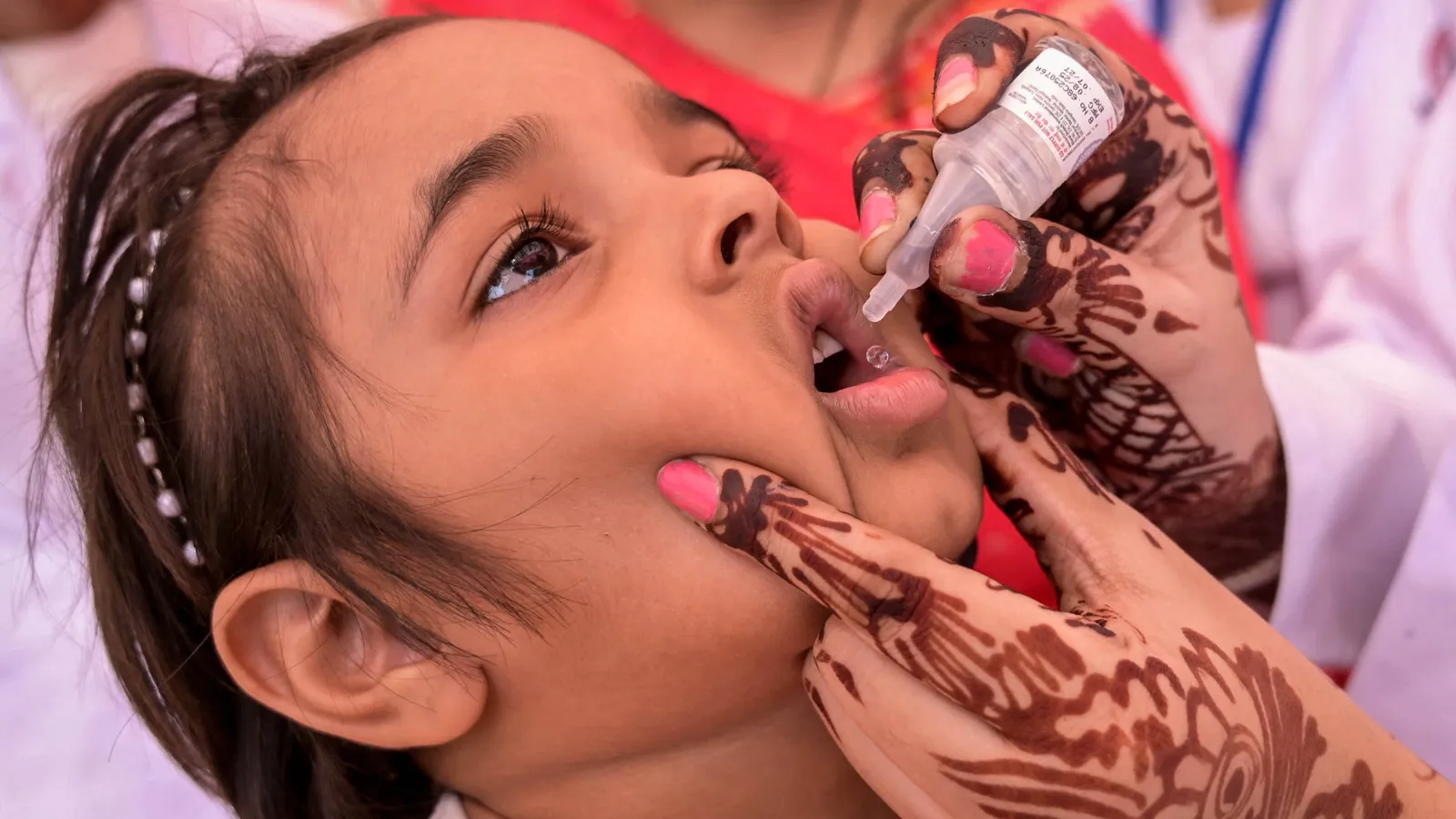
For decades, though, the horror story of the toddler who woke up one morning and could no longer walk has largely been confined to history books. Thanks to the groundbreaking work of Drs. Jonas Salk and Albert Sabin, who developed the first polio vaccines in the 1950s, the disease is almost entirely preventable. A few doses, administered orally or by shot, over just a few months, and kids’ immune systems are ready to fight off the virus. (The shot uses a dead version of the virus as target practice for the immune system; the drops use a weakened, but alive, one.) In 1979, the United States became the first country to declare polio eradicated following years of mass vaccinations; in subsequent decades, many other countries reported similar results. That collective success was critical. Unless other countries could eliminate the virus — and eliminate the risk of it spreading across borders — the globe would have to remain vigilant.
These days, for most regions across the world, polio is a relic of another era. During the 1980s, more than 350,000 new polio cases were reported annually; in 2025, there were just under 300. (Only Afghanistan and Pakistan still have actively circulating polio.) That progress has been in large part thanks to the Global Polio Eradication Initiative (GPEI) — a major collaboration among the World Health Organization (WHO), UNICEF, Rotary International, and the Gates Foundation, among other partners — which has disseminated the hard resources and technical know-how on eliminating the virus to the world.
Then came Jan. 20, 2025.
On the first day of Donald Trump’s second new administration, he announced that the United States “intends to withdraw from the WHO.” The country was defunding, de-staffing, and ceasing all negotiations with the organization. Two weeks later, Trump withdrew from parts of the United Nations — the parent organization of UNICEF — alleging the body’s efforts “act contrary to the interests of the United States.” Days later, the White House’s Department of Governmental Efficiency (DOGE) gutted the U.S. Agency for International Development (USAID).
“We spent the weekend feeding USAID into the wood chipper,” Elon Musk, DOGE’s leader, wrote on X at the time. “Could have gone to some great parties,” he added. “Did that instead.”
By the time the dust settled, some $230 million dedicated to fight global polio had evaporated.

Elon Musk, then de facto head of the White House’s Department of Government Efficiency, celebrating his dramatic cuts to government agencies and global aid.
SAUL LOEB/AFP/Getty Images)
One of the government’s few remaining experts quickly flagged the potential impact of the cuts. In a March 2025 memo titled “Risks to U.S. National Security and Public Health,” Nicholas Enrich, then acting assistant administrator for global health at USAID, wrote that the cuts could lead to an additional 200,000 severe polio cases annually in the U.S. Those figures could be even worse amid mounting anti-vaccine sentiment that has pushed polio immunization rates to their lowest on record. Millions of Americans, Enrich wrote, “are at risk for large outbreaks that can cause paralysis and death.” (Enrich was placed on leave soon after distributing the memo.) In the ensuing months, the global aid cuts deepened as countries like the United Kingdom, Germany, and Canada joined the U.S. bandwagon by pulling funding.
Now, one year after Enrich issued his warnings, experts fear they may be becoming reality. In 2025, the number of wild polio viruses (meaning, those found naturally in the environment) detected through a variety of screening methods — wastewater samples, swabbing healthy children — was 60 percent higher than in 2019. In a September 2025 report, the GPEI’s Independent Monitoring Board (IMB) “concluded with stark clarity” that certain variants of polio were “not under control,” calling the funding cuts an “‘existential threat’ to the dream of a polio-free world.”
Lately, that kind of existential threat — where once-vanquished viruses make a devastating comeback — is no longer speculative, nor hard to imagine. Susan Goldstein, a South African public health expert and member of the IMB, points to the ongoing measles outbreaks — which, as of Aug. 7, had infected over 4,500 American children, hospitalized more than 400, and killed three — as case study for how things may look on the polio front in the U.S. in the not too distant future.
“People didn’t believe measles can kill people and cause deafness — same with polio,” Goldstein says. “Look at the measles outbreaks. It makes me incredibly anxious that polio is going to be next.”
“It’s going to happen,” she adds, “in my mind, there is no doubt.”
POLIO HAS BEEN A PART of Bilal Ahmad’s life as far as he can remember. He contracted the virus when he was three, to the best of his knowledge. As for how he got it, though? That question, he can’t answer.

Bilal Ahmad says people have looked down on him for his whole life because of his polio, and he has struggled to find regular work.
Ahmad grew up in Kashmir, a region in India’s northwest abutting the Himalayas, replete with vast valleys, glassy mountain lakes, and purple iris and cyan forget-me-nots. He describes it as “heaven on earth.” It’s also a region that has fought hard to keep polio under control, a challenge due to both its hilly terrain, which can make vaccine missions downright dangerous, and its porous border with Pakistan, which has long struggled to tamp down the virus.
Ahmad, now 39, was the youngest of seven in a family that had food but scarcely any of the other “necessities of life,” he says, and certainly not enough to pay for health-care luxuries like leg braces or prostheses. Whenever he left his family’s straw home, walking with the signature hitch of someone with polio — painstakingly, unevenly, with a constant hand on his thigh — other kids taunted him. “Everybody told me I can’t do this, I can’t do that,” Ahmad recalls. “Many people looked down on me.”
“Look at the measles outbreaks. It makes me incredibly anxious that polio is next.”
public health expert Susan Goldstein
Then, around 11 or 12, Ahmad realized he had a talent: He could sing — well. Before, he was “mentally paralyzed,” Ahmad says. But once he found his voice, “it made me forget I was handicapped.” Classmates began approaching him at school with compliments rather than gawks and glances. “I felt that I am something,” he says. Kuch paakar khona hai, kuch khokar paana hai, goes one of his favorite anthems from a 1972 Bollywood movie: To gain something only to lose it, to lose something only to gain it.
That confidence, in time, took Ahmad far beyond what he called the “four walls” of his childhood. He taught himself to hike, scaling rugged mountain terrain slowly but surely, despite the havoc polio had wreaked on his limbs, singing all the while to “gather courage.”
Still, life wasn’t an alpine fairy tale. As a teenager, he’d desperately seek out day jobs, often in construction, to support his family. But, due to his apparent disability, he frequently went unhired, as the bosses “felt I was weak, that I could not work.” Thus kicked off a vicious cycle: Financial pressures forced him out of school, which limited his prospects mostly to blue-collar jobs, where he couldn’t get hired due to his condition. “I cannot express in words how much difficulty I have experienced,” he says.
In 1995, UNICEF launched a mass vaccination campaign across India to try to stop cases like Ahmed’s from happening. Four years later, the organization’s workers arrived in rural Muzaffarnagar, about two hours northeast of New Delhi, recruiting “social mobilizers” to join the effort. Azmi Rani leapt at the chance.

Social mobilizers, selected from within India’s hardest-to-reach communities, continue working to detect and prevent polio. “We were the ones on the ground,” says one campaign worker named Rani.
Rani, then in her early twenties, had an unusual upbringing and had weathered a difficult few years. The child of a devout Muslim family, her preordained path was to marry young and tend to the children and perhaps a few cows. She’d dutifully manage the home while her husband worked in the fields farming rice, or lentils, or sugarcane.
Instead, her mother sent her to the state’s capital to pursue her secondary education — which made her a pariah in their community. She became the first girl in her village to graduate university. Though she married quickly after school, her husband physically abused her and they soon separated. “I didn’t have any hope,” she says.
UNICEF’s campaign changed that. The group was enlisting women to persuade families to get vaccinated against polio. Rani, extroverted and a natural salesperson (she’d recently had a gig hawking life insurance), was ready. Soon, she was knocking on doors pitching Two Drops of Life, as the slogan for the oral vaccine solution went. “We are here to save the life of your child,” Rani would tell families, as she explained why they should get immunized.

Social mobilizers coordinate a polio vaccination campaign in Uttar Pradesh, India. Many such workers have faced pushback and even violence from vaccine skeptics.
Eli Cahan
The government gave social mobilizers like Rani a dual mandate. First, they had to get people — those living in the country’s most vigorously-held pockets of resistance, no less — to get the vaccine. Conspiracy theories — of euthanasia, of sterilization, of American bad intentions involving CIA spies, of viruses bred in pig cells (for those who kept Halal) or monkey cells (to Hindus for whom the macaque is sacred) — were common. Sometimes, the families made Rani take the drops herself. Sometimes, they made her give them to her daughters first. Sometimes, the hostilities were even more severe: More than once, she and her compatriots had bricks or hot oil thrown at them, or were threatened with knives.
The second task for mobilizers was arguably even more essential: They had to keep tabs. Who came and who went. Who got the vaccine and who didn’t. And perhaps most importantly, who had symptoms worrisome for a polio infection. “We were the ones on the ground who would give [leadership] the real picture,” Rani says.
Keeping tabs was no small undertaking. Only one out of every 1,900 polio infections results in paralysis. That’s a good thing, in the sense that even if a child is infected, the vast majority do not develop debilitating, and potentially fatal, consequences. But it’s also an epidemiologist’s nightmare: 99.9 percent of infections manifest as cough and snot, masquerading as the common cold, leaping rapidly between children but lurking quietly until a child like Ahmad is sickened for life. Or, rarely, dies.
Roma Solomon lived that nightmare for over two decades. Solomon, a physician who helped lead the social mobilization effort with UNICEF, spent days poring over maps of India’s towns and cities, strategizing how to turn homes marked with X’s (unvaccinated) into P’s (vaccinated). UNICEF’s outreach workers left no stone unturned, enlisting cricket icons, Bollywood stars, and clergy to convince reluctant households to get the drops.
Those efforts culminated in a weekly ritual. Every Friday, the national numbers would come out “and you’d look to see whether it was in your district,” Solomon says. Time and time again, her team’s efforts were met with frustration: “The virus, it would jump just like that,” she says. “It’s like a fire — if you don’t put it out here, it came up over there.”

Roma Solomon, who helped lead efforts to fight polio in India, says the virus is so contagious “it’s like a fire — if you don’t put it out here, it came up over there.”
Eli Cahan
Slowly, though, the X’s were turned into P’s. And in 2014, when India was officially declared polio-free, then-president Pranab Mukherjee highlighted the work of mobilizers like Rani as core to the achievement.
“We salute them on behalf of a grateful nation,” Mukherjee said in a victory speech. “On this day, I recognize their valuable contributions to win this battle for humanity.”
TO ERADICATE POLIO IN INDIA was, in some sense, to defy the odds. In a country of nearly 1.5 billion, wiping out a virus took herculean levels of coordination among local, national, and international agencies — think notebooks and inventory logs and flowcharts and process diagrams and protocols and lots and lots of contingency plans. Deeply unsexy work, but the stuff it takes to administer billions of vaccine doses to hundreds of millions of children.
That’s why, to Hamid Jafari, director of polio eradication for the WHO and a former director at the Centers for Disease Control and Prevention’s Center for Global Health, infrastructure isn’t an abstract buzzword. For decades, Jafari has spent most of his waking hours thinking about the minutiae of wiping the virus from the face of the Earth. For example, let’s say you can convince the family of a child with polio symptoms to provide a sample for testing. Where do you get the containers to store the sample? How do you refrigerate it en route to the lab? What do you need to do in the lab to isolate it? Who will be there to accurately read it?
“From a distance, it can seem like, why can’t these guys just finish polio, why can’t they just get these two drops into children?” Jafari says. “But it isn’t as simple as that.”
All of those questions rely on what the global health universe refers to as “technical expertise.” And that’s where international programs like the WHO, CDC, and USAID have historically played a critical role: helping under-resourced and understaffed health departments around the world implement gold-standard science.

Successful polio prevention programs involve tons of administrative work — notebooks, inventory logs, and lots of contingency plans.
Take USAID, for example. According to Goldstein of the GPEI’s IMB, the agency provided foundational funding — to the tune of over $130 million — for the “soft aspects” of the program, social mobilization among them. Cuts to USAID included the UNICEF collaboration Solomon helped lead, which trained nearly 30,000 polio workers across the world, who administered millions of vaccines to the hardest to reach and identified over 40 percent of potential polio cases in 2025 alone. The IMB, in its 2025 report, called the USAID funding cuts “a devastating blow to the infrastructure” upon which polio eradication programs rely.
But technical expertise is itself a notion that has come squarely within the crosshairs of the White House. In his 2027 budget, President Trump railed against the idea, calling it a stand-in for “duplicative administrative costs, unwieldy supply chains, and layers of endless bureaucracy.”
Instead, the Trump administration established the so-called America First Global Health Strategy (AFGHS). According to the Secretary of State Marco Rubio, the initiative intends to “end the inefficiencies, waste, and dependency of our current system,” to “make America safer, stronger, and more prosperous.”
A core pillar of the strategy is what Rubio called “strong bilateral agreements that promote our national interests.” However, as of Aug. 3, only 34 countries have signed memoranda of understanding for those agreements. (The WHO, in comparison, has 194 member states.) And while the president’s 2027 budget highlights polio as a priority under the AFGHS, the details are not yet clear. Namely, Afghanistan and Pakistan — the two countries in the world that still have endemic polio — have not signed any agreements with the U.S. Nor has India.
Nigeria, the African country with the greatest burden of polio, has signed such an agreement. But the memorandum only described supporting “faith-based health-care providers” to “prioritize protecting Christian populations” — a system that, the Department of State noted, serves roughly one-third of Nigeria’s population. (The majority of the country is Muslim, according to the government’s estimates.)
“This is not just a humanitarian issue — it’s a matter of U.S. national security,” Sen. Jeanne Shaheen (D-NH), said in a statement to Rolling Stone. “If polio spreads unchecked abroad,” Shaheen added, “it increases the risk of resurgence here at home, putting American families at risk.”
IMMEDIATELY AFTER THE PATIENT in upstate New York was diagnosed with polio — the country’s first native case in 17 years — the state and the CDC sprang into action. They did all the things we once upon a time counseled countries like India to do: doctor education, contact tracing, vaccine clinics, the works. It was all hands on deck. They had to figure out how bad the outbreak was. And they had to make sure it didn’t get any worse.
“The virus jumps like that. It’s like a fire — if you don’t put it out here, it came up over there.”
Rani, a social mobilization worker fighting polio in rural India
Eventually, the CDC came to a bedeviling set of conclusions. On the one hand, no other severe cases were found — meaning the patient contracted it from one of the 1,899 polio cases out of 1,900 masquerading as a cold. And on the other, ominously, almost one out of every 12 wastewater samples the agency assessed from nearby treatment plants was positive for polio.
“The origin of the [polio strain] detected in the patient’s stool and in sewage samples remains unknown,” the CDC concluded in a case report, “indicat[ing] a chain of transmission within the United States.” The virus, it seemed, was lurking just in the background.
Experts fear that the potential for U.S. outbreaks from silent cases of polio — the 1,899 with sniffles and sneezes — is realer than ever.
While 93 percent of American children are vaccinated against polio, over the past decade, that figure has been steadily dropping. (On Aug. 17, the CDC reported that record numbers of kindergartners had exemptions from getting required school vaccines, including polio.) More worrisome, experts say, is the fact that more and more pockets of significant under-vaccination exist across the U.S. In Idaho, for example, over the 2025-2026 school year, more than 20 percent of kindergartners lacked immunity against polio. Zoom in further, and certain communities have lower — potentially, much lower — rates of polio vaccination. For example, in Rockland County, where the New York case was detected, 40 percent of infants hadn’t received their polio shots. In certain Rockland zip codes, almost two-thirds of infants were unvaccinated.
“Until everybody is vaccinated,” says Solomon, who saw numerous such outbreaks during her tenure in India, “no child is safe.”
Anti-vaccine messaging from the federal government, especially from the Department of Health and Human Services (HHS) under Secretary Robert F. Kennedy Jr., may intensify these trends. (More formal efforts by the administration to filet the childhood vaccine schedule remain snarled in court.) In January 2026, Kirk Milhoan, a cardiologist and chairman of Kennedy’s hand-picked CDC vaccine committee, said on a podcast that “we need to not be afraid” of polio. “What we are doing is returning individual autonomy to the first order,” Milhoan added, of the committee’s approach to removing vaccine mandates. “Not public health, but individual autonomy.”

Mathew Varghese, one of India’s preeminent polio specialists, says “one slip-up“ in immunization protocol “is enough — it will take no time for the virus to spread.”
Eli Cahan
The messaging already seems to be having an impact. An October 2025 poll from KFF (formerly the Kaiser Family Foundation) found that 85 percent of parents felt the polio vaccine was safe for their children. Just four months later, another KFF poll found that number had decreased to 77 percent.
To the CDC, the anti-vaccine sentiment harkens future crises. “Low vaccination coverage…indicates that the community is at risk for additional cases,” the agency wrote in the New York case report. “Even a single case of paralytic polio represents a public-health emergency.”
TWO MILES NORTHWEST OF the majestic Red Fort in Delhi — past the buzzing Chandni Chowk bazaar, past the Mahatma Gandhi Park, past the Old Delhi Railway — up four flights of stairs, down a hallway, and nestled in the orthopedic unit at St. Stephen’s Hospital is India’s only remaining polio ward.
People flock from all corners of the country to see Mathew Varghese, a surgeon who has perhaps become the nation’s preeminent specialist for polio patients. Here, Varghese coordinates their physical therapy, builds their braces, fabricates their prostheses, and operates on their limbs, should things come to that. Over the decades, he has treated hundreds of polio patients across every age group. “It’s a lifetime of paralysis,” Varghese says, “a lifetime of disability.”
In recent years, the ward has become quieter and quieter. That, Varghese says, is a modern miracle. He hates the virus. He wants the world to move past it. We have come so close, he says.
Watching polio’s recent trajectory, though, Varghese is concerned. “One slip-up is enough — it will take no time for the virus to spread,” he says. And that, of course, means his services may come into high demand once again. “I am not ‘worried about’ it filling up,” Varghese adds of the polio ward. “I know it will fill up.”
Last year was not a good one for polio. In 2025, positive cases in Afghanistan and Pakistan were up. Positive wastewater samples there were, too. Vaccination campaigns in places like Nigeria were down. Outbreaks in places like Yemen went unchecked.
In its September report, the GPEI’s IMB highlighted “major political and financial upheaval arising mainly from policy changes in the United States government” as a major driver for these changes.
“With the U.S. abruptly pulling the rug out from under the system, many parts of the system are collapsing,” Tom Frieden, a physician and former CDC director under President Barack Obama, says.

Varghese examining a patient in India’s only remaining polio ward, located at St. Stephen’s Hospital in Delhi.
Eli Cahan
Some policymakers stress that the U.S. will continue funding programs focused on global health, including for polio. “No one wants polio to reemerge as a major threat to the American people or to children around the world. That’s why President Trump has set ambitious goals to combat polio,” Sen. Jim Risch (R-ID), chairman of the Senate Foreign Relations Committee, said to Rolling Stone in a statement.
But practically, it’s not clear how these programs will be implemented, Enrich, the former USAID official, says.
The Congressional Budget released in April proposed slashing global health funding almost in half. Specifically, it pitched eliminating funding for Gavi — the international organization that, historically, had played a central role supplying the polio vaccine. That’s in addition to the earlier dismantling of USAID (which trained social mobilizers for surveillance and active case finding) and the withdrawal from the WHO (whose technical expertise informed laboratory strengthening and data systems). In July, amid pushback from a bipartisan coalition of Senators citing “direct implications for Americans’ health security,” the State Department reinstated Gavi’s funding. Still, Enrich calls it “completely unrealistic” to believe that new organizations will rapidly emerge and step into the programmatic vacuum that USAID, and WHO once occupied.
“With the U.S. abruptly pulling the rug out from under the [global health] system, many parts of the system are collapsing.”
Tom Frieden, former CDC director under President Barack Obama
The shift in strategy — eliminating “soft” programs like social mobilizers or others like water sanitation and hygiene initiatives — could also bear significant longer-term consequences. Without them, “we have basically cut off our global early warning system,” Enrich says. “Our entire infectious disease policy is sort of like, ‘Let’s put a blindfold over our eyes and cross our fingers and hope.’”
The strategic pivot could also impact the world’s ability to eradicate polio completely.
That’s because most of the world relies on the oral vaccine, which consists of a weakened, but alive, version of polio. The weakened version acts as target practice for the body’s immune system — basic training of sorts. The oral vaccine also has the distinct advantage of stopping active infections in their tracks. The shot, which uses a dead version of the virus, can only prevent future infections, but not stop active ones.
However, in a fraction of children who receive the oral vaccine — one in 2.7 million — the weak-but-alive virus can cause paralytic polio: so-called “vaccine-derived” cases. The risk is minute, compared to not getting the vaccine at all: Children who don’t get the drops face a risk of paralytic polio that is at least 1,750 times higher. Put another way: For each Boeing 747 worth of people who get vaccine-derived cases, the entire city of Boston, if unvaccinated, would get polio.

Dr. Hamid Jafari, director of polio eradication for the WHO, says, “Polio eradication will only be achieved when you eradicate all types of polio.”
Rahmat Gul/AP
Much of the global effort to date has focused on vanquishing so-called “wild-type” polio: the virus that’s found in the environment, from infected fecal matter. Historically, vaccine-derived polio — the weak, but alive, version — has been something of an afterthought in comparison, Jafari, at WHO, says. These days, though, the majority of global polio cases are vaccine-derived: In 2024, dozens of countries reported small numbers of such cases. (The New York case was also vaccine-derived.)
“Polio eradication will only be achieved when you eradicate all types of polio,” Jafari says. “We shouldn’t be confused that when we eradicate the wild-type polio, the job is done.”
As such, getting rid of polio for good necessitates countries switching from the oral vaccine to the shot. But if the shots don’t get in arms anymore due to funding gaps created in part by the U.S. withdrawal, “polio eradication is unlikely,” the IMB says, despite “donors and stakeholders hav[ing] invested over $22 billion to eradicate polio since 1985.”
To some policymakers, the risk of global outbreaks fueled by funding gaps could constitute a walk back in time. “I remember polio vividly as a kid — a classmate would go to school healthy and could be paralyzed at dinner time,” Sen. Dick Durbin (D-IL) said in a statement to Rolling Stone. “But now due to the Trump administration and RFK Jr.’s erratic cuts, policies, and rhetoric, such historic progress could be dangerously reversed.”
“Their attacks on science and global funding,” Durbin added, “will have lasting impacts not just in the United States but across the world.”
IN INDIA, DESPITE THE infection that changed his life, Ahmad pushes on.
After facing rejection after rejection for construction work, Ahmad found a creative way around the perceptions: He could agree to a finished product, rather to any specific job itself, and subcontract out the parts of the work he couldn’t do. In time, Ahmad felt he shouldn’t be the only one with physical challenges who could access blue-collar work, forming a union for disabled workers in Kashmir.
Of the skeptics: “I have definitely proved them wrong,” Ahmad says.
But Ahmad also knows he alone won’t be able to solve the challenges people with disabilities — including those who have survived polio — face. He’s counting on his four-year-old daughter for that. He hopes she will work for the government someday. To fight for people like him. “I want her to know that people who are disabled can participate in the world,” he says.
Still, Ahmad wouldn’t wish his disability — preventable, as it was — on anyone. To that end, he has a simple message.
“Polio, it’s still here,” he says.
Daniel D`Amico for SANREMO.FM