
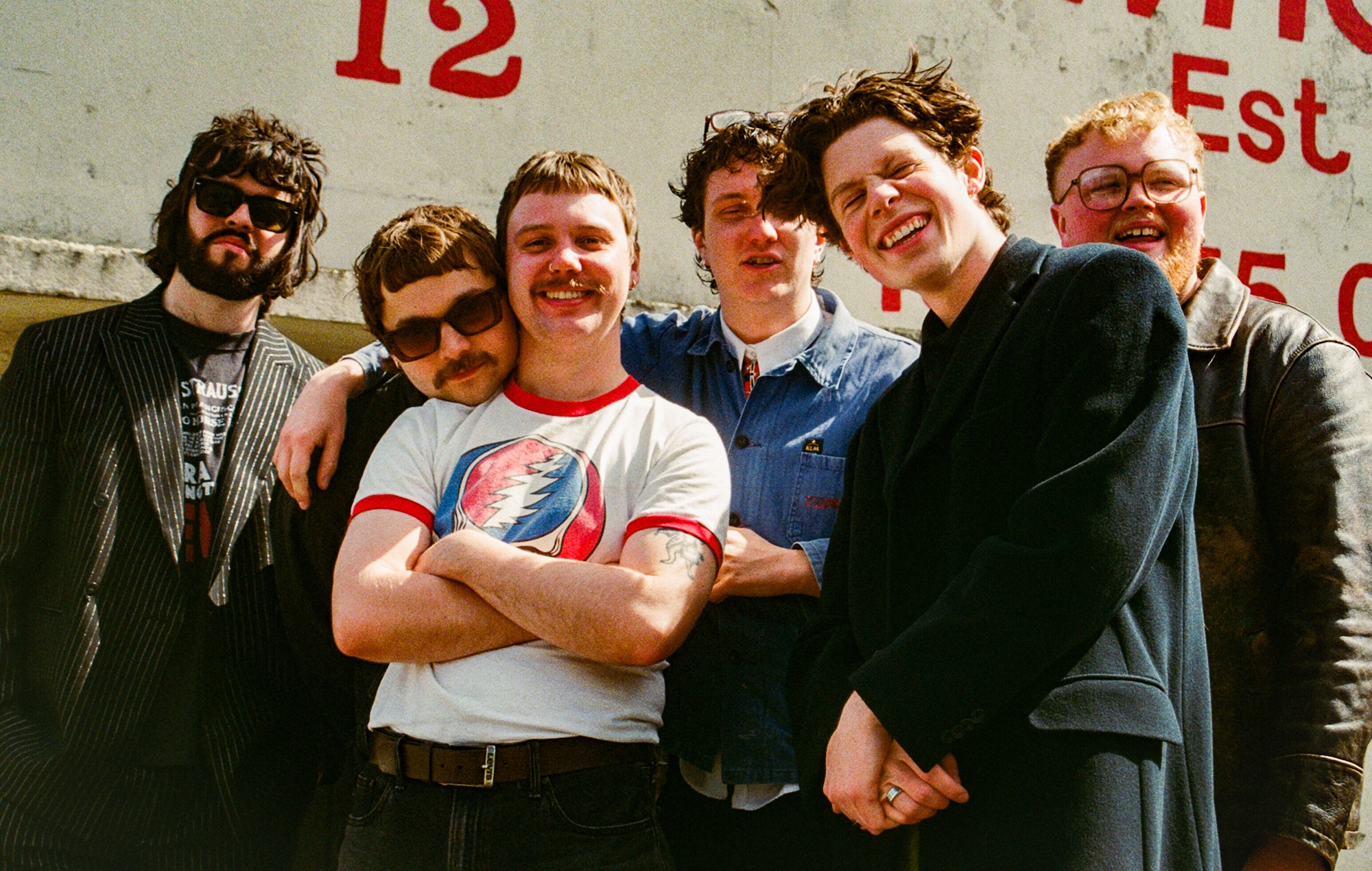
At this year’s edition of tastemaker new music festival The Great Escape, the most potent performance of the weekend belonged to a band whose roots stretch back more than a century. In the absolutely heaving basement of Brighton’s Chalk, Dublin sextet Madra Salach unleashed their visceral, punk-entwined take on Irish trad classics dating back to the 1950s (‘Murphy Can Never Go Home’) and the 1870s (‘Spancil Hill’), weaving their tales of displaced immigrants mourning for a sense of belonging among original new songs finding kinship within grief, love and loss.
At the set’s climax was closer ‘The Man Who Seeks Pleasure’: a slow-burning moment of ultimate emotional purging, dredged audibly from the core of vocalist Paul Banks. A song that eulogises the self-destructive line between pleasure and pain, it was written in mandolin player Jack Martin’s bedroom a short couple of years ago, but its hardened, world-weary sentiments – like much of Madra Salach’s outlook as a whole – feel timeless.
“The thing that I like about that line (“For the man who seeks pleasure, is the man who seeks pain”) is that it’s not saying anything new,” considers Banks, speaking to NME alongside Martin during a rare day off in Dublin. “It’s a behavioural pattern that a lot of people are stuck in that’s been summed up into a sentence that I can then scream over a drone, which then feels cathartic for me and seems to be cathartic for people watching. For a long time when we were gigging it, I’d almost always get too close to the line emotionally, and I’d be really dysregulated for an hour after the show. And I think that speaks to…” He takes a beat. “I like to think there’s something special about that song.”
Their live show’s gut-punching closing moments are but one reason why the band – completed by guitarist Adam Cullen, bassist Jack Lawlor, drummer Dara Duffy and harmonium player Maxime Arnold – have become one of 2026’s most unmissable new acts. Last summer, Madra Salach were yet to play a festival outside of their native Ireland; this year, they’re notching up around 30, from a support at Kneecap’s London all-dayer (where one in five people seemed to be sporting their merch) to hefty slots at Green Man, TRNSMT and Electric Picnic.
“The fact that it’s having this much commercial success is blowing my mind, because my hopes for this project were to find our own little pocket in the niche folk revival so we could play small rooms in Dublin,” Banks says.
But even from the beginnings of the project in 2023, Madra Salach have never stayed in just one lane. Their genesis is a “blurry” one, the two musicians state. On one side, Banks and Duffy had taken to playing live nights at their local pub, The 1884, covering The Pogues and The Dubliners at open sessions where “you were there to play drinking music”.
On the other, Martin – whose grandfather was the president of SIPTU, the largest union in Ireland – had proposed a project to the vocalist where they would reinterpret old workers’ songs, updating them with tape loops and ambient drones. “I grew up hearing those songs and, as I got older, I understood the context a lot more,” Martin recalls. “Usually people’s grandparents have photos of Jesus on the walls, but mine had [trade union leader] Jim Larkin. Jim Larkin is my granddad’s Pope.”
Over time, the two strains began to fuse. Madra Salach’s debut EP, January’s ‘It’s A Hell Of An Age’, was named after a line in ‘Murphy Can Never Go Home’ but its timely sentiment neatly sums up how the band see their mix of old and new. “The fact that, 80 years on, it’s still so relevant made sense to us in terms of what we’re trying to say with folk music: that it’s rooted in history and tradition, but we’re absolutely making music for now,” says Banks. “I think the centre of the folk ethos is that it’s just human stories – stories of individuals as opposed to the history book stories of battles and conquerors and kings. It’s a people’s oral history, so as long as you’re writing from a place of truth, everything else can follow.”
“Folk is a people’s oral history, so as long as you’re writing from a place of truth, everything else can follow” – Paul Banks
For the six-piece, that means taking these classic ideas and arranging them “like you would in a standard guitar band, but the instruments are different, and the songs are different,” suggests Banks. Firmly focused on the efficacy of their live set, they’ve been finding that their writing has been growing “more teeth” in tandem. “We haven’t had a chance to really cement a new body of work yet, but the new songs we’re writing are such live songs that are so structured around a performance with energy,” he notes.
Arriving in the wake of artists like Lankum, who’ve brought traditional Irish folk to a wider audience, the door has been opened for Madra Salach to experiment with the form in their own way. “I think we’re very lucky that we’re not having to plot this course on our own. People have the context. We don’t have to pander too much to like, swilling pints of Guinness and wearing big jumpers because other bands have showcased that, culturally, we have a lot more to offer than that – even though I love big jumpers and Guinness,” the frontman chuckles. “We jumped on the bandwagon, and it’s going great!”
Far from hitching a ride on anyone else’s train, however, the magnetism of Madra Salach lies in how clearly they believe in every note of what they’re doing. It’s there in the way the original songs on ‘It’s A Hell Of An Age’ – particularly the snarling sadness of ‘I Was Just A Boy’ – pick up the spiritual baton of their established forebears. And it’s there in the undeniable presence and power that’s made a Madra Salach live set one of the summer’s must-see shows.
“It’s funny, because I could do all the same noises and movements that I do, but people have really highly-tuned bullshit detectors, and if I didn’t mean it, they’d be like, ‘Ah, this guy’s fucking putting it on’,” says Banks. “So I really try to go to the emotional centre of the songs and stay with it, and I find that to be one of my favourite things about singing – just inhabiting that place. The shit I hate is loading in and doing soundchecks, but getting emotional? I’d be doing that anyway, so I’m more than happy to do it on the stage.”
Madra Salach play Green Man Festival on August 19. Visit the band’s website for their full tour dates and tickets.