
T
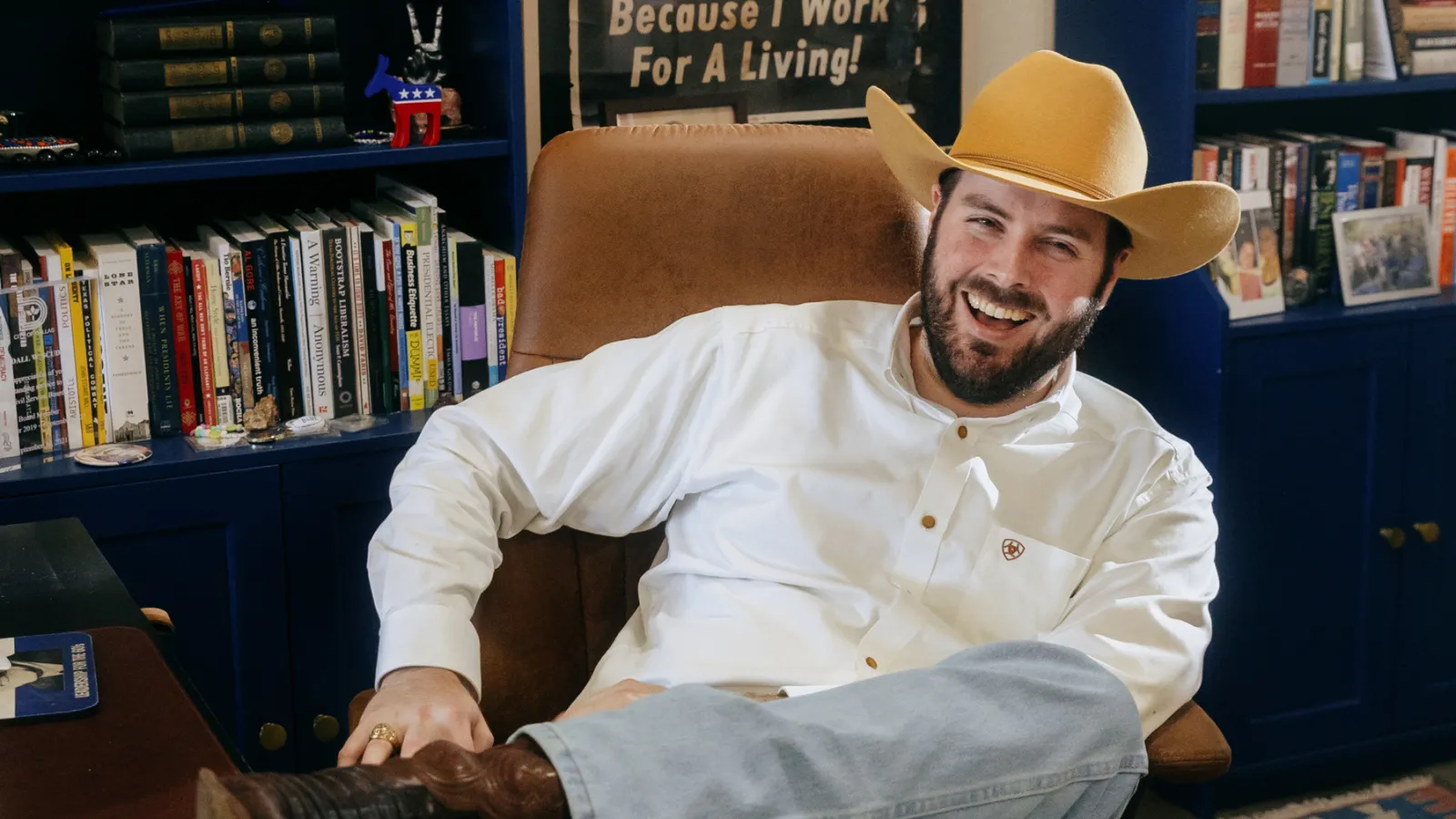
he personal office of Texas Democratic Party Chair Kendall Scudder is a museum to Democrats’ greatest victories, disappointments, close calls, and one-hit wonders.
“He’s a crazy motherfucker that guy,” Katherine Fischer, executive director at Texas Majority PAC, quips to me as I sift through boxes of what I estimate to be several thousand vintage (and not so vintage) campaign pins, trying to be mindful of old rusty needles. “In the best possible way,” she clarifies.
Buttons reading “UNBEATABLE MONDALE FERRARO,” “SHIRLEY CHISHOLM FOR PRESIDENT,” and “Smile If You Had an Affair with Bill Clinton” flow across the conference table like spilled gold from an overturned pirate’s chest. Every available flat plane of space from which something can be hung or displayed in the Dallas office is occupied. A collection of ceramic Jim Beam whiskey decanters shaped like Democratic donkeys lives behind his desk. Ashtrays full of lapel pins dot tables and shelves. An entry table holds a gavel belonging to former House Speaker Sam Rayburn, a true blue son of Texas. Campaign posters for Lyndon Baines Johnson — Scudder’s favorite president — Robert Kennedy, Barbara Jordan, FDR, Hubert Humphrey, Jimmy Carter, Barack Obama, and dozens of others form a crowded gallery wall spanning the length of the room. The closets are stuffed with storage bins containing money stacks of political bumper stickers and rolled poster boards. A “Frances Farenthold for Governor” sign is displayed above the toilet in the bathroom.
It is the lair of a political mad scientist, one whose experiment just came alive.
A Democratic senator from Texas is headed to Washington, D.C. A Democrat is going to be the governor. A Democrat is going to be lieutenant governor. The party also flipped the seats of the attorney general, comptroller, agricultural commissioner, land commissioner, and railroad commissioner. They converted 12 judicial seats from red to blue, took over the board of education for the first time in three decades, and won control of the Texas state House for the first time since 2002.
The transformation may feel like an overnight fluke to outside onlookers, with the party riding a wave of anti-Trump sentiment into a generational electoral coup. To think that would require discounting the work of extremely sophisticated candidate campaigns, organizers, and the work Scudder began to ensure that any gains made by Texas Democrats — however marginal — could serve as a foundation rather than a transitory win.
Six-foot-three with a large frame, dark hair, and bright hazel eyes, Scudder can cut a mean figure if he has the inclination to. When he’s not stumping, soliciting, or selling, he can be goofy, prone to bouts of excess energy, and eager to discuss the project he’s thrown himself into over the last 20 months: a radical reconfiguration of the Texas Democratic Party.

Kendall Scudder pours political pins out of one of his several bins where he keeps his large collection at the Texas Democratic Party headquarters in Dallas, on Nov. 11, 2026.
Shelby Tauber for Rolling Stone
As chair of the party, he’s angered longtime fixtures of the state’s political establishment, grated on the political economy of the region, and ultimately — through both accident and intent — placed Democrats in a near-perfect position to meet the moment when lighting finally struck.
It’s now a blue Texas, if he can keep it.
Growing pains
“I am quite literally the most partisan man in the state of Texas,” Scudder — a golden pin of a red-eyed donkey in boxing gloves glistening on his lapel — laughs over a tray of brisket. Elected the chair of the Texas Democratic Party in 2025 for what was initially only a partial term, Scudder now finds himself at the center of what generations of Democrats in the Lone Star State dreamed of every time they cast a ballot: a viable state party, with control of the levers of power, and political capital to spend.
“People kept saying you’re doing too much, too fast, you’re supposed to be a caretaker chair, you’re going to lose all this institutional knowledge,’” Scudder says in his Texarkana brogue that broadcasts his rural roots — when we first met at Terry Black’s Barbecue in Austin. “You’re worried I’m going to ruin the institutional knowledge of what? Losing?”
Veteran organizers, current as well as former Texas politicians, and advisers described the Texas Democratic Party of their lifetimes as a bloated, Austin-centric social club that did little for candidates, and even less for voters. The party was caught in a cyclical spiral of self-defeatism, and — through a combination of financial and structural factors — unable to retain and grow insurgent waves of voter support like that which boosted former U.S. Rep. Beto O’Rourke’s near-miss in the 2018 Senate race. After the losses of 2024, particularly among Hispanic and Black voters within the state, Lone Star Democrats found themselves in a crisis.
Democrats “thought you could lock a bunch of consultants in a room in Austin and buy your way out of the problem,” Scudder tells me, after (correctly) complaining that charging $50 for a tray of brisket and sides is ridiculous. Scudder, himself from a farming family, does not abide by sacred cows. His first three major actions upon assuming the chairmanship were to move the party headquarters out of the liberal stronghold of Austin to red-ringed Dallas County, clear the debt weighing down their accounts, and overhaul the party’s leadership.
The leadership overhaul almost derailed his tenure just as it began. Top staffers, including the party’s former chief of staff and executive director, resigned after Scudder announced they would be required to move to the new Dallas headquarters, accusing him of wanting to remain in his hometown (the Austin office was converted to a field office). Claims of union-busting and racism were leveled against him by former party employees, two of whom ultimately attempted to unseat him when he ran for a full term in the summer of this year. By then, Scudder had managed to bring enough of the party around to his vision to comfortably secure his reelection to a four-year term.

Kendall Scudder’s collection of political posters and items at the Texas Democratic Party headquarters in Dallas, Nov. 11, 2026.
Shelby Tauber for Rolling Stone
“When I came in the party had about a third of its precinct chairs full across the whole state, and about 20 percent of our counties didn’t even have a county chair. We needed to rebuild it.”
Scudder launched a widespread organizer and candidate development effort to establish a presence in all 254 Texas counties, the party surged recruitment and pulled in over 100 candidates to fill out downballot races — many of which hadn’t had a Democrat run in years — through the “Texas Challengers” program. For the first time in the party’s modern history, every race had a candidate. Now-outgoing Governor Greg Abbott and his advisers dismissed the effort as a “gimmick” earlier this year. A dozen of them would go on to win.
Texas Democrats staffed up over a thousand county and precinct chairs, and moved to open field offices in Houston, Eagle Pass, and Amarillo. The party rolled out paid civics education classes to boost voter turnout, and enforced a new, equal-opportunity bidding process for campaign consultants and services, negotiating universal rates to save candidates millions in expenditures across the state. They also built the first coordinated campaign in the party’s history, pulling together over $40 million in campaign contributions statewide, including a research consortium available to local candidates typically excluded from the multi-billion-dollar consultant and pollster economy. Fischer, who oversaw the coordinated campaign with Texas Majority PAC, told me that almost immediately after Scudder’s election “we started to build the machine that would be used in 2026,” with limited funds and a lot to prove, the partnership focused on “efficiency and creativity,” to make every dollar work for the party.
The way Scudder and his staff tell it, it was the beginning of a 10-year plan, maybe five or six if they managed to do every single thing right. To them, a great night in the midterms would have been one that sent James Talarico to the Senate, flipping a few House seats, and maybe even stealing the governorship. Roughly a week before the election, Scudder received a polling update from the research consortium, predicting blowout wins throughout the state. “I looked up at the team,” he recalled, “and said ‘fuck the consortium is busted.”
Not so.
A lack of patience
In early 2025, Scudder invited his wife, Carly — a specialized therapist for foster children — to his office. The couple were expecting their first child later that year, and he had a pitch to make.
On one side of a freestanding dry erase board, he had a bulleted list of “all the things we wanted in a name.” A name that wasn’t weird or exceedingly common, worked with Carly’s mother’s maiden name (Joiner) as a middle name, and ideally a reference to a family name.

Kendall Scudder, chair of the Texas Democratic Party, at the Texas Democratic Party headquarters in Dallas, on Nov. 11, 2026.
Shelby Tauber for Rolling Stone
“I walked her through it,” he gushed, reenacting how he flipped over the board for her, and there in large letters was his proposal: LYNDON JOINER SCUDDER — after the 36th president of the United States, a born and bred Texan, and also an amalgamation of her full name — Carolyn — and her father’s name, Don. “We couldn’t name him Don,” he adds in a conspiratorial whisper.
Little Lyndon — now 15 months old and completely unaware of what just happened in his his state — was born last July.
LBJ clearly looms large for Scudder. He’s not only a symbol of the true power of progressive Texan governance, but of the power elected officials ultimately have to shape the lives of those they govern.
“Johnson’s Great Society pulled my family out from poverty,” he says. Born in East Texas near the not-so-new town of New Boston, Scudder’s family carved a path to their American dream on the winds of the Democratic social policies of the 20th century. His grandfather was delivered alone by his mother “in a wash bucket” on the family farm that, as he claims, only had water and electricity because of FDR. The programs of the New Deal and Great Society would rescue the Scudders from the fallout of the Great Depression. His left hand sports a gold wedding band, his right an edgeworn class ring from Sam Houston State University, the word “honor” engraved inside the band. He was the first person in his family to go to college, and it “might as well have been Harvard.”
“Everything I have in my life is because progressive Democrats,” he insists. “Democrats were the only people fighting for me. I love this party, and to think that Republicans could get elected, get rid of such a rich history of this progressivism in this country, and just run them up the way they did — I have no fucking patience.”

Kendall Scudder’s class ring from Sam Houston State University at the Texas Democratic Party headquarters in Dallas, on Nov. 11, 2026.
Shelby Tauber for Rolling Stone
That patience began to run out at around 12 years old. In the early 2000s Republicans would seize same sex marriage and relationships — in a similar manner as they now treat anti-trans issue — as a supposed social contagion with which to browbeat the opposition. Outgoing Sen. John Cornyn (R-Texas), then the state attorney general, defended anti-sodomy laws criminalizing same-sex couples, and the party at large sought to brand LGBTQ individuals as unfit to parent. Scudder, the child of a lesbian couple, took to door knocking in opposition.
He became an organizer for Texas College Democrats and Texas Young Democrats, opening dozens of chapters throughout the state. His own attempts at seeking elected office fell flat — losing a Texas state Senate race to Republican incumbent Bob Hall in 2018, and a Democratic primary to Texas House Rep. John Bryant, a former member of the U.S. House of Representatives, in 2022. It is perhaps a testament to Scudder’s graciousness that Bryant has since become a close friend and adviser, so much so that he officiated his wedding.
Perhaps the most revolutionary thing about Scudder is his lack of cynicism. Losing doesn’t scare him, losers don’t disgust him. “I know where all the landmines are because I’ve stepped on them all,” he jokes at one point as we stand in among his collection of decades of campaign shrapnel. All the names of victors, legends, disappointments, and “what ifs” piled together into a movement he can now shape.
Same old, same old
Almost everything in Jim Hightower’s home looks like it was brought into the world by human hands. The ranch-style house in a quiet Austin neighborhood just off of South Congress is full of things that were carved, woven, pinched, molded, and whittled. It’s the kind of lived-in western space the tech transplants of the Austin goldrush pay out the ass for, but never really achieve. Outside, his garden is an untamed tangle of native plants and wildflowers. At 83, he likes that they “basically take care of themselves.” Voters, not so much.
Hightower is a bit of a legend among those who know political ball. As a younger man he worked under Texas Senator Ralph Yarborough — a staunch supporter of integration and civil rights during a time when most Southern senators refused to do so. He founded the progressive newspaper The Texas Observer and served as Texas Agriculture Commissioner between 1983 to 1991 — the last Democrat to hold the office until Clayton Tucker was elected last week. He is now one of the only living members of the last generation of Texas Democrats to serve in statewide elected office — one that held power during a time when the party represented union labor, farm workers, and social and economic advancement for the diverse population of the state.
“Populism began in Lampasas, Texas. Literally four farmers sitting around a kitchen table saying the banks are screwing us, and the railroads are screwing us, and we’ve got to do something,” he explains to me as we chat on his screened-in back porch. Somewhere along the way, as corporate interest and big money took hold of American politics, “our party quit standing for worker rights, environmentalism as strongly as we had. We still ostensibly stood for it but we lacked conviction and we lacked action, and people noticed that.”
When Hightower ran for Agricultural Commissioner— alongside future governor Ann Richards, then a candidate for State Treasurer — the candidates ran as a collective ticket, a “unified campaign” that built on their individual constituencies. “They thought they couldn’t win, and here we came,” Hightower recalls. It wasn’t “just one ego, but an actual progressive movement that could change Texas.”

Kendall Scudder’s collection of Democrat and USA pins at the Texas Democratic Party headquarters in Dallas, on Nov. 11, 2026.
Shelby Tauber for Rolling Stone
It’s a romantic vision of a time long gone, but it rhymes with the Democratic victory of 2026. In the aftermath of 2024, with Texas Democrats once solid multi-racial coalition in shambles, it was clear something needed to change. As the party looked to make inroads in the state in 2026, O’Rourke advised Governor-elect Gina Hinojosa to treat her run as a joint venture with the party’s Senate candidate, arguing that it would be near impossible for a single Democrat to pull off the upset without building a multi-candidate voter coalition. Quality candidates with robust campaigns could make the jump under the right set of circumstances, in the right cycle — but making the party a true competitive force long term would require specialized attention. “We were looking for a party chair who could do something besides sit there in the chair,” Hightower says. Scudder, adept at fundraising and a wunderkind communicator, seemed like a viable choice. “He was willing to fight the bullshit and the bullshitters who were retarding the party, who didn’t seem to even quite understand what the party was and what it could be.”
The people who work with Scudder will tell you that he’s kind of crazy, a bit gregarious, a font of boundless energy that sometimes needs to be reined in and is smart enough to know it. He will readily hand out his phone number to anyone who asks for it, take any call, respond to whatever request comes from whatever part of the state. Lillian Salerno, a senior adviser to Scudder and former Obama administration official, met him when he was 19 years old.
After years favoring corporate Democrats, Scudder wanted to create a culture where “when candidates came in, they felt recognized” by the party, Salerno tells me over coffee near the Texas Capitol. She had run and lost a House race in 2018, and knew firsthand how the process feels for a candidate. “It didn’t work out for me — but I didn’t feel like the party gave a shit whether I ran or not,” she says. “Maybe it was just my impression, but I felt like I wasn’t an Austin person, so I didn’t really have a place. If I felt like that, maybe other candidates did too.”
Scudder’s opening blitz was about as subtle as a gunfight, but it served to (mostly) reset the decayed relationships between the party core and the state at large.
The party “was always asking me for a contribution, as opposed to doing anything that I felt was particularly meaningful to get me elected,” says Texas House Rep. John Bryant. “Under Kendall, it’s completely different, and a lot of the elected officials are having to come around to this realization.”
“In my experience the county chairs of the staff had just clashed endlessly, they couldn’t stand each other,” Terri Burke, the current Executive Director of the party, tells me over Diet Cokes in Scudder’s office, which is separate from the main party headquarters because (as he will readily tell you) he can be a bit overwhelming. “The State Democratic Executive Committee (SDEC), they couldn’t stand the staff. The staff couldn’t stand them. There was so much conflict. There was so much dysfunction.”

Kendall Scudder’s collection of political posters and items at the Texas Democratic Party headquarters in Dallas, Nov. 11, 2026.
Shelby Tauber for Rolling Stone
And not just dysfunction, but a refusal to adapt. “We’ve been doing the same old, same old for a long time, but not getting the results that we all of us wanted to see,” says Texas state Senator Royce West — a power broker and longtime fixture in the Texas political scene. “Yes, there were some controversial decisions that were being made. But here’s the deal: sometimes you’ve got to be a disruptor. And if you’re going to be a disruptor, it has to be done with the purpose. Kendall is the person to do it.”
As goes Texas politically, so goes America
Scudder is quite young compared to most of Texas’ Democratic greats. During our first meeting in Austin, Scudder, still a little scrambled by the outcome of election night, mentions that there was not a single living Texas Democratic Party chair who knew how to actually plan a gubernatorial inauguration. He was going to be flying blind.
Getting Gina Hinojosa sworn in is a small task compared to the plans Scudder is already brewing for 2028 and beyond. Democrats made history, now his job is to retain their control of the state, and ideally expand it.
“I gotta protect all these flips. I gotta flip a couple Senate seats,” he rattles off at one point. “If you think I’m not going after that Senate next cycle you haven’t met me yet.”
Scudder also intends to do all he can to ensure Democrats govern as Democrats. There’s a lot of talk at the moment of concession-making and what sort of limits Hinojosa and other Democrats should abide by in order to avoid rattling the temporarily dormant Republican coalition in the state. Scudder sees part of his job as ensuring the coalition doesn’t give up the shop.
“We just want to be helpful, but part of that being helpful is understanding that it’s a Democratic governor, and we would expect her to stay as close to the Democratic platform as we could possibly get,” he says. “People got her elected as a Democrat, and we would like for her to govern as such.”
They’re up against immense challenges. There will not be a major statewide candidate on the ballot in 2028, which means their efforts will be attached entirely to the presidential ticket. Republicans in the state have already broadcast their intent to throw wrenches into Hinojosa’s tenure wherever they can. He will have to convince the national Democratic party that Texas is no longer a state that they can afford to write off.
We are “responsible for a movement” now, he says. Our “job is to grow it.”
Should he succeed where his predecessors have failed, the implications go far beyond Texas.
One of the first people to call Scudder and congratulate him after election night was Senator Bernie Sanders (I-Vt.), who has advised the chair on his organizing efforts, and frequently campaigns on behalf of Texas candidates.

Kendall Scudder, chair of the Texas Democratic Party, at the Texas Democratic Party headquarters in Dallas, on Nov. 11, 2026.
Shelby Tauber for Rolling Stone
“As goes Texas politically, so goes America,” Sanders tells me over the phone, noting that the trove of Electoral College votes harbored by the state would make presidential math near impossible for Republicans. “What happened on November 3 is extraordinarily important, not just for Texas but for America — and Kendall, in a very quiet way, helped make that happen by demanding that there be candidates in every race, every legislative seat in in the state, and by building the kind of grassroots movement that should be built not only in Texas but all over the country.”
“There is no reason why [Texas] should not be one of the more progressive states in the country,” the senator adds. “It’s a young state, it’s a working class state, large minority populations — there was no rational reason why it was run by right-wing leaders — and I think that’s something that Kendall understood in what he did.”
Making Texas a true swing state or returning it to a true blue stronghold, would be the political feat of the century.
Scudder is not taking his eye off the ball. “It’s one thing to burn their house down,” he tells me with a hungry glint in his expression. “But I want to nail their door shut.”