
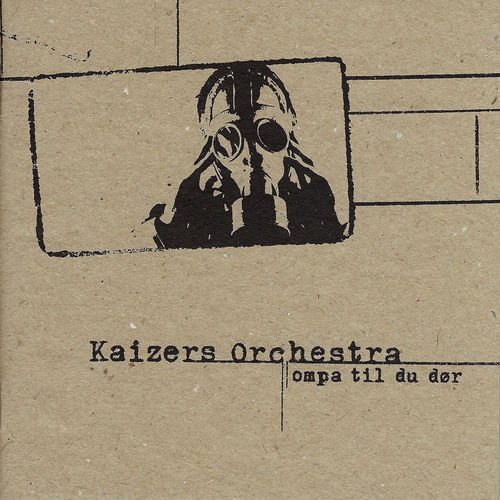
Kaizers Orchestra is one of the most important bands in the history of Norwegian music. Singing in a mixture of bokmål (Standard Norwegian) e jærsk (dialect of the southwestern area), on rough music with limited radio concessions and cinematic lyrics all set in the same alternative universe, have generated a career of nine albums at number 1 in the charts.
Despite having zero exportability on paper, given that in their own country there are those who struggle to understand the lyrics, they have managed to gain a solid cult following in Denmark too (three albums in the top 20 over the course of their career).
The project came to life in 2000, at the hands of Janove Ottesen (vocals, acoustic guitar and piano) and Geir Zahl (electric guitar and backing vocals), two childhood friends born and raised in the small town of Bryne, who already have two projects behind them with limited edition self-distributed releases, namely Blod, Snått & Juling and Gnom, both oriented towards contemporary folk with a low fidelity sound.
For this new adventure, however, they raise the bar of ambition, aiming for complex arrangements that require broader training: they are accompanied by Terje Vinterstø (electric guitar), Rune Solheim (drums and percussion), Helge Risa (harmonium and piano) and Jon Sjøen (double bass and electric bass). With the exception of the latter, who left in 2003, the others remained traveling companions of the duo throughout their career.
“Kaizers Orchestra Ep”, released in March 2000, and sold in just 500 copies, seems to keep the dimension of their music on the same levels as previous attempts, when Remo Rehder, head of the small independent label Broiler Farm, is impressed by their performance at the festival for new talents by:Larm and decides to sign them.
To record the debut album, “Ompa til du dør”, the record company invested what was necessary to make it a first-rate product, using Jørgen Træen and Stian Carstensen. The former is one of the most important Norwegian producers and at the time he had already directed the works of internationally cult artists in the most disparate fields, from metal (Enslaved, Emperor) to jazz (Jaga Jazzist), passing through songwriting (Sondre Lerche). The second is a multi-instrumentalist in the jazz and folk area, with less high-sounding collaborations, but highly respected among professionals.
The sessions were held in June 2001 in Bergen, at Træen's studio, and lasted just six days. Most of the material is recorded live, given that the band is already well established live at that point, and the overdubs are limited to a few tweaks.
The setlist opens with “Kontroll på kontinentet”, which immediately puts the main coordinates of the proposal on the table: a progression similar to the polka (indicated with the popular onomatopoeia “ompa”), patterns of harmonium to give the push (less attentive listeners often mistake it for an accordion), metallic percussion to strengthen the rhythm (the band usually uses oil drums and car rims), rough intermittences of electric guitars and double bass lines that combine the band's performance with a desecrating approach in which the strings are plucked violently, generating a distorted and percussive sound.
The band has never made a secret of loving the music of Tom Waits and Nick Cave, but this admission has often prevented us from perceiving the extreme originality of their music, which contains so much more, starting from the school of alternative rock in Norwegian, which for obvious reasons a listener foreign to the country's culture cannot grasp: among the declared points of reference, historical groups such as Jokke & Valentinerne and the Dumdum Boys.
Then there is the voice, very distant from the bristly and shadowy baritone tones of Waits and Cave: Ottesen has a decidedly more natural timbre, ringing and close to speech, as in use among many indie rock singers at the turn of the two millennia. However, the interpretation is not very linear, both thanks to his range three-octave vocal, which is fully exploited, both for the numerous changes in approach, which range from theatrical declamation – with an obvious influence of Central European cabaret – to choral nursery rhyme, up to the aggressiveness of punk.
There title track maintains the characteristics of the opening piece, but adds to the arrangement a saxophone introduction, played by session musician Jan Kåre Hystad, and a string trio.
Ottesen himself provided the best description of it: “A strident air-raid siren chord with a mass of overlapping dissonant notes, a riff guitar as the main theme, so full of semitones that it almost seems gypsy-like. Then it rattles and limps like two German tanks that end up on a mine every four strokes” (source: Rogalyd.no).
The sax has even more space in “Bøn fra helvete”, which in the first part borders on rhythm'n'blues, before derailing into an arrangement whose timbres gradually become more and more saturated and ferrous, as well as recovering the band and gypsy component starting from 1'18”.
“170” shows off a martial pace, alternating the hypnotic voids of the banjo (played by Carstensen) with the fullness of the electric guitars, openly Morriconian. The resulting epic atmosphere is particularly suited to being expanded live, and it is no coincidence that the song often occupies the final part of the band's concert set list.
It is surprising how malleable arrangements that rely on specific elements such as harmonium, double bass and metal percussion are: take “Rullett”, in which they blend perfectly with the tremolo of the mandolin (played by Vinterstø), the progression of the plucked strings and the rustle of a gramophone left to run idly in the background.
The surprises don't stop, from the solo of kaval (typical flute of the Balkan peninsula) which appears in “Dr. Mowinckel”, again by Carstensen, to that hybrid between gospel, swing, polka, folk and punk that is “Resistansen”, with a wind section composed of cornet, euphonium, kaval and two saxes.
At the end there is “Mr. Kaizer, hans Constanse og meg”, a sort of funeral march for wind instruments and harmonium: Helge Risa thus squares the circle, concluding the album with the same sound that opened it.
It is to all intents and purposes a concept albumgiven that, as mentioned, it tells stories with the same setting, although not necessarily related or placed in chronological order.
Norway is openly mentioned in the texts, but the anachronisms are many and such as to clearly indicate an alternative universe to the real one, in which the capital of Norway is still called Christiania, a name that Oslo held until 1878. However, the characters make use of practices and technologies that do not correspond with that date: for example, in the title track the identity of a murderer is discovered thanks to fingerprints, a technique that Europe began to use at an investigative level only at the beginning of the twentieth century.
The references can be very specific and difficult to grasp for those unfamiliar with Norwegian culture: always in the title track Ten Sing, a youth movement founded in 1968 that merges Christian faith, theatre, dance and music, and Fredrik Meltzer, a politician who designed the Norwegian flag in 1821, are mentioned.
The title itself is not easy to translate: “Ompa until death”, where ompaas already mentioned, is the onomatopoeia associated with polka and the music of village bands.
There are also more linear moments, such as the clear anti-war intent of “170”, in which the protagonist soldier is called by number rather than by name by his commander, but in general the album has a construction that combines individual scenes without giving them a linear development, like a film noir choral film that makes extensive use of time jumps to narrate a dark and soot-stained Norway, dominated by criminals and squalid characters. Due to its fragmentary nature, it was deemed unnecessary to translate the texts step by step: anyone who is curious can still consult them in English on the website Kaizers.konzertjunkie.de.
The album, initially distributed in a limited edition, sold out in a flash and the same happened for the immediate reissues, helping the growth of Broiler Farm itself, until then unknown. The climb is unstoppable: released in September 2001, it entered the charts at number 37. That same January it reached the top 10 and in March it reached number 1. It ended up selling 100 thousand copies, the highest figure ever obtained by a first rock work sung in Norwegian.
After disbanding in 2013 and reforming in 2022, the band is still bringing tour their own repertoire, giving ample space in the setlists to “Ompa til du dør” and its mix of alternative rock, industrial noises, theatre, atmospheres noirpolka, marches, cabaret, circus music, gypsy folk and Balkan influences.
Their concerts are considered among the best on the Norwegian scene, both thanks to Ottesen's charisma and the atmosphere out of date and retro-futuristic, given by the presence on stage of the wheel rims and oil drums, but above all by Risa's ideas, who wears the most unusual objects (from the military helmet to the gas mask that stands out on the cover of this same album), as well as decorating the harmonium with period lampshades and black and white photos.
07/19/2026
Daniel D`Amico for SANREMO.FM