
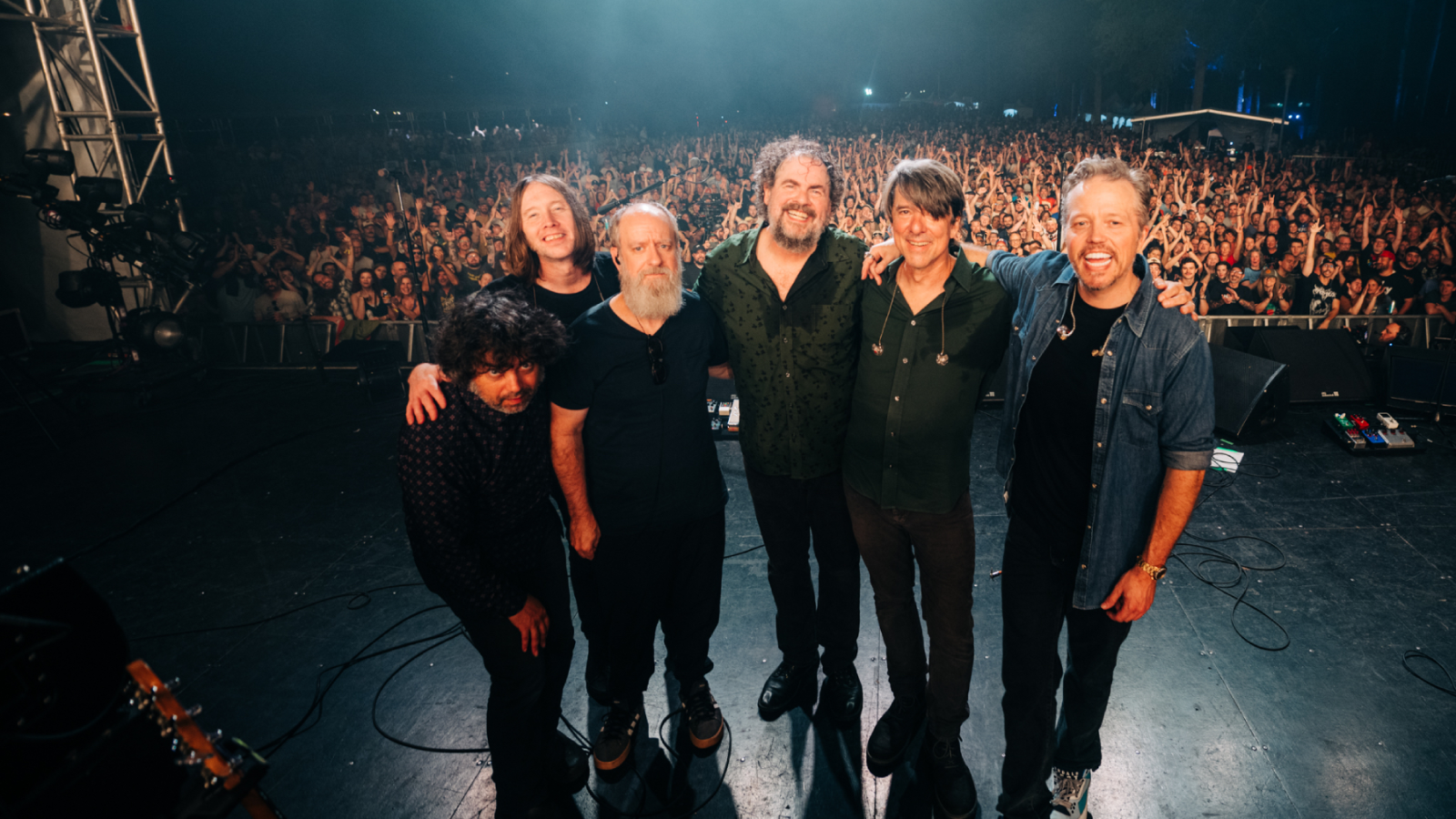
“Y’all ready, motherfuckers?!”
Patterson Hood flashes an exuberant, devilish smile to likely the largest hometown crowd of his career as he trades an acoustic guitar for his horned Gibson SG, an instrument much better suited to the menacing riff he’s about to play.
The final chords of opener “The Deeper In” have barely receded before the Drive-By Truckers erupt into “Sink Hole,” Hood’s barn-burning screed of a man pushed to extremes to save his family farm from an unscrupulous banker. Inspired by the 2001 Ray McKinnon short The Accountant and the loss of the farm where he grew up in northwestern Alabama, the song sets the tone of the band’s 2003 album Decoration Day.
Before launching into “Sink Hole,” though, Hood addressed the man standing stage right who is responsible for the third guitar onstage tonight: Jason Isbell. “It’s a family reunion,” Hood says, pointing to the secret weapon of the band’s early-aughts classic era, who was fired from the band in 2007 and clawed his way into sobriety and then found success with his fourth solo album, Southeastern, in 2013.
Saturday night’s one-off performance at the Isbell-curated Shoals Fest in Florence, Alabama, is not only the first time Isbell has been onstage with the Truckers for a full set since his dismissal, but also the first time they’ve played Decoration Day in its entirety (the 2002 acoustic set featured on The Definitive Decoration Day box set has every song except “When the Pin Hits the Shell”).
Twenty-three years ago, Drive-By Truckers were riding a crest of critical acclaim for Southern Rock Opera, the two-disc concept album that put the band on the national map, when they dropped their fourth album, Decoration Day.
Arriving three months into America’s second Iraq war, when the national attention was concerned with overseas calamity, Decoration Day sharpened the focus on those trampled by decades of a domestic agenda that further enriched the wealth class and resulted in the loss of millions of middle-class blue-collar jobs.
But the people left behind by Reaganomics and NAFTA weren’t entirely forgotten (“Ain’t waitin’ around for the trickle down!” Hood repeated on Saturday in the closing bars of “Sink Hole”). Hood, Cooley, and new arrival Isbell wove their tales of divorce, suicide, classism, and generational family violence and trauma into dark dramas punctuated by caterwauling guitars and biting lyricism that gnashed at the facade of post-9/11 American unity.
“I thought that was a heated political time then when we made that record,” Hood says, reflecting on the division of the era. “It was like, ‘God, we all hate fucking George W. Bush with a passion.’ I thought we’d hit rock bottom. They couldn’t be worse than this — which scares the shit out of me saying that now, because how much worse could it get?”
A month away from the midterm elections of Trump’s second term, the president’s approval rating has dropped below the so-called “Bush line” that marked the cratering of his approval rating to 39 percent before a blue wave swept Democrat majorities into Congress during the 2006 midterms.

Drive-By Truckers perform with Jason Isbell at ShoalsFest 2026. Photo: Josh Weichman*
As America steams headlong into November, working-class folks are still at loggerheads with its political class. The themes of division recurring throughout the runtime of Decoration Day — opposition and conflict between families in the title song, classism in “Heathens,” and general malaise in “Hell No, I Ain’t Happy” — reflect the sentiment of Americans with its elected leaders and one another.
“Decoration Day, as an album, is one of those documents of American protest that will never not be relevant,” says Wright Thompson, a friend of the band whose 2024 New York Times bestseller The Barn: The Secret History of a Murder in Mississippi inspired the as-yet-unreleased Truckers song “I Never Heard of Emmett Till.” “The struggles of the people in these songs were the struggles of our great-grandparents and will be the struggles of our grandchildren.”
Musically, the album showed the band evolving beyond the Southern-rockisms of Opera, drawing upon contemporary influences like Centromatic and Steve Earle as well as heroes who recorded in their hometown. Check the Rolling Stones swagger of Cooley’s “Marry Me” and Hood’s “Do It Yourself” — a distinction not lost in the place where Jagger, Richards, and Co. tracked parts of Sticky Fingers (which fans can relive in tours of Muscle Shoals Sound Studio and Caution! Stones Ahead, billed as the largest public exhibition of Stones memorabilia).
Another source of inspiration behind the album’s songs are the characters populating the grit-lit novels of Southern writers like Larry Brown, who was in the audience of some early Truckers shows they played in Oxford, Mississippi. Although Hood never met him, he was a fan of the empathy Brown exhibited writing about rural people whose limited resources and family histories drive their decision making, much like the characters on Decoration Day.
For writer and musician Michael Farris Smith, who cites the album as a source of inspiration for novels like Desperation Road and Blackwood, the themes still resonate. “I’ve spent most of my life thinking, ‘Okay, give us another 5 or 10 years, or another 5 or 10 years, or another 5 or 10 years,’ and here we sit with the exact same issues with the exact same dying towns and the exact same things being neglected that have always been neglected,” he says. “Decoration Day could come out tomorrow, and it would be as timely as it was in 2003.”
But like the ShoalFest performance, the addition of Isbell is perhaps the most obvious difference between Decoration Day and the band’s three previous albums. “Outfit,” in which a father cautions his son not to forget his roots, is still a mainstay in sets with the 400 Unit today, while his other contribution, a fictionalized account of a deep-seated family feud, gave the album its title and symbolizes the broader divisions of a nation at odds with its past, present, and future.
“It’s happened over and over again, and I’m still writing about that stuff because I’m still trying to figure it out,” says the Truckers’ co-frontman Mike Cooley. “Twenty-three years ago, we thought we were on the brink of moving past some of the darkness and some of the division, only to be pulled back into it. We were writing [2016’s] American Band thinking we were coming out of the thing that we got pulled back into with a vengeance.”
After concluding their performance of Decoration Day, which also included the deep cuts “Uncle Frank” and “TVA,” Hood introduces “World of Hurt,” the closing song on A Blessing and a Curse, their final album with Isbell.
“I wrote this song during some of the darker times of our band, and it sure feels good to get to play it in front of all these beautiful, smiling faces at this beautiful park,” he says, “with all of us still alive and well and kicking.”
The Truckers left the stage to one of the night’s biggest rounds of applause — every bit as full-throated as the cheers that met Isbell’s headlining set with the 400 Unit, and perhaps rivaled only by Isbell’s “Dress Blues,” a tribute to a local classmate who was killed in Iraq in 2006. As Trump’s war of choice in Iran eclipses seven months with no end in sight, the crowd of thousands roared as Isbell intoned, “What did they say when they shipped you away to fight somebody’s Hollywood war?”
Daniel D`Amico for SANREMO.FM