
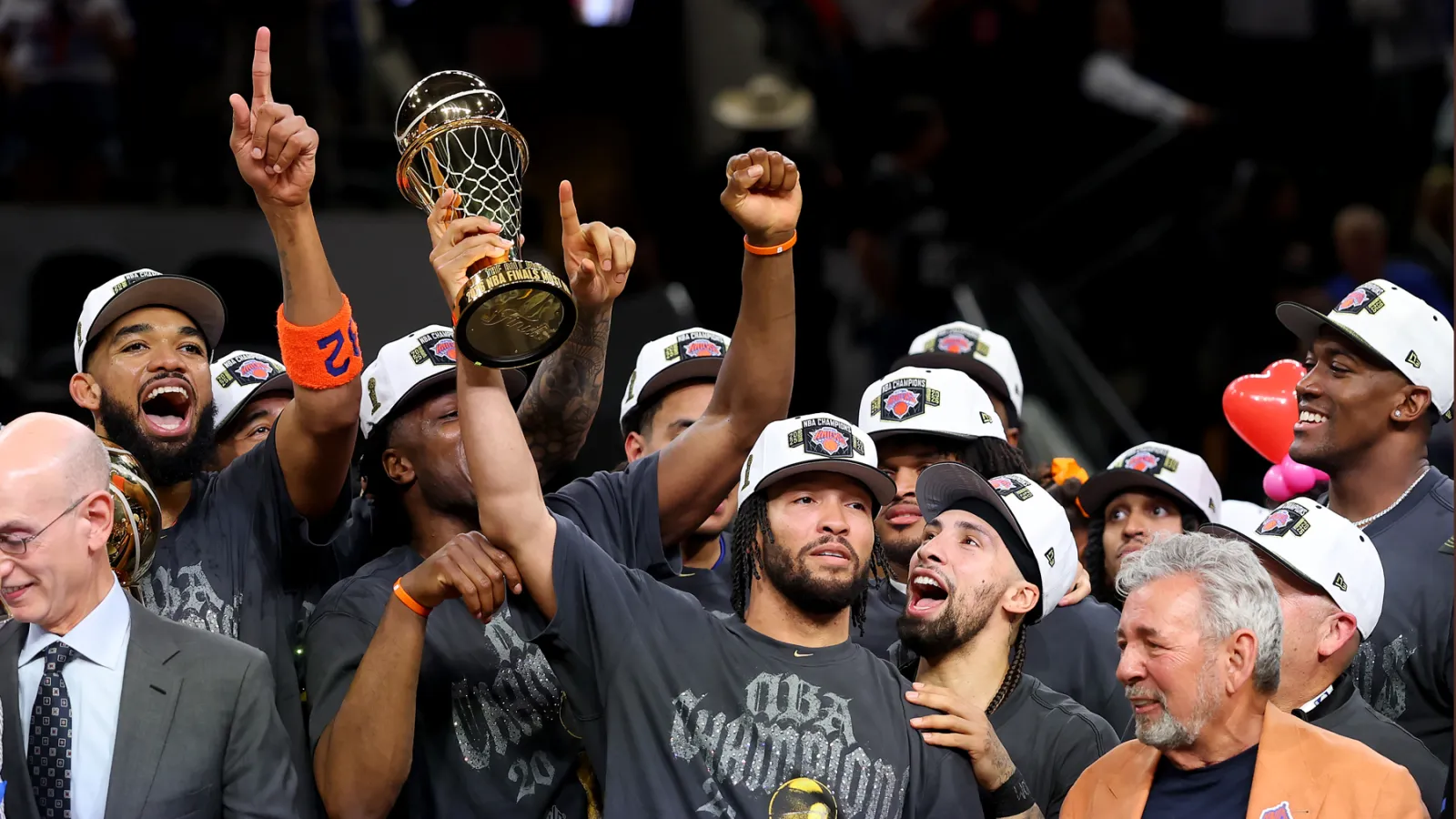
Time and again throughout these NBA playoffs and especially during the championship round, we witnessed Knick point guard Jalen Brunson, the smallest player on the court, produce a miracle. At crunch time, often down by double digits in the score, he would inevitably exert his will and find a way to lead his team to victory. Sometimes it was through his shooting three-point bombs, at others he was attacking the basket, spinning through defenders to find some impossible angle off the glass. His determination and stoic unflappability were always the difference. The opponents would crack, and the Knicks, led by Brunson, somehow always rallied.
Brunson is not particularly fast. He's generously listed at six feet two. He's got hops but didn't dunk once during the playoff run. His game is decidedly below the rim. He's all skill. He creates space where there is none. He dives and darts, and then stops on a dime and hits a three. The difficulty of what he is able to achieve sometimes gets lost in the fact that he keeps doing the impossible.
During the finals, the Spurs tried to push Brunson around. They watched him the length of the court. They handchecked, bumped, and pressed him. They sent different defenders, taller guards to try and get the Knicks captain out of rhythm. They knocked him down repeatedly. Brunson's demeanor hardly ever changed. He adjusted. And when it mattered most, the Spurs simply couldn't stop him. In reflecting on their defeat, the Spurs' seven-foot-four center Victor Wembanyama highlighted Brunson's ability to control the game.
Control is what makes for greatness. Basketball is a game of flow state, constant movement, and spacing of players and the ball — within 24 seconds, what a German philosopher might call being in time. In the last 50 years of the sport, there have been those one-named players who, at times, have had that total control: Magic, Bird, Jordan, Kobe, LeBron, Curry to name just a few. They would consistently take over the flow of the game and nothing their opponents did could really stop them. You could feel that determination with Brunson. During Game Five, when the Knicks, down big, began to come back once again, Brunson attacking and attacking the Spurs' defense, the younger San Antonio team lost their grip and victory felt almost inevitable.
New York is a tough town for athletes, the pressures immense. Last year, the Knicks fell in the playoffs to the Indiana Pacers, who staged a miracle comeback of their own. The Pacers, too, sent wave after wave of bigger guards to push Brunson off his spots and disrupt the Knicks' flow. Surely that painful lesson helped Brunson weather the Spurs barrages. He'd done this before and failed. When asked, after winning the championship, about having to come back each game from double digit leads, Brunson mentioned his “belief” and a willingness to “fail.”
In fact, his whole life had been in preparation for this moment. His father, Knick assistant coach Rick Brunson, had been the 12th man on a Knicks team that reached the finals in 1999 and lost to the Spurs. You can watch videos of the father and his young son drilling online, rep after rep, shot after shot in endless repetition. Jalen would go on to win a state championship in high school. He then won two college championships at Villanova and now the NBA finals Most Valuable Player award putting him in the rare company of Michael Jordan, Magic Johnson, and Kareem Abdul-Jabbar and a handful of other NBA legends. When the Knicks traded for Brunson, more than a few NBA commentators said he was too small to win an NBA championship with, that he was a liability.
I have been a Knicks fan my entire life. In grade school, you could go buy a ticket for less than $20 and go watch the great Bernard King from up in the blue seats of Madison Square Garden. There were the Patrick Ewing years and two runs to the finals. In 1994, I was traveling and watched the devastating loss of Game 7 on tape delay, already knowing the painful outcome. In 1999, I spent my last dollar to watch, with an obstructed view, from the top row of MSG, as the Spurs closed the Knicks out in Game Five. Decades of mostly mediocrity and worse followed. Former Knicks coach Pat Riley once said, “There's winning and misery.” Knicks fans know all about the misery part.
There's a certain intangible quality that New Yorkers always embrace: grit. The ability to get knocked down and rise again. Maybe it comes from all the concrete, maybe it's a strange aspect of being so close together on the subway and streets, shared spaces where at any time one's character might be exposed and put to the test. Or it could be the shared calamities we New Yorkers have faced together over the decades. Whatever the case may be: This town will always embrace effort and toughness.
My wife, who has gamely suffered through my Knicks fandom, recently bought me a Brunson hat that I've hardly removed during the Knicks run. On the side there's a quote from Brunson that sums up what he and his Knicks are all about. It reads: “The Magic Is In the Work.”