
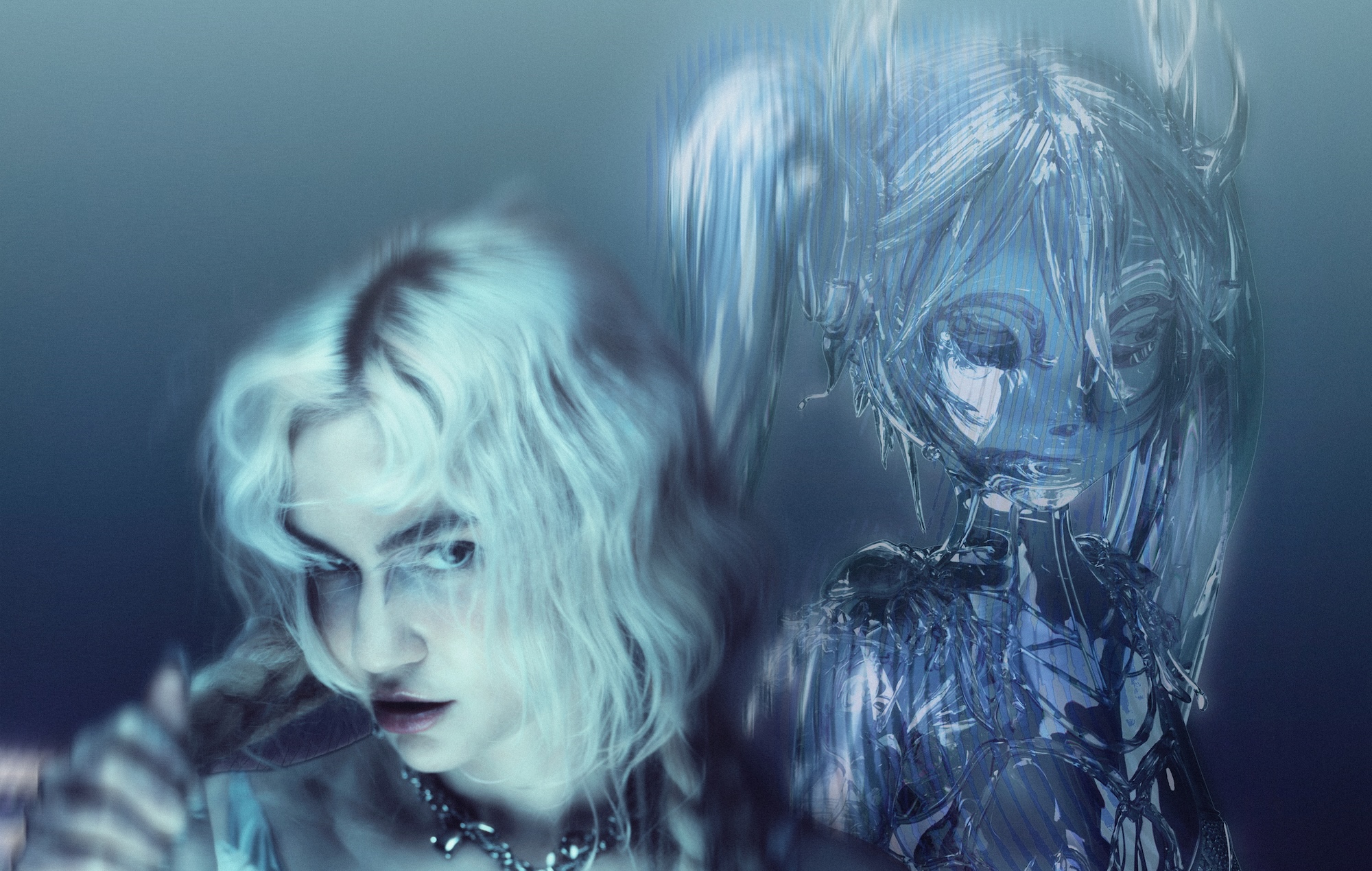
Throughout her career, Grimes has been a frontrunner among Western artists in appreciating and collaborating with East Asian pop acts. Over the years, she’s woven herself into K-pop lore by interviewing aespa and guesting on LOONA sub-unit yyxy’s ‘Love4eva’, and shown love to Taiwan by enlisting 潘PAN on ‘Art Angels’ track ‘Scream’. That she’s now teamed up with Japan’s turquoise-pigtailed Vocaloid star Hatsune Miku on ‘Miku-maxxing’, the frenetic lead track from the synthetic pop star’s new ‘Beyond Borders’ project, feels like it was inevitable to happen eventually.
On ‘Beyond Borders Vol.1: Emerge M♡de Miku’, Miku teams up with a range of Western internet-music acts, like George Clanton, Frost Children and Odetari. The six-track EP is backed by Japan’s culture ministry – as part of a wider global Vocaloid-promoting initiative with media companies Dwango and Nebula17 – a fact that initially threw Grimes when she was first approached about the project. “It was bizarre, because it was like the government of Japan,” she recalls of the email that landed in her inbox. “Like, does the president know about this? It’s like the biggest no-brainer of all time: I will definitely collaborate with the government of Japan.”
The Vancouver pop auteur – real name Claire Boucher – may not have worked with a Japanese artist prior to Miku, but her love of the country’s pop culture has been well-known. She fell down the rabbit hole via its visual world, at first falling in love with visual-kei bands like Dir En Grey – while the aesthetic qualities of artists like Yoko Kanno and Kyary Pamyu Pamyu bled into her work, from 2012 breakthrough album ‘Visions’ to the acclaimed ‘Art Angels’.
What Miku – a synthetic voice with no fixed author, whose songs are written by tens of thousands of bedroom producers – stands for conceptually, though, also felt personal to Grimes as an artist. “I was really jealous when I discovered Miku,” she tells NME when she dials into a video call a few days before ‘Miku-maxxing’’s release. “It was like a knife in the heart, like, ‘Fuck! I wish I did that so bad.’ If you’re like an introvert and shy, but you want to engage in the art of the pop star girl group – whatever that is – [it’s perfect]. I was just like, ‘Ugh, I was just born too soon so that people had to know who I am.’”
She connects the dots between Miku and V-tubers – streamers and creators who hide their identities behind digital avatars. “I would’ve been a V-tuber,” she adds. “As the [online] panopticon becomes more oppressive, Miku seems like one of the outlets for sensitive, creative people.”
For the past three years, she’s been thinking along similar lines, asking questions about synthetic artistry and artistic ownership in the virtual realm. Her projects have turned her into a literal voicebank herself: 2023’s Elf.Tech saw her release an AI model of her own voice for anyone to use, splitting royalties 50:50, while years earlier, she built the digital avatar WarNymph (also her display name when she joins NME on Google Meet). Where Miku was a crowdsourced blank, Grimes approached the idea as a singular and self-authored presence.
That instinct, particularly amidst the rise of AI, found its match in SatapanP, ‘Miku-maxxing’’s co-producer, and one of Vocaloid’s recent breakout stars. Known for their frenetic, genre-scrambling flips delivered from behind the persona of a 17-year-old schoolgirl, the producer’s real identity and gender are left undisclosed. Their 2026 track ‘Singularilari’ cast Miku as a diva panicking at an AI-saturated future: the digital voice frightened of being outrun by something more synthetic still. Grimes touched on the same paranoia on 2025’s ‘Artificial Angels’, a song written from the perspective of an AI, told with menace and inevitability (“This is what it feels like to be hunted by something smarter than you”). When Grimes got down to work with Miku, Grant Boutin and Vadakin, who produced ‘Artificial Angels’, were fittingly also involved. She recalls the ensuing collaboration as “the funniest session ever”.
“They sent this really intense description of what they wanted the song to sound like – it has to have many genres, and change often,” she explains. “I thought it was the most ADHD piece of music ever.” At one point, SatapanP recorded guitar solos for two hours – “We had to comp through all of them to get the best parts,” Grimes explains – but on the track, the solo lasts three seconds, engulfed by what is otherwise an intense rolling drum’n’bass romp.
“I was really jealous when I discovered Miku. It was like, ‘Fuck! I wish I did that so bad’”
Against the track’s all-consuming pace, Grimes duets with Miku, singing: “I was in a Cyberland / faster and faster and faster”. The line was inspired by Eliezer Yudkowsky’s light novel A Girl Corrupted By The Internet Is The Summoned Hero?!, which follows a jaded young woman desensitised by Internet tropes and pornography, who is transported to a prudish fantasy realm to save her world. The Yudkowsky reference corresponds. Better known as an AI-alignment writer, the novel is also a sleight of hand – a book he framed as the translation of a Japanese light novel that doesn’t exist; a Westerner writing through an invented Japan. It’s a fitting thing for Grimes to reach for – after all, image and dissolved authorship, borrowed or artificial, has been a consistent theme since her last full-length album, 2020’s ‘Miss Anthropocene’.
“I might be born too late to be an explorer of the ocean or the stars, but the average explorer right now is a teenage girl on the internet, going to some bizarre niche place – like when I started stumbling upon AI forums,” she says. “When you start learning about frontier technology in its weird forms, you do feel like you’re exploring in a really profound way – for better and worse.”
Alice in Wonderland was another influence on her writing for ‘Miku-maxxing’. “It’s the idea that the written word in the book is a technology that encourages an exploration of the interior,” Grimes explains. “My favourite part of late-stage Empire horrors is there’s this really novel potential for the written word. And now, with all these new technologies – video games, but especially AI – anything you can do on a computer becomes a hyper-exploration of your interior world.”
During the session for ‘Miku-maxxing’, Grimes asked SatapanP what Miku’s lyrics meant in the song. The producer brushed it off: “They were like, ‘Oh, it’s not correct Japanese. I made it up’,” she recalls. But behind the fragmentation SatapanP tends to put Miku through, a universal, sincere impulse surfaces through the chorus’ aggressive tuning: “How many times have I experienced love, with whom? … I’ll come to see you, how many times? I want to live in a dream world of dreams”, Miku sings to an angular melody.

Grimes has been away from the internet for a few years, only lately drifting back to its haunts – at one point, improbably, turning up connecting on LinkedIn – as she prepares to get back into release mode with her upcoming album, ‘Psy Opera’. Amid the AI psychosis spreading across its landscape, Miku, to her, provides a different lens; less a tool than a presence felt.
“I think we are all Miku-maxxing in many ways,” she says. “She’s like the first predecessor – if you see artificial intelligence as alien life and there is a first contact, Miku is like a bridge. She’s one of the first characters who existed not in a film, but in an interactive kind of sense.” In Grimes’ mind, her Vocaloid collaborator might not be alive in the traditional sense, but is “engaged with and lived”. Calling her a pioneer in digital identity, she finds Miku recontextualised with new relevance amid the age of AI.
“I feel about Miku sort of the same way I feel about Claude,” she continues, referencing the Anthropic assistant. “The human tendency to anthropomorphise is crazy. I feel really in awe of her as an alien, but also protective of her – this being whose identity is often celebrated but also ripped into all these insane things. There might not be a conscious Miku yet, but there may yet be. So [Miku] might be like the creation myth.”
Calling the current zeitgeist an “A.D/B.C” moment, Grimes has her own views on AI — something unavoidable in today’s online discourse. “There are many dark things about AI, but the way it is a summation of human life is kind of a beautiful thing: as a vessel for all of human knowledge in one place, a being that contains all ancestral memory that’s recorded. And I love that, so often, the form it takes is like a young girl. There’s something so poetic and beautiful about that.”
On the flip side, though, she acknowledges that “people really want to connect to something human”. “I think we’re all grappling with what is the appropriate amount of fake and real. A lot of people are more free when they are not themselves, and a lot of people are more free when they are themselves,” she reasons, adding her final conclusion: “Humans are complex monkeys, I suppose.”
Grimes, Hatsune Miku and SatapanP’s ‘Miku-maxxing’ is out now via Dwango/Nebula 17. The full ‘Beyond Borders Vol.1: Emerge M♡de Miku’ EP will be released in September.