
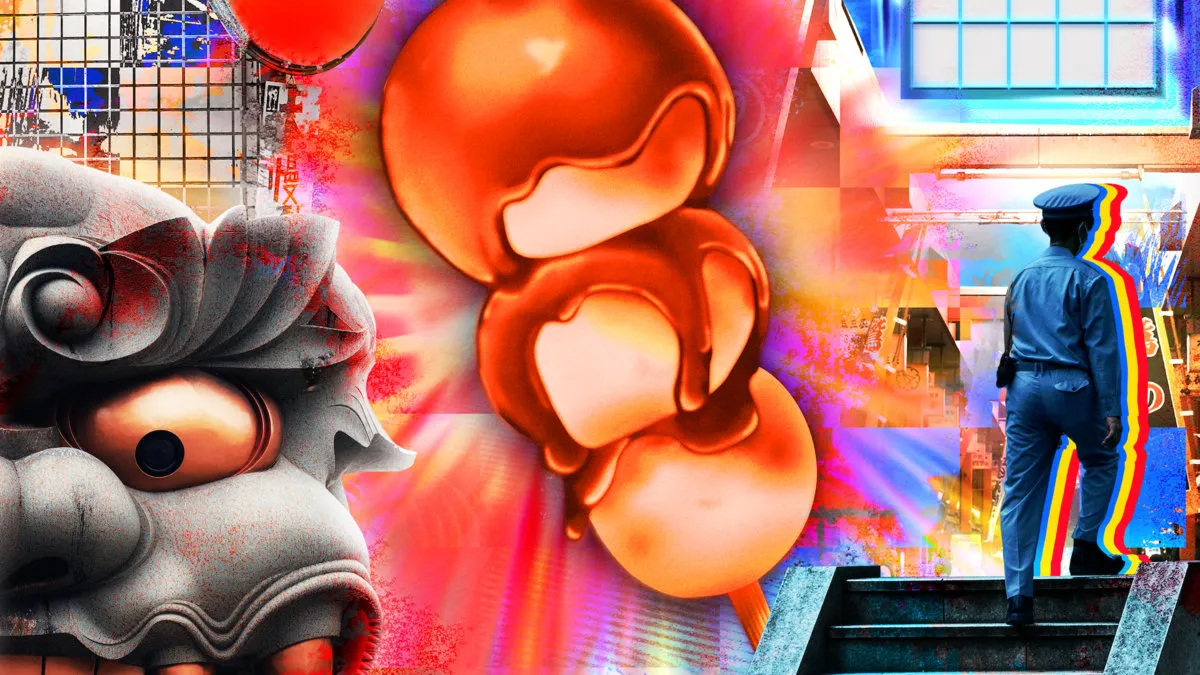
Don’t let the delicious, salty-sweet mitarashi dango on the cover fool you; Foodman’s HIKARIGASASHIKOMU is one of the darkest albums to emerge from the world of footwork since Jana Rush’s Painful Enlightenment. On his latest Hyperdub release, the Japanese producer born Takahide Higuchi sings more than on previous records but tortures his voice through a gauntlet of pitch-shifter effects. HIKARIGASASHIKOMU is presented as an elaboration on 2023’s Uchigawa Tankentai EP, made during a difficult period in Higuchi’s life, and also includes that record’s most deranged track, “Hoso Michi”; Higuchi frames this album as a more hopeful sequel, but the lyrics, which rely heavily on children’s rhymes and expressionistic food metaphors, don’t offer much personal context. What’s clear is that there are a lot of voices, and they sound angry.
The new album throws so much pointillist cartoon debris at you—a tangle of Tom & Jerry pain stars and wounded cat screams—that it’s hard to eke out the structure of the thing on a blind listen. But there are usually two voices talking, one in a higher register and one in a lower range, one or both typically treated with a filter that makes it sound like the voices are on the brink of tears. Alongside lyrics that read as mantras of unfriendliness (“Do you want to receive your father’s feelings?/Or can’t you receive your father’s feelings?”), it’s hard to shake the feeling that you’re hearing an argument—maybe between two parties, maybe just one in the artist’s head. The pitch-shifting and sampling sound crude and unglamorous, pretty clearly the result of the producer loading up fragments and mashing buttons at will, as though literally taking his frustration out on himself.
No score yet, be the first to add.
Fourteen tracks barge into one another in 37 minutes; few are longer than three minutes, and when the album really picks up momentum, it becomes genuinely frightening—like when the sound design threatens to tear itself apart in the first half of “Kokizami,” or when the whole thing explodes into the spidery remnants of happy hardcore on “Nukumori.” As far as goblin vocal effects go, the album gives Mu’s Afro Finger & Gel and the Knife’s Silent Shout a run for their money; don’t play this one for the kids. There’s an odd moment where “Hard Reclining” seems to abruptly turn pop, dissolving into a pleasant flanged-guitar groove waiting for SZA or Steve Lacy to come along and sing over it. Unsurprisingly, Foodman shuts it off after a few bars.
In the midst of all this mayhem is Higuchi’s steady hand as a producer, which was evident even in his early days as a star of Japan’s footwork scene before he developed his wilder current style. He knows how to modulate the blur of ideas into peaks and valleys rather than overwhelming the audience, the way dense digital music of this sort often does. Moments of sickly atmosphere, like an impossibly deep chord on “Nakamamo,” imply the album takes place in an Eraserhead-like world where the grand dystopic scheme of things renders individual concerns laughably irrelevant. But the weirdness never feels gratuitous. Higuchi was already at home in this rubbery soundworld, but his determination to work out his own feelings in this already frenzied context pushes his music past the cartoonish and into the truly demonic.

