
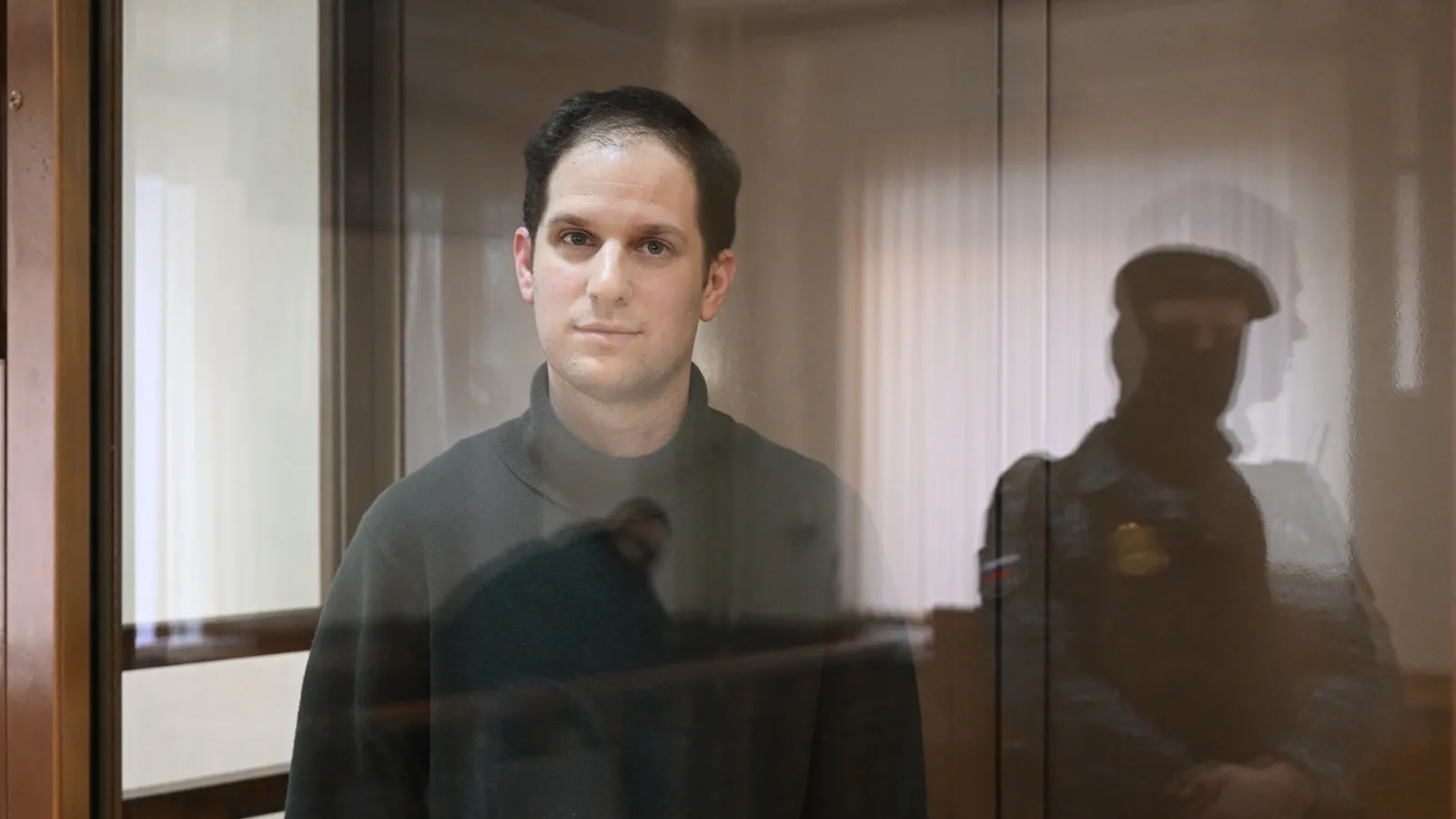
Evan Gershkovich had worked for The Wall Street Journal for a little over a year when he was arrested for doing his job. Gershkovich had moved to Moscow six years before, a young journalist hoping to parlay his familial knowledge of Russian and interest in his parents’ homeland into a career as a foreign correspondent. He was successful — but at a terrible cost.
In 2023, while reporting on the Russian private military company Wagner Group, Gershkovich was arrested by agents with Russia’s security services and accused of being a spy. His trial, and subsequent detention, was one of the most dramatic media stories of Russia’s invasion of Ukraine. Gershkovich spent 17 months in jail, much of it in Moscow’s notorious Lefortovo Prison, before he was freed as part of a political prisoner swap in August of 2024.
This Cursed Beautiful Land, in bookstores now, is Gershkovich’s account of his extraordinary path through international journalism and an era-defining conflict launched by a country that is an indelible part of his family history and personal identity. In this exclusive excerpt, Gershkovich describes the surreal environment of solitary confinement at Lefortovo, reckoning for the first time with the possibility that he could spend the rest of his life behind bars.
***
The first thing I registered was the music. It was soothing, upbeat — soft rock, perhaps from the mid-2000s. After the song came a jingle. “Relax FM,” a smooth baritone male voice announced in accented English before switching to Russian, “for calm and happy thoughts.”
My thoughts weren’t exactly calm or happy: The door to cell number 40 had just slammed shut. As I took in my new surroundings, I heard the clank of metal keys in the lock behind me, the dead bolt sliding into place with two noisy turns.
I ducked my head under an overhang and stepped into a snug space. About twelve feet long, eight feet wide. At its highest point, the concave ceiling rose about eleven feet above the cement floor. Since I’m exactly six feet tall, the cell could fit two of me lying down from end to end and just more than one of me lying across.
But that’s if the cell was completely empty. As I would learn, two measurements really mattered: the width of my shoulders and the length of six or seven steps. Along the right side of the cell attached to the floor was a twin-size metal bed, perpendicular to which ran another bed frame at the far end. Despite the second bed, I was alone in the space. On the left side of the cell was a small tabletop bolted to the wall; underneath was a bench, and above, two cabinets, which were metal like the bed frames. In between all this, one adult person could take a short stroll up and down the length of the cell.
There were other amenities, too. Near the entrance, at the foot of the first bed, was a medium-sized white refrigerator, on top of which lay a black remote control for a small TV hanging from the wall above. Across from the fridge — on the left side of the cell — were a stainless-steel toilet bowl and matching sink, with a small rectangular recessed mirror. A beige tiled partition — a kind of short, elbow-high wall — offered a smidge of privacy for the toilet user.

At the far end of the cell, above the second bed, was a large window, which opened inward and was left slightly ajar. The glass was opaque, so I walked over and pulled the window in a little more to peek out. I could see bars and, beyond them, a courtyard with what looked like storage sheds. Above the large window was a smaller one, a flat rectangular slit. The glass of this window was clear, and through it, I could see more bars and behind them the darkening sky.
I turned around and looked toward the entrance to the cell. Above the overhang — where I had ducked to enter — was a camera with a glowing red dot in a protective glass covering. Below it was what looked like a vent, out of which flowed the jolly music. At the bottom of the vent was a small knob, which I could just about reach. I wasn’t sure whether I was allowed to turn it, so I didn’t.
Suddenly, a slot on the cell’s iron door flew open, revealing a large peephole. An eye looked right at me, and then the cover shut, swinging back and forth slightly like a pendulum before falling still. About ten minutes later I could hear feet shuffling down the hallway along with the jingling of keys. The peephole opened again. An eye appeared once more. With time, I would learn to recognize the eyes of each guard checking in on me, six times an hour, more than a hundred times per day.
I’d been given a thin but firm mattress, which I tossed on the far bed. I had also been provided stained off-white sheets. A felt blanket. A lumpy pillow. Two small towels. A thick polyester prison robe (the clothes I was arrested in, I had been told, were being disinfected). A pair of scratchy underwear and socks (to complement my own, which I had been allowed to keep). A small undershirt that barely covered my belly. A pair of leather boots. A metal bowl, plate, mug, and utensils. Toilet paper. A toothbrush and toothpaste powder. A bar of soap. Two plastic tubs (one bright yellow, the other bright red). And two rags. I asked what the latter were for. “For cleaning the cell,” the guard, who wore a camouflage blue uniform, told me. “We don’t want to live in filth, do we?”
Lefortovo was something of a contradiction: It was Russia’s most notorious prison, reserved for the highest-profile inmates — both Russian and foreign — but it also had the best conditions among Russian detention centers. My cell seemed to confirm that. It looked as if it had been recently renovated. The floor was clean, a smooth orange-red gloss of paint over concrete. The walls were a dull mustard yellow until halfway up; closer to the ceiling, they turned off-white. Two lights hung from the ceiling: a bright fluorescent bulb and a duller, yellow light contained in a matte glass cage.
I had gotten lucky: I had made it to Lefortovo around four in the afternoon on a Thursday. There was no better time to check into the prison. Thursday is shower day for men. (Women get to shower two days a week — on Tuesdays, too.) Before settling into my cell, I had been allowed to stand under hot water for fifteen minutes. The running water had soothed my aching body and emptied my mind, as if it was taking a rest ahead of all the thinking it would do in the coming days. It was a pleasant surprise that the water was hot and the pressure strong, but the fifteen minutes flew by. The shower cell had two showerheads, meant for a pair of cellmates. I wondered if I would soon have one. I had not seen a single other prisoner on my way to the showers and then the cell, following orders that were barked in rapid bursts.
I didn’t have books or anything else with which to entertain myself, so I turned the television on and the volume up to mask the soft rock that continued to play from the radio. The first channel that came on was Rossiya-1, one of Russia’s main state TV channels. It was half past five, and the 60 Minutes political talk show had just begun. The name 60 Minutes was, of course, borrowed from the storied TV newsmagazine in the United States, which frequently airs investigative reports about national security and social issues. The Russian version was nothing like that. It was a propaganda spectacle meant to convince Russian viewers that their neighbors in Ukraine were Nazis. Masked with a title copied from the West, the show’s rhetoric could be presented as legitimate, under a facade of normalcy. That day, however, the main topic wasn’t Ukraine. It was me. The show was playing a clip from the American cable news channel MSNBC, where a journalist I knew was discussing my case. I shuddered. I was someone who reported the news, not a person who appeared on it. Now I was firmly in the public spotlight, my position in life flipped upside down. There was nowhere to hide. I quickly turned off the screen.
An hour or so later, I heard a cart rolling down the hallway. Keys jingled when it approached. A guard opened what I would learn is called a kormushka — a feeder, or trough — a small square window in the door about the size of a human head. The feeder dropped down at a 90-degree angle, becoming a flat surface across which everything from meals to letters to parcels would be passed. Through the opening I could see a guard standing off to the side and, up front, a man with the bulbous red nose of a drinker. Dressed in a chef’s uniform, he had with him a large pot of porridge and a tray of boiled fish. He filled my bowl with the porridge, placed a piece of fish on my plate, and asked if I wanted tea, bread, and sugar. Maybe it was the rancid smell of the fish and the sliminess of its texture, or maybe it was the weak tea — water with a few leaves floating around in the mug — but after dinner was when the reality of my new surroundings slammed into me.
I curled up in bed on my side, my knees pulled to my chest. My hands were still numb from the hours spent in handcuffs — there was a cut on my left wrist where one had dug in — and I rubbed them between my thighs, trying to get the feeling back into them. As I did, my body became tense and my anxiety grew, my thoughts ricocheting inside my head.
Courtesy of Penguin Random House
Earlier in the day, I’d had a comforting one: They’ve taken me for a swap, I told myself. That’s all this is. I’d written about this kind of thing plenty of times over the years. Trevor Reed had come and gone; so had Brittney Griner. There was always someone or something Moscow was trying to get in return for an American pawn.
But now, lying in the fetal position, I thought, What if it won’t be that easy? Paul Whelan, who had passed through Lefortovo after his arrest, was still stuck in a Russian penal colony more than four years later. My situation was exactly like his: a deliberate setup, not an opportunistic grab. Had Pavel been working for the FSB all along, or had he been pressured into cooperating on my entrapment? Either way, I now could clearly see that he had knowingly helped get me arrested.
How, I asked myself, could I have possibly trusted him and gone to that second meeting? How did I not see it? How could I be so naïve? “You can’t tell the story if you’re dead,” a colleague had once told me, and now I thought of a coda: You can’t tell the story if you’re in prison either.
Another thought followed: What if the FSB really does think I’m a spy and wants to make an example out of me? It’s wartime, after all. Maybe they don’t want to swap me at all. Maybe I really will spend twenty years here.
I began to count. I’d be fifty-two when I got out, a broken man without a wife or kids. Would I ever see my mother again? She’d be eighty-seven. If she was even still alive. The thought of her contemplating this same cruel math, with her son fated to spend years in a prison cell in the country she had chosen to leave, was wrenching. In that moment, I felt like I had done something unspeakably cruel. I remembered Naama Issachar’s mother, whom I’d met in 2019 in Moscow, where she’d come from Israel to be close to her daughter after her arrest on drug charges. She presented a powerless figure but still carried herself with dignity. I had held her hands while we spoke, unsure of what comforts I could offer, wanting to give her some strength. I yearned for someone to do that with my own mother now, too.
“Doigralsya,” I said to myself out loud. The Russian word literally means “You’ve played your way into trouble.” Or, perhaps more ac-curately, “Boy, you’ve really fucked up now.”
At some point the feeder opened again. I turned to see a man peering in. “Come here,” he instructed.
I complied without thinking — an automatic response to the countless commands that would come to punctuate my days. I walked over and crouched down, looking out into the hallway. The man was wearing white scrubs. “Read and sign this,” he said, placing a piece of paper and a pen on the open feeder. The paper contained a statement saying that I understood smoking was bad for my health. That was a fact with which I indeed agreed: I had quit on New Year’s in Berlin three months earlier. Now, though, I really wanted a cigarette. Struggling to hold the pen with my numb hand, I signed the paper and passed it back. “Thanks,” said the man in the scrubs, his breath reeking of tobacco.
I went back to my bed, this time turning toward the wall. A while later, the feeder opened once again — I’d lost track of time; a couple of hours must have passed — and a guard peered in. “Otboy,” he said. Lights out.
Translated that way, though, the statement wasn’t accurate: Only one of the two lights had turned off. The one in the cage — seemingly protecting the bulb from inmates unscrewing it — stayed on, leaving the cell bathed in a dim yellow haze.
Also, the music hadn’t stopped playing. I tapped on the door. The guard came back and looked through the peephole.
“That one always stays on,” the guard said, pointing to the dim light in the cage.
“What about the music?” I asked. But he was already walking away. I wrapped one of the two towels around my eyes. The room went dark. Yet the cheerful tunes played on. I thought of the movies I’d seen in which music is used as a form of torture, typically heavy metal. A friend had also once told me that while pledging for a fraternity at an American college his classmates had to listen to Eiffel 65’s “Blue (Da Ba Dee)” in a basement for twelve hours, and while they laughed at first, they had nearly lost their minds by the end.
There was a square European-style light switch above the fridge and below the television. “If you need anything, press the signal,” a guard had said earlier. I thought it might be a buzzer, so I pressed it on and off a few times.
The guard came back. “I see the signal,” he said. “You just need to press it once, and then when I get here, you turn it back off.” (Later, I saw that the switch turned on a red light above the door of the cell on the outside.)
I was almost yelling now. “Will you turn off the music?” Calmly, the guard said, “Look up.”
There was the small knob I’d noticed earlier. I reached up and twisted it. The music stopped.
“Thanks,” I said to him sheepishly.
Excerpted from This Cursed Beautiful Land by Evan Gershkovich. Copyright © 2026 by Evan Gershkovich. Published in the United States by Crown, an imprint of the Crown Publishing Group, a division of Penguin Random House LLC.
Daniel D`Amico for SANREMO.FM