
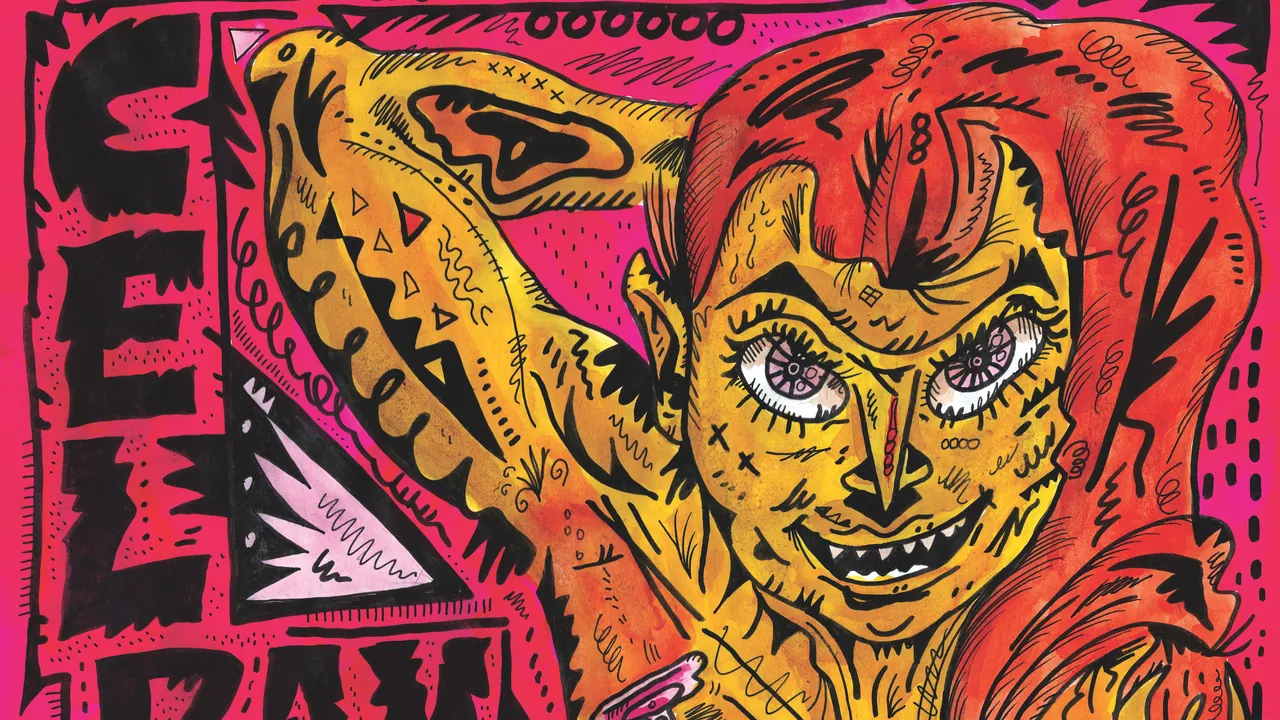
Modern post-punk’s yappiest frontmen leverage comedy like it’s a pillar of the genre: sardonic vocals as an auditory plot device, parody as critique, roasts of their fellow man as feminist credentials. That’s all well-intentioned and fine, but it rarely coaxes an actual laugh out of me. But when Cel Ray frontwoman Maddie Daviss resorts to comedy, it seems to come from an entirely natural place. Like fellow Chicago-reared women whose wit pours forth from diminutive frames, Daviss is loud and loose in a literal sense, with limbs that swing around onstage and a voice that carries without a microphone. It’s as if she was born ready for vaudeville, though it doesn’t hurt that she honed her instincts in improv comedy classes.
In Cel Ray, Daviss hollers about purse dogs and mall misfits while trotting around thrusting her hips, kicking her legs in the air, and hunching over with knocked knees. Even without the visual aspect of a live performance, she’s wildly entertaining, and on their first few releases—2023’s Cellular Raymond and Piss Park—she was the reason why Cel Ray stood out from the egg-punk pack. Three years later, her bandmates match her speed on Cel Rayzer, their debut full-length album, to push both their energy and her comedy forward.
No score yet, be the first to add.
Guitarist Josh Rodin, bassist Kevin Goggin, and drummer Alex Watson rattle with carbonated fizz on opener “Gotta Get Away,” the track sloshing in erratic directions as if it’s a can of the unappetizing novelty soda the band lifted its name from. Rodin reaches farther on the shelf for underutilized chords and dissonant combinations, varying Cel Ray’s approach to post-punk by dirtying his sound: the spastic strums in “Chitty Chitty Bang Bang,” his trip hazard pacing of “Teen (Cult) Song.” That variation hits a sprawling peak with “Snake’s Maw,” in which Cel Ray tackle the rare slow number with the flair of a cool-headed stoic accepting the demise of everything around them.
As her bandmates poke and prod at familiar sounds from fresh angles, Daviss continues her oddball musings: Why does nobody carry pens anymore? How come only detritus gets to experience the sensation of being wadded-up in a pant pocket? She’s a clever lyricist when targeting strangers, like the husband dying to spoil his wife who can’t manage his gasoline budget, but Daviss earns twice the laughs when mocking herself. On “Toxic,” she skewers her inability to make healthy choices and her desperation to be clever with a withering self-own: “Thought I’d be so smart/Because I was when I was young.” Earlier on Cel Rayzer, with a voice teetering between nasal and shrill, Daviss admits she compulsively craves gossip about the “nasty details” of your aunts and uncles. Her justification borders on an explanation for Cel Ray’s existence: “We have so much time/We have to fill this void with noise.”
Cel Rayzer was five years in the making for the Chicago punks, and its material is a worthy introduction to their music, especially in its ability to convey their droll live shows. You can practically hear Daviss push her oversized glasses up the bridge of her nose while flailing on a stage. After she spends minutes stomping around demanding sweets on “Treat Economy,” admitting that she only toils through work to get to the good stuff, Rodin’s sugary power chords downshift into the weighted chugs of a hardcore breakdown and Daviss snaps her head back: “But what? Wait, what the heck? Is this a trick?” It’s a simple bait-and-switch, but the gag lands perfectly thanks to everyone’s evenly matched efforts. Humor comes organically when you’re surrounded by a reliable creative springboard.