
If, earlier in her life, Beth de Araújo had tried to write about what she saw on a Sunday morning in Golden Gate Park, she thinks it might have been a poem. Or perhaps a series of poems, interlinked by the trauma of witnessing something horrific at such a young age. Maybe, the filmmaker wonders aloud over a Zoom call, if she had attempted to process it “50 years from now or something,” it might have been a painting. What Araújo knows is that, shortly after graduating from film school at the AFI conservatory in 2013, the story seemed to present itself as a series of scenes in her head. And even though she had never set out to mine her memories of the incident in any sort of creative fashion, Araújo had been feeling a need to wrestle with her thoughts and feelings about the decades-old incident. It suddenly felt like it was time to get this pivotal moment in her formative years down on paper.
“I just started with running in the park,” Araújo says. That was something she and her father, a former Olympian for Brazil, did most every weekend when she was growing up in San Francisco. That particular day, they had just parked their van when they heard a scream. Beth was told to wait as her dad went to see what was going on. In real life, the youngster would eventually leave the car to find out what was happening. In the “vomit of vignettes” that Araújo was writing, the eight-year-old girl had simply sprinted in front of her dad and ended up in a secluded woodsy area. What both the filmmaker and her fictional counterpart on the page saw, however, was the same: a half-naked woman in either her late twenties or early thirties, who’d just been sexually assaulted.
From there, Araújo began writing down everything else she remembered about the aftermath of the assault, waiting in the police car with the woman (“the only scene that’s exactly to my memory still”), the way her father started playing soccer with her, “trying to pretend nothing had happened.” The next day, she added a few more details: her dad being told he’d have to testify, overhearing that the man had plead not guilty — how could he plead not guilty?! — and finding out that he’d been released on bail. Araújo didn’t feel she had anything resembling a narrative, much less a screenplay, yet. But somehow, she knew that this personal experience would be at the core of something she felt she had to make. It was all filtered through the perception of an eight-year-old girl. And that girl would be named Josephine.
Nearly 16 years passed between the day Araújo started writing that first draft to seeing variations of those memories play out on a huge screen in front of a large audience. But her movie Josephine recounts a version of this traumatic event — and how the emotional fallout affects the youngster and her parents — in a way that feels as if the wounds are still fresh. Centered around an absolutely stunning performance by newcomer Mason Reeves as the title character, and costarring Channing Tatum and Gemma Chan as Josephine’s parents, the film took home both the Grand Jury Prize and the Audience Award after its premiere at this year’s Sundance. Now playing in select theaters and set to open wide on December 4th, Araújo’s sophomore effort already feels like a milestone in terms of dealing with the ripple effect of sexual violence. Rarely has a work felt so simultaneously scarring and healing at the same time.
“I remember when I was working on that initial draft, I wasn’t really sure what it was about yet,” Araújo says. “Once I started on a second draft and I’d begun pitching Film SF for a grant, I was able to say that ‘It’s about my fear. It’s about fear in general.’ Once you come to understand what male violence is, and how it changes the way you see the world… .” She trails off for a second, before continuing. “Part of the struggle with PTSD is the hypervigilance. My friends would think I was paranoid when I’d say, ‘You have to stand in front of this door while I use the bathroom.’ But it’s hard to tell what is irrational fear and what is rational fear when someone’s seen evidence that their fear is real. Something in me needed to explore that.”
Araújo researched the topic, sat through an assault trial “from start to finish in the courtroom; I wanted to get a sense of what this woman had to go through afterwards,” and kept working on drafts. She began sending her script out, and endured dozens of polite “Thank you, but no’s.” Araújo kept developing other projects, but the idea of turning Josephine into a movie never left her. Around 2019, she got a call from Gemma Chan’s agent. The Crazy Rich Asians actor had come across a copy of Josephine, and the story struck a chord with her. She really wanted to talk to Araújo about being involved with it.
“‘I know you don’t want to meet with her because you think she’s too pretty — I’ve heard you say that to other agents.’ Which, y’know, was true,” the director admits, laughing at the recollection. “I was struggling with casting a someone who was a genuine movie star, because I wanted this feel very grounded. But she said, ‘Please meet with Gemma, just once.’ And look, when an actor is really talented and ready to give you 5,000,000 percent, and wants to make something as much as you do?” Araújo shrugs. She took a meeting. The two talked for hours. Chan agreed to come on as a producer as well as play the mother. Both of them were now pitching it around town for months on end. The No’s kept on coming. Once Covid hit, what little momentum the two had built up fizzled out.
“Because I couldn’t get Josephine up and running, and I was so devastated, I had shelved it for a while at that point. It had just broken my heart too many times,” Araújo says. She talked about what she saw as a kid on an episode of the Moth podcast, but still hadn’t fully got it out of her system. In an effort to get more experience as a director under her belt and do something — anything — that reminded her she was still a moviemaker, Araújo put together a feature that she could shoot quickly in very few locations. The result was Soft & Quiet, her 2022 debut that followed a group of small-town Neo-Nazi Karens as they planned a hate crime. Just to add an extra degree of difficulty, Araújo decided she’d film the whole thing in one continuous take. It was, by her own account, a stressful shoot. But the movie got into SXSW, and proved to many folks — not least of all, herself — that she could handle the pressure of a chaotic production. “After you shot a film in one continuous take, everything else is easy,” Araújo jokes.
The reception to that film opened doors, but Josephine was still proving to be a hard sell. Araújo didn’t want remain idle, and began casting for another potential projects. That brought her into Zoe Kravitz‘s orbit, and the two hit it off. At the time, the actor was editing her directorial debut Blink Twice, and was soliciting Araújo for notes. One afternoon, Araújo began describing this movie she’d been working on for close to a decade. “My partner jokingly calls it my swan song, because I’ll never get this made until the very end of my career,” she recalls saying. According to Araújo, Kravitz replied, “Well, Channing wants to work with you, so I’m sure he’d do it.”
“Channing” was, of course, Channing Tatum, the Magic Mike star and Kravitz’s boyfriend at the time. It turns out he’d seen Soft & Quiet, and had been blown away by it. They met, she described Josephine, and Tatum said he was all in. Araújo still wasn’t sure she wanted to risk having the project break her heart yet again. “I sat on this offer for three months,” the filmmaker admits. “I’m not sure why. Maybe it was the whole ‘movie star’ thing again. But at a certain point, I just stopped myself and thought: You have another extremely talented actor who wants to take a chance on this, he responded strongly to the material, and is willing to gain 30 pounds to get a dad bod for this. You fucking idiot! If Channing Tatum wants to be in your movie, you fucking put him in your goddamn movie, Beth!”

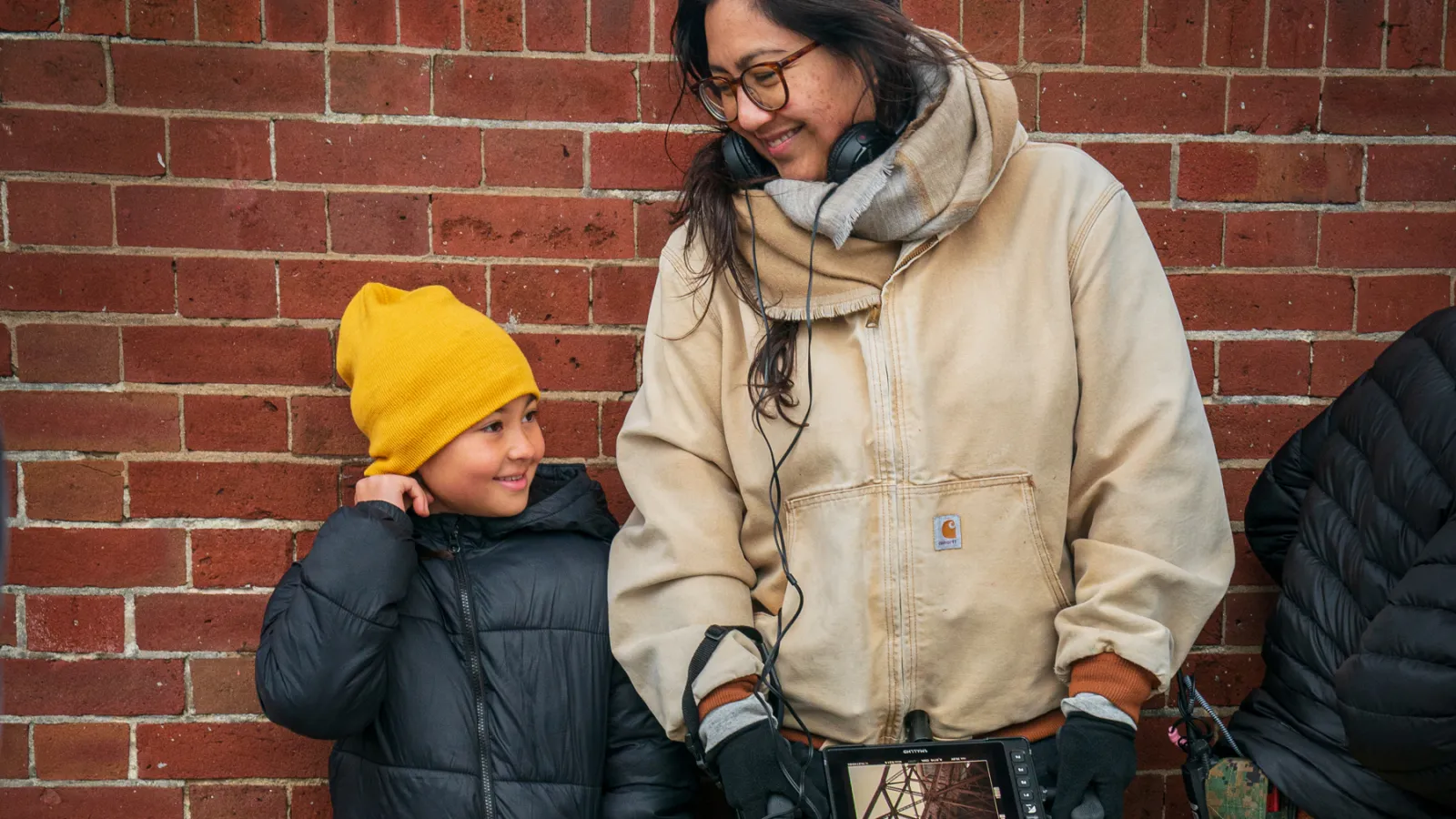
Channing Tatum, Mason Reeves and Beth de Araújo on the set of ‘Josephine.’
Stefania Rosini SMPSP
Once Tatum became involved and Chan once again circled back, Araújo was able to procure financing — and Josephine was now looking like it would finally get made. Now all they needed was a new Josephine. Araújo had been working with a young actor during the initial rounds of pitches, but that person had now aged out of the role. She had to recast the part.
It was around that time that Araújo had returned to San Francisco to visit her family, and happened to stop by the Clement Street Farmer’s Market one weekend. She saw this eight-year-old girl whiz by her with a bag full of dates in her hand. Something about the kid struck Araújo immediately. “You could tell she was sporty,” the filmmaker says. “You could tell that she was zipping around this busy farmer’s market with ease. And then I noticed she was half-Asian, and thought: She could definitely by the love child of Channing Tatum and Gemma Chan.” She asked the girl, whose name was Mason Reeves, if she could talk to her parents. Mason reluctantly brought Araújo over to meet her mom and dad.
“The whole time I was talking to them, telling them that I was a filmmaker, and that this was a legitimate thing, Mason wasn’t saying a word,” she says. “But her eyes were glued on me. She was listening to every word we said, soaking it all in. I could tell just from watching her that she was sizing me up.” When Mason sent in an audition tape, Araújo recalls thinking, “Ok, you have my attention. And then every single time we asked to read with her, it just became clearer and clearer that she was the one.” During their final meeting, the director asked Reeves to do an improvisation: think about someone who’s really hurt you, and if you could say anything to them, what would you say? Reeves put her head down for 30 seconds, then looked up at Araújo with an expression of rage and screamed, “Why would you do that?” The role was all hers.
As Araújo and her cast began rehearsing, she began taking extra steps to make sure that Reeves’ participation would take place in a safe psychological space for her underage actor. In lieu of reading the script, Reeves memorized her lines with her help from her parents. Her reaction shots to some of the more intense scenes were filmed separately. Both Tatum and Chan went out of their way to make sure their costar was protected on set, as well as creating a strong family dynamic off-set; Tatum reportedly got a manicure-pedicure with Reeves and sat in on several of her after-school jujitsu lessons. When it came time for Araújo to give directions to Reeves, “it was a lot of: faster, slower, hotter, colder. Or ‘Oh, let’s remember this other time in your life when this boy beat you on the monkey bars. Let’s actually shift the emotion to thinking about that.’ She was great at reacting naturally to whatever Gemma and Channing were doing as well. I just feel very lucky to have found her.”
There’s a pause. “You know, I wrote, financed, shot, edited, premiered and sold Soft & Quiet in 11 months. It took me almost 11 years to get Josephine made. I’ve now had the gamut of experiences in the industry, and the reception to the film has been even bigger than I could have imagined. So I feel lucky in more ways than one.”
But does she feel a sense of catharsis through making Josephine? There’s a longer pause. Araújo has, unsurprisingly, been asked a variation of this question several times over the past 10 months. After taking a beat, she brings up the fact that the survivor of the assault testified in her attacker’s trial. Araújo was not forced to do so. In the film, however, Josephine must testify as a witness when the woman refuses to do so.
“I’ve only started thinking about it this week, to be honest — the question of: Why I did end up having Josephine testify?” she notes. “I think it’s because I wanted to say what my truth was of this day. Just having the opportunity o saying, ‘This is what it was.’ It has haunted me forever that [the attacker] plead not guilty. I couldn’t wrap my head around the idea that, based on everything I had seen that day, everything I heard that day, that he could possibly think of himself like that.
“And I think it was just somehow my way of saying like, ‘No this is what my truth was of that day,’” Araújo continues. “And however much it will or will not affect me moving forward — and it will come in waves — I can say this is the first year I have slept through the night in some fashion. So that is certainly huge for me, you know. And I think it does have to do with the fact that I have made this now. I’m putting this out in the world, and now the experience is kind of coming to a close.”