
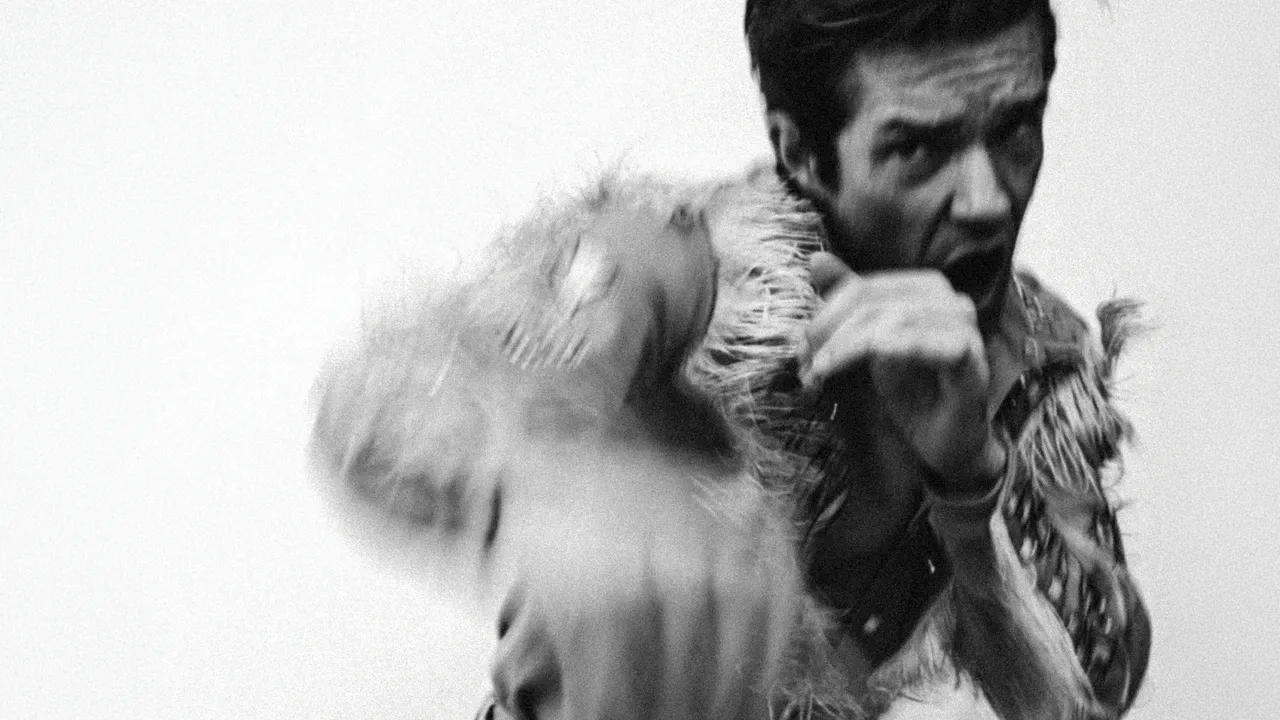
At the risk of damaging my aura of critical distance and credibility, I confess to occasionally wondering whether Brandon Flowers might be the most important man alive. My affection for him goes beyond “irrational”; I have 20-year friendships predicated on the joy of making fun of him and the belief that he must be protected at all costs, like an endangered panda. I felt this fierce love surge last month, when Flowers released an “album trailer” video for his third solo album and first-ever country record, THRASHER. For mortals, a press release about the genre switch would suffice; for Flowers, only a tracking drone shot of the sun-baked American desert would do, his voice-over intoning: “Walt Whitman said it best: ‘I am large; I contain multitudes.’ Well, I’m larger than I was 20 years ago.”
The only thing funnier than this—if, indeed, anything could be funnier than this—is his need to reassure his audience that this doesn’t mean he’s abandoning rock’n’roll, like parents breaking the news of their divorce to very small children. Imagine if Tom Holland spent every press junket this year explaining to bewildered interviewers that the reason he was able to play both Spider-Man and Telemachus in separate movies is because he is an actor, and thus able to embody different characters. It is this extra-terrestrial sincerity, as much as his clarion voice, or all-anthems songwriting, that sets Flowers apart, makes him special.
No score yet, be the first to add.
To the surprise of probably no one, these attributes carry over beautifully into the work of country songwriting. Flowers decamped to Nashville, hired producers Shawn Everett and Jonathan Rado, whose work excels at mimicking the textures of older records, and recruited a band full of session-pro ringers. But the songs on THRASHER work all by themselves, the same way good Killers songs work: You give yourself over to them, in all their gaudy enormity and pure-hearted grandeur. Flowers’ “country” singing voice is a revelation, pitched at a barrel-chested mid-range that makes him a dead ringer for Waylon Jennings. Flowers’ voice also carries some of Waylon’s wry, bear-hug generosity, that warmth that always makes his music feel like good company.
But Flowers’ songwriting gestures—skywriting-sized, aimed at football-stadium cheap seats, several degrees removed from human interaction—suggest a different country icon. Garth Brooks, with his apple-cheeked grin and lunar relationship to the idea of “cool,” represents a far more likely spiritual predecessor for Flowers than anyone from the outlaw-country ’70s. Consider “Plans,” one of THRASHER’s advance singles. The shuffle that the band kicks up feels note-perfect, in part because it’s the product of decades of muscle memory: That’s David Rawlings on guitar, legendary pedal steel player Bruce Bouton, and Charlie McCoy on harmonica, who played on Bob Dylan’s Nashville records. Flowers’ voice glints like sunlight off a Ford truck’s chrome sideview mirror. It sounds so good, and so convincing.
And then you notice the gentle derangement happening inside Flowers’ lyrics, which seem to understand “regional specificity” as the only marker of country lyricism, and maybe the only attribute. Here’s how the first verse opens: “The pond is fed by July melted snow/That we watched fall from January windows/In our homeroom class, teacher wondering how the hell they wound up here/So far from the plans they drew up years ago.” July melted snow, January windows, homeroom teachers—do you think Brandon Flowers has finished zooming in? He has not. The next 45 seconds manage to mention a three-lane highway headed south, a “desert wind,” and “the thunder of the all-you-got engine always bound for the big show”—until you cry “BINGO!” or “uncle,” whichever comes first. If Flowers wrote “Jack & Diane,” we wouldn’t just get the Tastee-Freez; we’d get the exit ramp number, the population of the neighboring town, maybe the number of napkin dispensers on the countertops.