
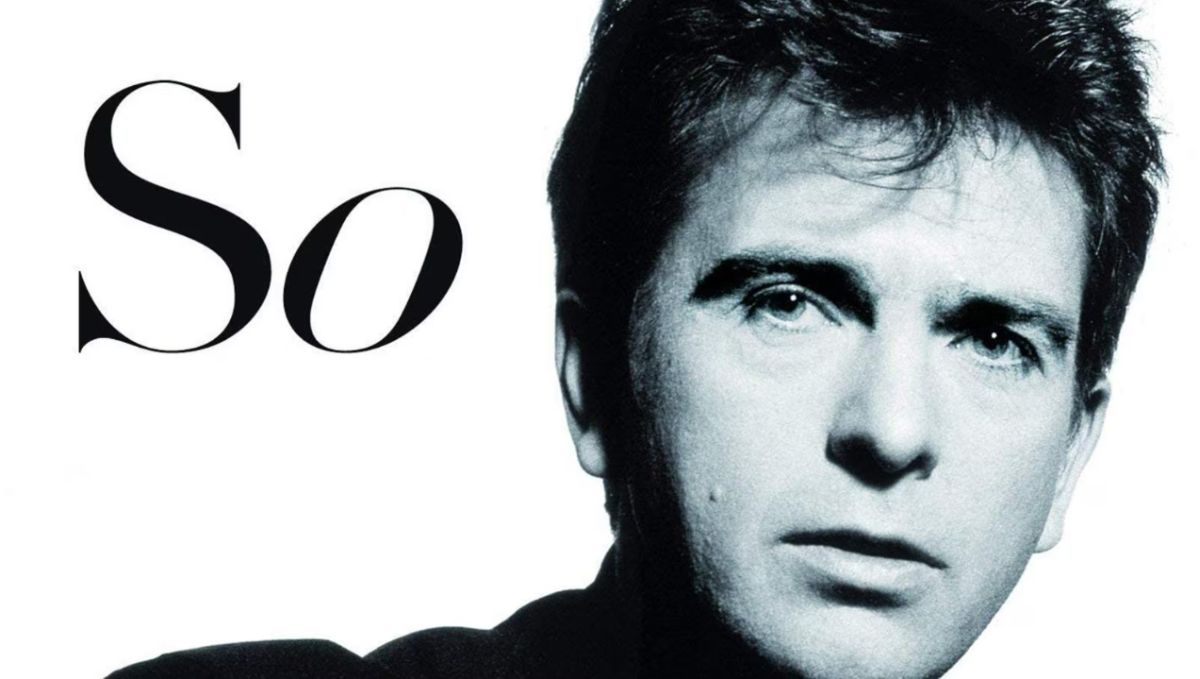
Thursday 30 July, at 11.45pm, on Rai5, Peter Gabriel talks about the genesis of the album “So”, released in 1986, in a documentary directed by George Scott. Considered his most successful work, as well as his most musically accessible, “So” transformed Gabriel from cult artist to international superstar. The album received unanimous acclaim from specialized critics, being praised for its sound and fusion of different genres, and was nominated for the Grammy Award for album of the year.
Who knows if it was also the “Collinsmania” that raged in the mid-eighties that pushed Peter Gabriel towards pop. What is certain is that none of the ex-Genesis would have ever expected overwhelming success like the one that the drummer-singer from Chiswick was achieving in that period, with a mass of hits produced continuously (“In The Air Tonight”, “You Can't Hurry Love”, “Easy Lover”, “One More Night”, “Against All Odds”, just to name a few). “Who would have ever imagined it”, will be the ironic comment of bassist Mike Rutherford. In short, the success of the tireless drummer, with whom – as we have seen – Gabriel had also collaborated as a soloist, risked overshadowing the ex-leader of those Genesis that Collins himself was ferrying in those years towards unsuspected pop-rock shores. And so the UK press and public enjoyed stirring up a competition between the two. Without even imagining, however, that in the end, knowingly or not, Gabriel would actually descend into that ring. Landing a technical knockout blow.
Having overcome a difficult family phase – between an intense relationship with the actress Rosanna Arquette and marital therapy to piece together the pieces of the relationship with his wife Jill – the English artist dedicates himself to the launch of his fifth album, which will also be the first to have a real title, albeit without a particular expenditure of letters. Only two: “I know”. “An anti-title… it could be more of a piece of artwork, rather than something with meaning and intention. And that's what I've done ever since,” Gabriel will explain, renewing his distaste for record titles that, in his opinion, would take the eye away from the cover images. An apparently unpretentious title, therefore, which however reflected the particular intensity that the English composer had lavished on the new project, after having done everything possible to resolve his personal problems.
As Things went well, therefore, in the year 1986, for the English musician. That is, as always, continuing to demonstrate how the depth and originality of an artist are not measured only in his chosen field, but are a precious gift that can be expressed even beyond the most unpredictable frontiers.
Credited as a prophet of political rock and the most uncompromising world music, Gabriel thus begins to flirt with pop mainstreamsupported in the director's cabin by Chris Hugues and Daniel Lanois. “'Birdy' was a work essentially based on textures and sounds and this time I wanted to concentrate more on the songs, to be more cheerful and less mysterious – the English musician will tell us – I was coming out of a dark period and I had to try to open up to the world”. And he will succeed, crowning another of his spectacular transformations. Struggling with catchy, melodic, obsessively captivating pop songs, Gabriel will prove incapable of giving birth to banal and obvious products.
Moreover, to guarantee an aura of respectability to the album was already the patrol of guests and musicians involved, tangible testimony of Gabriel's credibility and charisma on the music scene of the time: the usual Jerry Marotta, Tony Levin, David Rhodes, the extraordinary French drummer Manu Katché, a horn section led by Wayne Jackson, and also L. Shankar, Richard Tee, Stewart Copeland (drummer of the Police), Kate Bush (already appeared, as seen, on “III”), Jim Kerr of Simple Minds and Michael Been of Cali (with whom he had already sung on “Everywhere I Go”). A prestigious team that will contribute to making “So” an album comparable in terms of depth of time and richness of language to Sting's contemporary “The Dream Of The Blue Turtles”.
In the meantime, Peter Gabriel continues to publish the songs that will be included in the next album “o/i”, expected in complete form by the end of the year. Gabriel places the piece within a broader path, linked to a parallel show he has been working on for some time: a narrative project focused on the brain as a conceptual fulcrum. “Put The Bucket Down” represents a passage in which the boundary between autonomous thought and external influence becomes uncertain, questioning the very origin of ideas and consciousness. On a musical level, the piece was born around what the artist defines as an “unbalanced loop”, an irregular rhythmic structure that found full expression in his work with the band. During the orchestral sessions, Gabriel involved John Metcalfe for an essential and minimal part, while the wind instruments take on a central role thanks also to the contributions of Paolo Fresu in the studio and Josh Shpak in the live performances.
The English musician's new recording project arrives as a direct sequel to “i/o” (2023) and takes up its conceptual approach: this time too, in fact, Gabriel will release a song every full moon, until the release of the complete album expected by the end of the year.
Presenting the album, Gabriel said: “I'm happy to say that tonight, with the full moon, we start a new year of monthly releases under the name 'o/i'. The songs are a collection of thoughts and feelings. I'm thinking a lot about the future and how we might react: we are entering an unprecedented transition phase, probably triggered by three main waves, artificial intelligence, quantum computing and the brain-computer interface. Artists have the task of looking into the fog and, when they glimpse something, to hold a mirror. We are not and have never been totally self-determined, independent beings who have been given free reign over the world. We are something else, we are part of nature, a part of everything, and feeling some connection, moving our butts and giving and receiving a little love can help us find our place, and put a big smile on our faces,” added Gabriel.
The English composer then summarized the relationship between the two albums as a sort of complementary diptych: “i/o” represents “the inside that finds a new way out”, while “o/i” is “the outside that discovers a new way in”. A reflection that broadens to a less individualistic vision of the human being, understood as an integral part of nature and of a broader whole, in which emotional and physical connection becomes a tool for finding one's place.
Some of the new songs, he added, will flow into the “brain project” that Gabriel has been carrying out for years, while others are born simply from the desire to convey joy. “I hope you like them,” he concluded.
In a different context, Gabriel also recently thanked director Josh Safdie for including his song “I Have The Touch” in the film “Marty Supreme,” starring Timothée Chalamet.
Daniel D`Amico for SANREMO.FM