
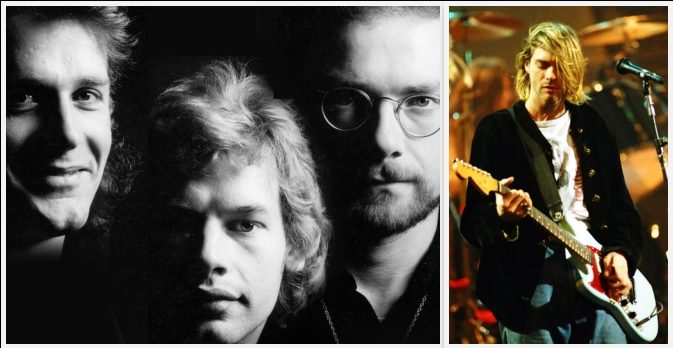
It has been repeatedly underlined on these pages how absurd the contrast between prog and punk sounds (see also this in-depth analysis). But the long progressive wave reached even further, touching the frontiers of one of the dominant genres of the 90s: Seattle grunge. An elective affinity that can be summarized in a special bond: that of Kurt Cobain with King Crimson, and in particular with their 1974 album, the revolutionary “Red”.
Red in the evening
Just forty minutes to demolish decades of future progressive clichés. “Red” is first and foremost this: the compendium of an entire season now in its twilight, but also an essential handbook for the rock of the future. The fertile hybrid that ridicules in one fell swoop all the lies about the supposed artificiality of prog as opposed to the genuineness of “street” rock'n'roll. No instrumental onanism, no mold: “Red” is modern and abrasive rock, in which even symphonism transforms into excruciating explosion.
It is not surprising then that Kurt Cobain was among his most fervent admirers. The Nirvana leader even went so far as to point to “Red” as the “greatest album of all time”. Not only that: Robert Fripp said that the record was found in Cobain's CD player after his death. Producer Butch Wig revealed the circumstance during a conversation with John Wetton, singer and bassist who played in King Crimson for three albums (“Larks' Tongues In Aspic” in 1973, “Starless And Bible Black” and “Red” IN 1974).
Beyond the anecdotes, however, the connection is above all musical: the influence of “Red” seems to resurface in the search for a physical, rough and anti-patina sound that would characterize “In Utero”.
Released in 1993, Nirvana's third and final album was also a reaction to the sonic perfection of “Nevermind” and the abnormal dimensions of its success. Cobain wanted to recover friction, noise, extreme dynamics, the feeling of a band playing without filters. Steve Albini's choice was decisive: huge and natural drums, guitars left to scratch, feedbackdistortions and violent dynamic excursions. “Scentless Apprentice,” with his riff monolithic and the drumming devastating by Dave Grohl, is perhaps the most obvious example; “Milk It” alternates between ghostly voids and explosions, while “Radio Friendly Unit Shifter” transforms feedback and noise in structural elements. Even behind the melody of “Heart-Shaped Box” and “All Apologies” there remains something rough and corrosive.
The departure from an era
This is where the imprint of “Red” becomes clearest. Naturally, this is not a mere musical reproduction – we are always on very distant coordinates – but rather a common conception of sound. Almost twenty years before “In Utero”, Fripp, Wetton and Bruford had already understood how modern a music built on this burning and abrasive tension could be. And it is precisely this modernity that makes “Red” an anomaly in the history of progressive music. King Crimson had contributed decisively to founding its imagery with “In The Court Of The Crimson King” in 1969: mellotron, dilated atmospheres, psychedelic echoes, improvisation and symphonic grandeur. Five years later Fripp seems intent on destroying that same language from within. The complexity remains, but it loses almost any ornamental character. Virtuosity does not disappear: it is bent to violence. Symphonism survives, but becomes threatening. And the guitar, instead of embroidering, hits hard.
The revolution was announced by “Larks' Tongues In Aspic” (1973) and “Starless And Bible Black” (1974), which showed Fripp's desire to undermine the dogmas of prog through an increasingly square, obsessive and percussive guitar playing. “Red” takes that process to the point of no return. Without completely dispersing the romantic and solemn inspiration of the first King Crimson, Fripp invents a sort of dry and sharp heavy-prog, destined to reverberate on the following decades.
A sonic concept sublimated in the twelve minutes of “Starless”, which summarize King Crimson's past and simultaneously surpass it. We start with the ancient enchantment of the mellotron, Fripp's poignant phrase and Wetton's sorrowful song; then the music empties and one of the most formidable constructions of tension in the history of rock begins. Fripp obsessively reiterates a minimal figure while bass and percussion accumulate pressure, until the explosion of the entire group and the final reprise of the initial theme, transfigured by the sax. Cosmic quiet and paroxysmal tension, romanticism and brutality find a definitive synthesis here.
Without dispersing the romantic and solemn inspiration that had made the fortune of the first King Crimson, therefore, the supreme leader Fripp operates yet another palingenesis, inventing a sort of heavy-prog which – at the risk of falling into the oxymoron – could be defined as dry, it is so harsh and sharp. Fripp confirms himself as a two-faced genius: on the one hand the cultured avant-garde who pursues an “artistic” perspective, on the other the rock musician who knows how to hit the listener in the stomach. Here then are the tools of the prog trade – violin, keyboards, oboe, mellotron – coexisting with the guitar assaults of an ensemble that has never been so aggressive, in a record that sounds like a black liturgy, with its disturbing symbolism (“red nightmare”, “fallen angel”, “bible black”…).
Two parables
“Red” and “In Utero”, moreover, also share a curious position in their respective parables. They are two terminal albums, made by groups who have reached a critical point in their history, and both react against what risked imprisoning them. King Crimson seemed to want to escape from the progressive music they had helped invent; Nirvana – and in particular their leader – tried to escape the lure of rock mainstream into which the success of “Nevermind” had catapulted them. In both cases the answer passes through the tightening of the sound and the rejection of smoothness.
When “Red” arrives in stores on October 6, 1974, King Crimson has already disbanded: Fripp decreed the end of the band a few weeks earlier. The album doesn't achieve great commercial results, but time will give it an immeasurable revenge. More than the testament of the prog era, it will end up becoming its definitive ferry to another era. The sky is starless, the angels fall and the King is about to take leave of his court. Yet “Red” speaks above all of the future: of the most oblique metal, of math-rock, of noise and post-rock, but also of that boy from Aberdeen (USA) who many years later would choose it among his cult records.
Daniel D`Amico for SANREMO.FM