
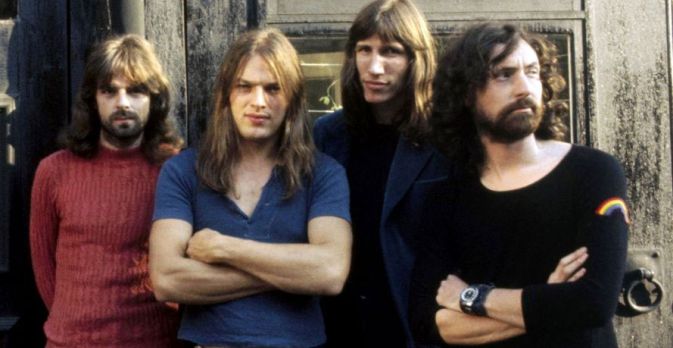
There's a Pink Floyd song that David Gilmour called practically “impossible” to sing. Not for the vocal range or for some particularly difficult melodic passage, but for a much more concrete reason: Roger Waters had written so many words that Gilmour simply couldn't manage them. That song was “Dogs,” the monumental 17-minute song that takes up much of “Animals,” an album released by Pink Floyd in 1977.
You've Got To Be Crazy
Written and composed by Waters and Gilmour, “Dogs” is one of the longest pieces in the band's repertoire and also one of the most representative of the phase in which the creative balance within the group was rapidly changing. His story, however, had begun several years earlier. The song was in fact born with the title “You've Got To Be Crazy” – often shortened to “Gotta Be Crazy” – and was already part of Pink Floyd's live repertoire in 1974, together with “Raving And Drooling”, the future “Sheep”. Both compositions were developed before “Wish You Were Here” and could have found a place on the 1975 album. Roger Waters, however, preferred to set them aside to concentrate the album around “Shine On You Crazy Diamond” and the other songs linked to the themes of absence, alienation and the music industry. A decision that Gilmour didn't particularly agree with.
The two pieces came in handy shortly afterwards, when Roger Waters conceived “Animals”, a much darker and more aggressive album, built around a ferocious representation of British society in the mid-70s. Freely inspired by the allegorical mechanism of George Orwell's “Animal Farm”, the album divides human beings into animal categories: pigs represent the dominant classes, sheep the passive and manipulable mass, while dogs are the careerists, the businessmen and the ruthless social predators willing to do anything to achieve success. This is precisely the figure told in “Dogs”: an individual who must learn to be cold, opportunistic, distrustful and ready to hit others before being hit. Social climbing becomes a form of training for oppression. But behind success inevitably lies loneliness: the “dog” ends up consumed by fear, old age and isolation, a victim of the same system to which he has dedicated his existence.
Musically, “Dogs” develops this atmosphere through a slow and detailed construction. The song opens with Gilmour's acoustic guitar and a suspended harmonic progression over which his voice enters. The initially almost intimate dimension is progressively contrasted by the interventions of the electric guitar, up to the long central instrumental section, dominated by synthesizers, effects and electronically processed dog sounds. The phrase “dragged down by the stone” becomes almost a mantra and introduces one of the most alienating passages of the composition. When the initial harmonic circle returns, it is instead Waters who takes on the role of singer, leading “Dogs” towards an increasingly harsh and threatening conclusion.
Gilmour's objections
But the part entrusted to Gilmour was initially much more difficult to interpret. Waters had written a text so dense that it was almost impractical from a vocal point of view. Gilmour remembered it this way: “Every now and then I'd find something uncomfortable to sing. The first set of words Roger had written for 'Dogs,' when it was called 'You've Got To Be Crazy,' was simply too long to sing. 'Dogs' had so many words that I physically couldn't fit them. In the end we cut out two-thirds of its lyrics to make it possible.”
The solution was therefore drastic: cutting a good part of Waters' words to allow the vocal line to breathe and adapt to the musical structure.
The episode reveals how “Dogs” was also the result of the meeting between the two main creative personalities of Pink Floyd of that period. Waters brought with him above all the conceptthe texts and the political vision; Gilmour contributed decisively to the musical construction, arrangement and sound identity of the piece. In “Animals” this balance still existed, but it was starting to become fragile. Waters was taking more and more control over the group's artistic direction, and the process would come to a head with “The Wall.” During the making of the 1979 double album, internal tensions increased until Richard Wright's departure, while Gilmour remained one of the few musical interlocutors capable of truly engaging with Waters, as demonstrated above all by the genesis of “Comfortably Numb”.
From this point of view, “Dogs” represents one of the last great examples of the Waters-Gilmour compositional collaboration before relations definitively deteriorated. It is a composition in which Waters' conceptual and polemical writing and Gilmour's melodic, guitar and harmonic sense coexist, within a structure that retains something of Pink Floyd's great psychedelic suites of the early 70s but at the same time anticipates the harshness and pessimism of the following phase.
The return in 2018
“Dogs” returned to the limelight with “Animals 2018 Remix“, a new version of the album made in 2018 and published in 2022 after a long gestation, also in 5.1 surround version. A new opportunity to rediscover one of Pink Floyd's most ambitious songs: 17 minutes of tension, alienation and virtuosity, born from a song that, in its original form, had so many words that it was, at least according to David Gilmour, physically “impossible” to sing.
Daniel D`Amico for SANREMO.FM
