
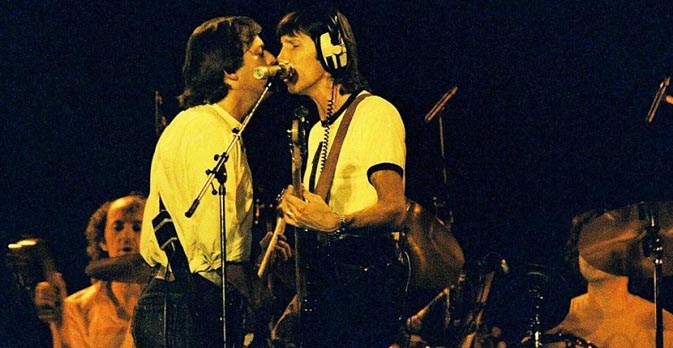
When Pink Floyd inaugurated “The Wall” tour on February 7, 1980 at the Memorial Sports Arena in Los Angeles, it was already clear that this would not be an ordinary concert. After all, “The Wall”, released a few months earlier, was not a simple album, but a monumental work in which Roger Waters had transformed his obsessions – alienation, the weight of fame, the increasingly conflicted relationship with the public and the trauma of Syd Barrett's absence – into one of the most ambitious narratives in the history of rock.
The tour, therefore, also had to sweep away all conventions. More than a series of concerts, it was a gigantic theatrical show, an immersive experience destined to change the language of live performances forever. A real wall took shape in front of the spectators, built brick by brick during the show until it completely separated the band from the audience, physically materializing the central theme of the work: the isolation of Pink, the rock star protagonist of the story. Lights, special effects, animations by Gerald Scarfe, a gigantic Stuka warplane crashing near the stage and a colossal set turned every evening into a total spectacle.
Waters' vision was born from the frustration he developed during the 1977 “Animals” tour, culminating in the famous episode in Montreal, when he spit at a spectator. “The creative drive of 'The Wall' arose from my growing restlessness and disillusionment with rock concerts,” he would say years later. From that sensation he came up with the extreme idea of building a wall between the artist and the public. Initially he even imagined symbolically “bombing” the spectators to make them part of the performance, only to abandon the project after the objections of manager Steve O'Rourke and the record company. In its place the famous Stuka entered the scene, destined to become one of the symbols of the show. “Rock was becoming greed disguised as entertainment, just as war became greed disguised as politics,” Waters explained.
From an economic point of view, the tour was making a loss even before leaving. The construction of the wall required hundreds of cardboard bricks, while sets, special effects and the impressive lighting system designed by Marc Brickman drove costs to unprecedented levels. Yet that very production effort transformed “The Wall Live” into a watershed in the history of live entertainment. For the first time a rock concert took the form of a total theatrical work, in which music, scenography, narration and technology were part of a single story. Many of the great stadium shows of the following years, from U2 to Muse, owe something to that revolution.
When fake Pink Floyd came on stage
The most surprising provocation, however, came even before the wall began to grow. When the audience listened to the first notes of “In The Flesh?”, it was not Roger Waters, David Gilmour, Richard Wright and Nick Mason who appeared on stage, but four unknown musicians, dressed like them and with disturbing masks reproducing the faces of Pink Floyd. They were a sort of “Pink Floyd surrogates”, called to impersonate the band in front of the spectators. Only with the next song, “The Thin Ice”, did the real Pink Floyd finally enter the scene.
The effect was deliberately unsettling: Waters wanted to force the public to ask themselves what was authentic and what was fiction, immediately questioning the very concept of celebrity. Those anonymous musicians represented the most superficial side of the entertainment industry: the mechanism by which the brand, the image and the myth risk counting more than the real people who embody them. Waters himself later joked that he would have preferred to leave the stage to the surrogate band every night while he went on vacation. Behind the joke, however, there was a much deeper reflection: even if an artist gives his all on stage, the audience could react the same way to someone who simply looks like him. It was a fierce criticism of the transformation of rock into mass entertainment and the progressive depersonalization of stars.
Many of the musicians involved in that idea would later continue to collaborate with Pink Floyd and Waters himself. Among them also Snowy White, destined to become one of the band's support guitarists and subsequently a regular presence in the bassist's solo tours.
The idea would manifest itself again ten years later in the monumental concert of “The Wall – Live In Berlin”, organized by Waters on 21 July 1990 to celebrate the fall of the Berlin Wall. On that occasion the “fake Pink Floyd” were played by the Scorpions, while the cast included Van Morrison, Sinéad O'Connor, Bryan Adams, Marianne Faithfull, Cyndi Lauper, Tim Curry, Albert Finney and Ute Lemper. “If this concert is meant to celebrate anything, it's that the fall of the Berlin Wall is a liberation of the human soul,” Waters explained.
The relevance of that gesture in the time of avatars and AI
More than forty years later, that gimmick appears even more modern than it did in 1980. At the time it appeared only as a satire of rock stardom and the music industry. Today, in the age of digital avatars, virtual artists, holograms and artificial intelligence capable of recreating voices, faces and performances, that provocation takes on an even more dystopian meaning. Posing very current questions: what makes a concert truly authentic? Does the physical presence of the artist still count or is his perfect simulation enough? Without being able to imagine it, Waters had anticipated a debate that today runs throughout the entertainment industry. The surrogate band was not just a theatrical device: it was a reflection on identity, on the replaceability of the artist and on the risk that the character would end up counting more than the person.
The tour of “The Wall” ended on June 17, 1981 at Earls Court in London after just 31 shows, distributed between Los Angeles, New York, Dortmund and the British capital. It remained an unrepeatable event, as expensive as it was revolutionary, and represented the highest point of Roger Waters' artistic vision and the last great triumph of the classic Pink Floyd lineup of the Seventies.
Behind that grandeur, however, the cracks were now deep. During the making of “The Wall” the relationships between Waters, Gilmour, Wright and Mason had already deteriorated, and with the subsequent “The Final Cut” (1983), increasingly conceived as a personal work by Waters, tensions finally exploded, to the point of preventing the band from promoting it on tour. Shortly thereafter the bassist left the band, convinced that Pink Floyd had now concluded its journey. The group – as is known – would have continued without him, amidst controversies and mixed poisons. The tour of “The Wall” thus remains to this day the last extraordinary chapter of the formation that in the Seventies had changed the face of rock forever.
Daniel D`Amico for SANREMO.FM