
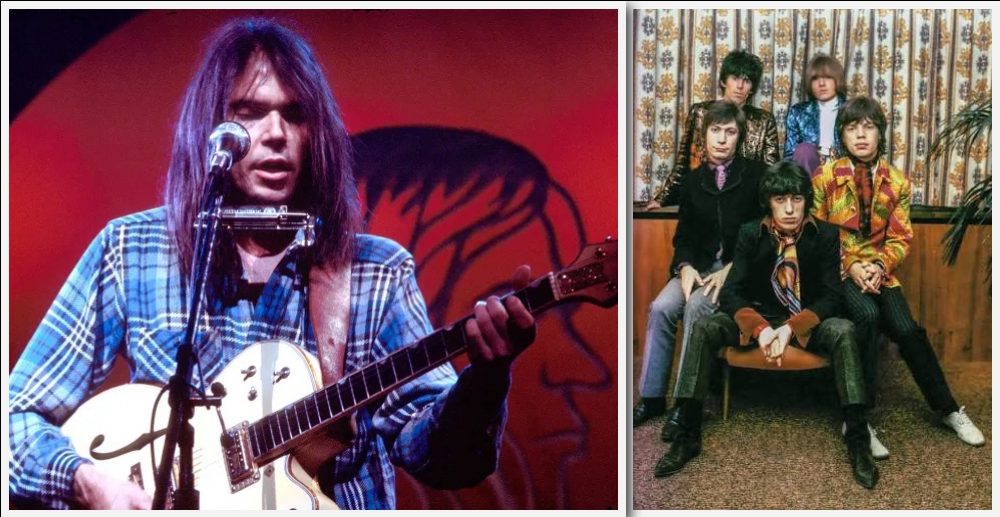
There are artists who try to hide their influences and others who declare them openly. Neil Young chose a third path: building an entire song on someone else's melody and making it the symbol of his own creative and personal collapse. It happened in “Borrowed Tune”, one of the most intimate and devastating songs on “Tonight's The Night” (1975), the album born as a reaction to the death of two fundamental people in Young's life: guitarist Danny Whitten, member of Crazy Horse, and roadie Bruce Berry, both victims of overdoses.
The disc of pain
The entire “Tonight's The Night” is crossed by a sense of mourning, anger and disillusionment. And “Borrowed Tune” marks one of the most dramatic moments on the album. Biographer Johnny Rogan, in the volume “The Complete Guide to the Music of Neil Young”, even claims that “Borrowed Tune” contains Young's “most devastated” vocal performance of the entire collection. A significant judgment, considering that “Tonight's The Night” is unanimously considered one of the most painful works of his career.
In the song – a requiem built on piano, harmonica and his characteristic thin, sorrowful and nostalgic voice – the Canadian singer-songwriter uses a famous melody: that of “Lady Jane”, one of the Rolling Stones' most refined compositions, written by Mick Jagger and Keith Richards and published in 1966 on the album “Aftermath”. Characterized by a Renaissance atmosphere, thanks above all to the dulcimer played by Brian Jones, the song evokes Elizabethan England and, according to the most widespread interpretations, it could refer to Jane Seymour, third wife of Henry VIII, or to Lady Jane Grey, the young queen beheaded in 1554.
Young makes no attempt to disguise the “loan” in the slightest. Indeed, he openly confesses it in the very verses of the song:
I'm singin' this borrowed tune, I took from the Rolling Stones
Alone in this empty room
Too wasted to write my own
Or: “I'm singing this borrowed tune, I got it from the Rolling Stones. Alone in this empty room. I'm too stoned to write my own.” Not a tribute or a provocation, but a confession of total disarmament, the portrait of a man who feels he has lost even the ability to write an original melody.
Plagiarism as an artistic statement
The borrowing of the melody of “Lady Jane” does not arise from a lack of ideas, but becomes an integral part of the very meaning of the song. If Young had hidden the reference, few would probably have noticed. Instead he chooses to make it explicit, turning what might seem like plagiarism into an artistic statement. The inability to compose something new thus becomes the concrete demonstration of his psychological state. The gesture of “stealing” a melody tells much more effectively than any metaphor how the author felt emptied and devoid of creative energy.
In another passage of the song he sings:
I'm climbin' this ladder, my head in the clouds
I hope that it matters, I'm havin' my doubts
Or: “I'm climbing this ladder, with my head in the clouds. I hope this all makes sense, but I'm starting to have doubts.” Verses that reflect an existential crisis even before an artistic one. The “ladder” can be read as career and success achieved, but Young questions whether all this really has meaning. If death comes to everyone anyway, what's the point in continuing to write songs?
The paradox of “Borrowed Tune” is precisely this: the admission of the “theft” itself becomes a creative gesture. Far from wanting to appropriate the work of the Rolling Stones, Young uses that melody as tangible proof of his loss, instead of simply saying that he has lost inspiration, he demonstrates it in front of the listener.
It is not known how much this choice was planned and how much, instead, it arose spontaneously during the recordings. Moreover, “Tonight's The Night” was not conceived as an album destined for commercial success, nor as an exercise in style. The recording sessions were rather a collective outburst, a way to process a pain too great to be told otherwise.
Rebirth in desperation
“Tonight's The Night” is an album that exudes pain, the pain of those who have seen loved ones fall into the abyss of sin without ever re-emerging. But the manifestation of suffering in this case is catharsis and not simple self-pity; means through which to face the loss, hit the bottom of the barrel and then begin the ascent. We don't know if Young really succeeded, the fact is that “Tonight's The Night” is one of those cases in which art and real life interpenetrate inextricably, making the boundary between mere artistic expression and the externalization of a feeling non-existent or at least blurred.
“Tonight's The Night” is perhaps the first concept album on the pain of the history of rock, in which Neil Young, having a clear vision of his time, manages to grasp the excesses of an ideality, moving everything into the context of his personal experience, processing the experience, entering into cognitive dissonance with what he had believed in (a similar operation was carried out by David Crosby of “If I Could Only Remember My Name”). The greatness of the album lies in being an all-round work, in which the depth of the contents is conveyed by a sound original, immensely influential on subsequent generations of musicians.
Thus, paradoxically, that very dark album contributed to saving the Canadian singer-songwriter. Putting his pain into music allowed him to face grief and rediscover, little by little, the desire to create. For this reason “Borrowed Tune” remains one of the most singular episodes of his production: a song built on the melody of another author who, thanks to that choice, manages to tell with extraordinary sincerity the most fragile and desperate moment of Neil Young's life.
(Contributions by Antonio Ciarletta)
Daniel D`Amico for SANREMO.FM