
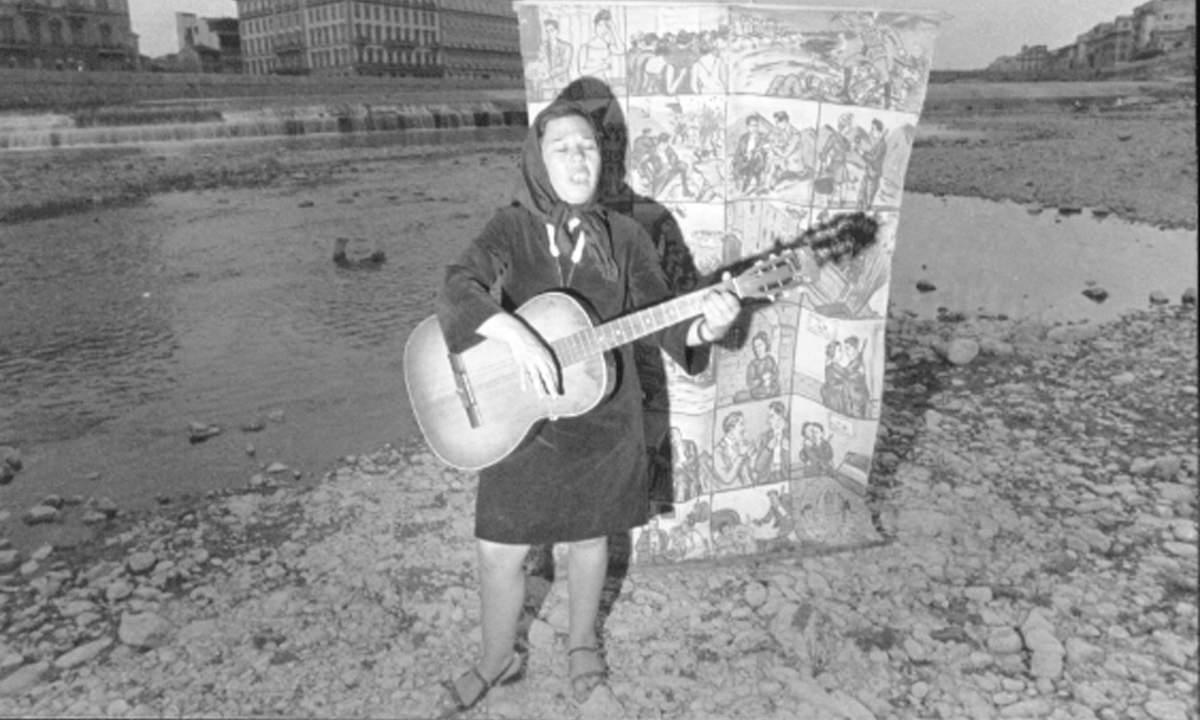
2027 marks one hundred years since the birth of Rosa Balistrerithe most authentic voice of Sicilian popular song. Born in Licata on 21 March 1927 and passed away in Palermo on 20 September 1990, Rosa transformed her biography marked by poverty, injustice and prison into a song of redemption that gave dignity to the Sicilian language and a voice to the poorest. In view of the centenary, Sicily has launched a broad program of initiatives which will culminate in 2027. In this article, constantly updated, we collect the portrait of the artist and all the initiatives of the celebrations as they are announced.
Article being updated. The centenary program is being finalized. We will update this page with concerts, exhibitions, publications and events as they become official.
Who was Rosa Balistreri
Rosa Balistreri was one of the first great performers to bring Sicilian popular music to stages throughout Italy. Hers is a very harsh human story: childhood in poverty in Licata, an imposed marriage, detention, emigration to Florence, where she comes into contact with the cultural environment that leads her to a career. From there Rosa's voice becomes an instrument of social denunciation, capable of describing the farmers, women, the marginalized and migrants of her time.
In the sixties and seventies he collaborated with central figures of Italian culture such as Dario Fo, Andrea Camilleri And Renato Guttusoand becomes a symbol of the struggles for workers' and women's rights. His repertoire, often reduced to the label of folk music, was actually born from a cultured recovery work: many of the songs he brought to success draw on the research work of Giuseppe Ganduscio and the so-called Corpus Favara, before arriving at new sources and collaborations. This interweaving of popular tradition and authorial rewriting makes his figure central in the history of Italian ethnic music.
The centenary of Rosa Balistreri: initiatives towards 2027
The celebrations are coordinated by Made in Sicily Foundation by Giovanni Callea and Davide Morici and by Rosa Balistreri Foundation of Licata, with the support of cultural institutions and bodies. The program is called One Hundred Years and is divided into different directions.
The One Hundred Years Manifesto
The symbolic heart of the route is the programmatic manifesto “Singing Sicily, narrating the human”, a document that identifies the principles of the celebrations: active memory, valorisation of the Sicilian language, female freedom and independence, culture as an instrument of identity. The Manifesto has already gathered support from institutional and cultural entities such as the Sicilian regionThe Municipality of PalermoThe Municipality of LicataThe Teatro Massimo in Palermothe Conservatory of Music and the Association of Italians of Chicago, as well as hundreds of citizens.
Alongside the institutional memberships, a group of Sicilian women active in culture, entertainment, research and information have publicly signed the document: among them the presenter Giusi Battaglia, the photographer Shobha Battaglia, the author Claudia Fauzia, the philosopher Maura Gancitano, the astrophysicist Violette Impellizzeri, the lawyer and activist Chaty La Torre, the singer-songwriter Giulia Mei, the actresses Ester Pantano and Lucia Sardo and the journalist Marina Turco. Among the objectives indicated by the Manifesto include the candidacy of Sicilian popular song to UNESCO intangible heritage and the issuing of a commemorative stamp.
The book “My Rose”
The volume kicked off the journey My Rose. Living memory of Rosa Balistreri by Felice Liotti, published by Navarra Editore, which collects anecdotes, documents and unpublished materials on the human and artistic life of the artist, with a preface by Giovanni Callea and contributions by the musician Francesco Giunta.
The mural in Palermo
Among the initiatives is the creation of a mural dedicated to Rosa in Palermo, entitled “One Hundred Years” and entrusted to the street artist Julius Rosk. The work is part of the Itinerary of Roots, the project that recounts the symbolic figures of Sicily through public works in urban space.
Pink in schools
The project “A Century of Rosa. The hundred years of Rosa Balistreri in schools”, coordinated by Pino Apprendi with a scientific consultancy of ethnomusicologists, brings the study of popular singing into the classrooms. On the institutional front, the Sicilian region has allocated funding dedicated to artistic projects in musical high schools and music-oriented schools on the island.
Rosa Balistreri today: the legacy in contemporary music
The figure of Rosa continues to speak in the present. In 2025 Carmen Consoli he signed the film's soundtrack The love I havedirected by Paolo Licata and dedicated to the life of the artist, from which the song is also taken L'amuri ca v'haju. A project that brings his story back to a new generation of listeners. Among the younger voices, Delia indicated Rosa as a declared reference, bringing the Sicilian repertoire and language from the X Factor stage to that of the Arcimboldi in Milan.
Photo: Cent'Anni press office, Made in Sicily Foundation / Rosa Balistreri Foundation
