

vote
8.5
- Bands:
FLESHCRAWL - Duration: 00:54:37
- Available from: 06/08/1992
- Label:
-
Black Mark
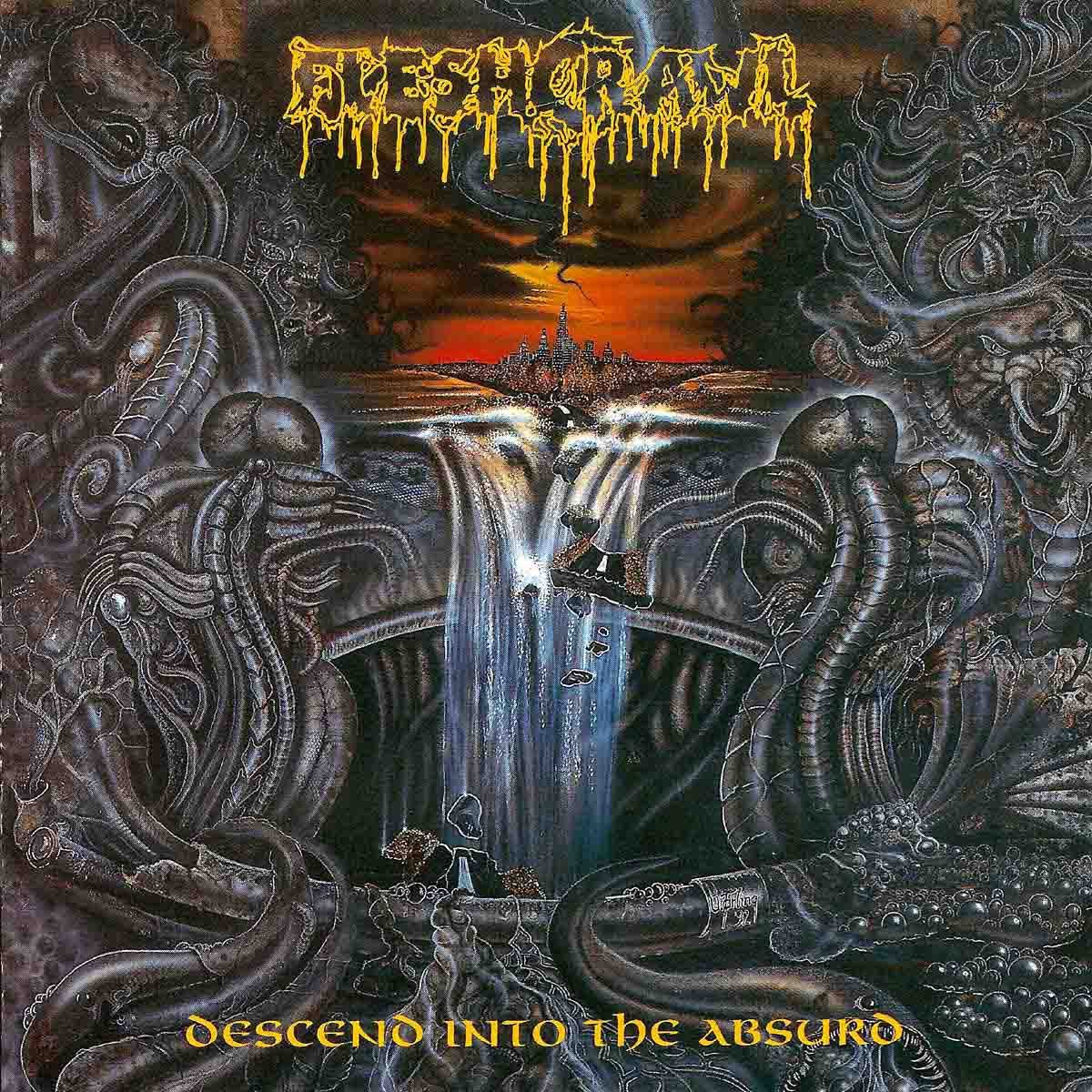
When we talk about Fleshcrawl, the almost automatic reflex is to think of the works released in the second half of the nineties, when the German band dove unreservedly into the reworking of the classic Swedish death metal sound modeled by Entombed, Dismember and co. That period came to define their fame, but it only tells part of the story. At the beginning, in fact, the Fleshcrawl were a completely different creature: less aligned, more oblique, and decidedly more difficult to pigeonhole. Their debut full-length, 1992's “Descend Into the Absurd,” is the perfect snapshot of that embryonic and restless phase.
The German death metal scene, after all, has never had a monolithic identity. If we observe the first protagonists of the 1990s season, it is clear that each group followed its own path. Just think of the stylistic distance between Morgoth and Atrocity: two pillars of the scene, but often almost opposite in terms of sensitivity and musical language. Fleshcrawl fit perfectly into this fragmented mosaic, choosing a personal trajectory that mixes different influences without ever completely adhering to a specific school. The sonic heart of “Descend Into the Absurd” pulsates with an almost telluric heaviness, far from the agility and sharp imprint that instead distinguishes the first works of the aforementioned compatriots. Some riffs seem to emerge directly from the ground, with the same density as early Asphyx or Bolt Thrower in the “Realm of Chaos” period: granite guitars, often slow and crushing rhythms, a sense of implacable advance that recalls an armored column moving among the ruins. But Fleshcrawl don't just replicate that kind of power: they often slow down further, dragging their midtempos into almost death-doom zones, where the music becomes viscous, serious, full of palpable emotional darkness. In those moments, there is an echo of the first Paradise Lost, those of “Lost Paradise”: the same taste for dilated times and for a leaden atmosphere, crossed by a sense of fatalistic melancholy. The result is a record that seems to proceed wrapped in a blanket of dark fog, as if each song emerged from a devastated landscape, where the violence of death metal coexists with a subtle sensation of imminent tragedy.
Despite this widespread gloom, the album never remains still: Fleshcrawl play a lot on the contrast between the slower parts and the moments in which the music springs forward with greater aggression. When the guitars get tighter and the drums press on, the sound takes on a rougher and more combative, almost belligerent quality, creating a continuous tension between oppression and momentum. One of the most fascinating qualities of the album is in fact its internal construction: many songs are well over six minutes and develop like small sound narratives, where the riffs act almost like chapters of a dark tale. The guitars change moods, open sudden glimpses or sink into new rhythmic abysses, guiding the listener through shifting soundscapes. In tracks like “Perpetual Dawn” or “Lost in Grave” this narrative dimension emerges with particular clarity: the music really seems to evoke images, scenarios, movements.
Paradoxically, however, this structural richness is not the first thing one perceives. At first listening, what is most striking is the sound mass of the guitars: thick, dark, almost opaque in their gravity. It's a sound that might make you think of a band dedicated to brutal and primitive, cave-like death metal. Only with time does a more subtle plot emerge, made up of variations and emotional changes that work beneath the surface. In this sense, one can even glimpse a link with the more visionary side of Darkthrone's death metal before their black turn, when they released the technical and imaginative “Soulside Journey”. Even Fleshcrawl seem more interested in the internal movement of the music than in the demonstration of skill: no technical fireworks, but a chisel work on the riffs, tempos and atmospheres.
For this reason, “Descend Into the Absurd” remains a rather singular object in the panorama of European death metal of the early nineties. Obviously it's not a record that changed the course of death metal or started a new current within it. Instead, it is a work that absorbs some of the stylistic tensions of the era and recomposes them according to its own logic, favoring the writing and construction of the songs. In other words, it is one of those records that live in the folds of the history of the genre: inevitably a step behind the so-called most celebrated milestones, but capable of enriching the panorama with a different, discreet and in its own way very interesting nuance. An album for curious listeners, who find pleasure even on the less traveled paths.
Daniel D`Amico for SANREMO.FM