
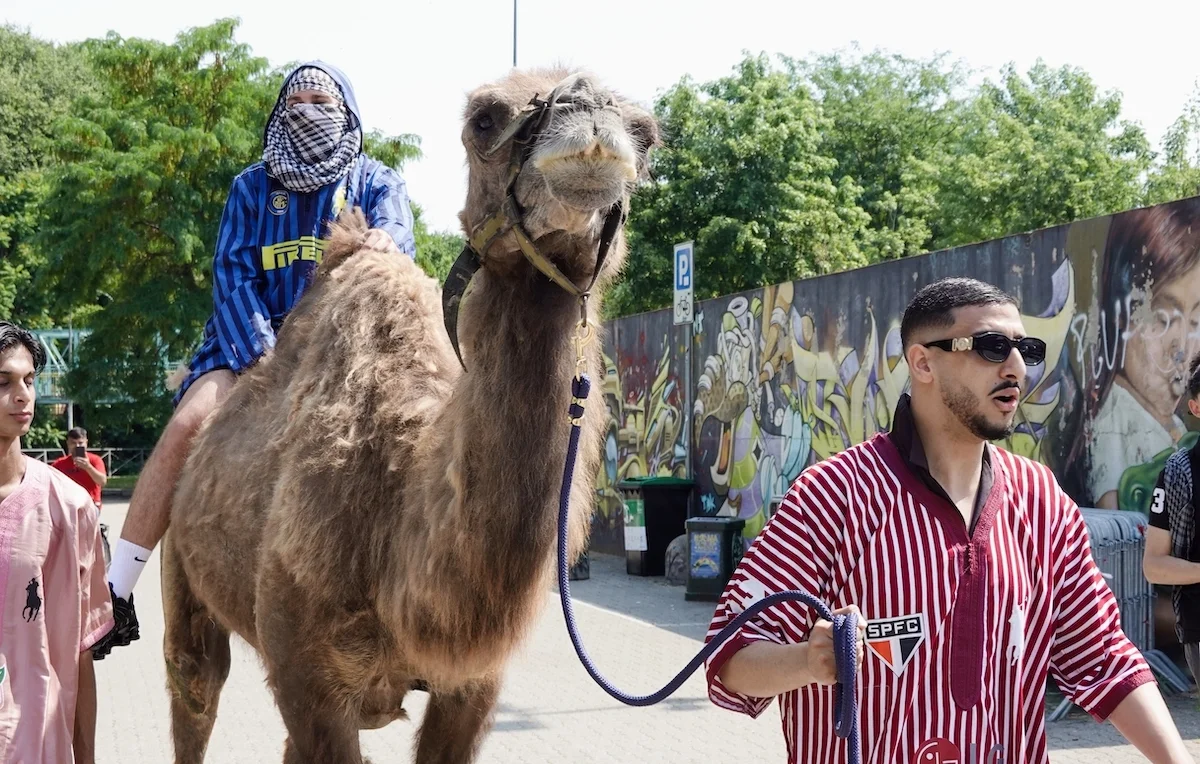
At the sight of the camel, the skiers' gaze lights up with a mixture of surprise and bewilderment. After all, it is not common, during a Sunday walk along the Martesana canal, to come across an exotic animal. The same amazement can be seen on the faces of the local police officers when they verified that all the permits necessary for his presence were perfectly in order. Meanwhile, all around you can feel the atmosphere of a neighborhood party. Dozens of children run and chase each other armed with water guns, while onlookers and passers-by stop to observe the scene.
It is at that moment that the rapper Mowgli CLL makes his entrance: riding the camel, wrapped in a gallabeya personalized with the colors of Inter, with his face covered by a balaclava. Shortly afterwards a fake Silvia Sardone also appears. An actress plays the Northern League MEP, haranguing those present, surrounded by election posters and propaganda material created for the occasion. Everything is filmed by the cameras and is part of the video clip Dancethe new song by Mowgli CLL released today on all platforms. A deliberately spectacular and satirical staging that presents itself as a desecrating response to the growing “anti-maranza” rhetoric fueled in recent years by the right-wing government.
«You know, we are not naive», claims Mowgli while we chat sitting in one of the many Egyptian bars on Via Padova. «We don't want to play the game of the media and politicians. He's not smart. We prefer to make fun of them, do activities that make the neighborhood happy and make the kids think.” It is not a theoretical position. In recent years Mowgli has already been the subject of numerous controversies on social media. His video clip Welcome to VP had attracted the attention of Northern League member Sardone, a figure who built a significant part of his political notoriety around the narrative of Via Padova as a symbol of the difficulties of immigration and urban security.
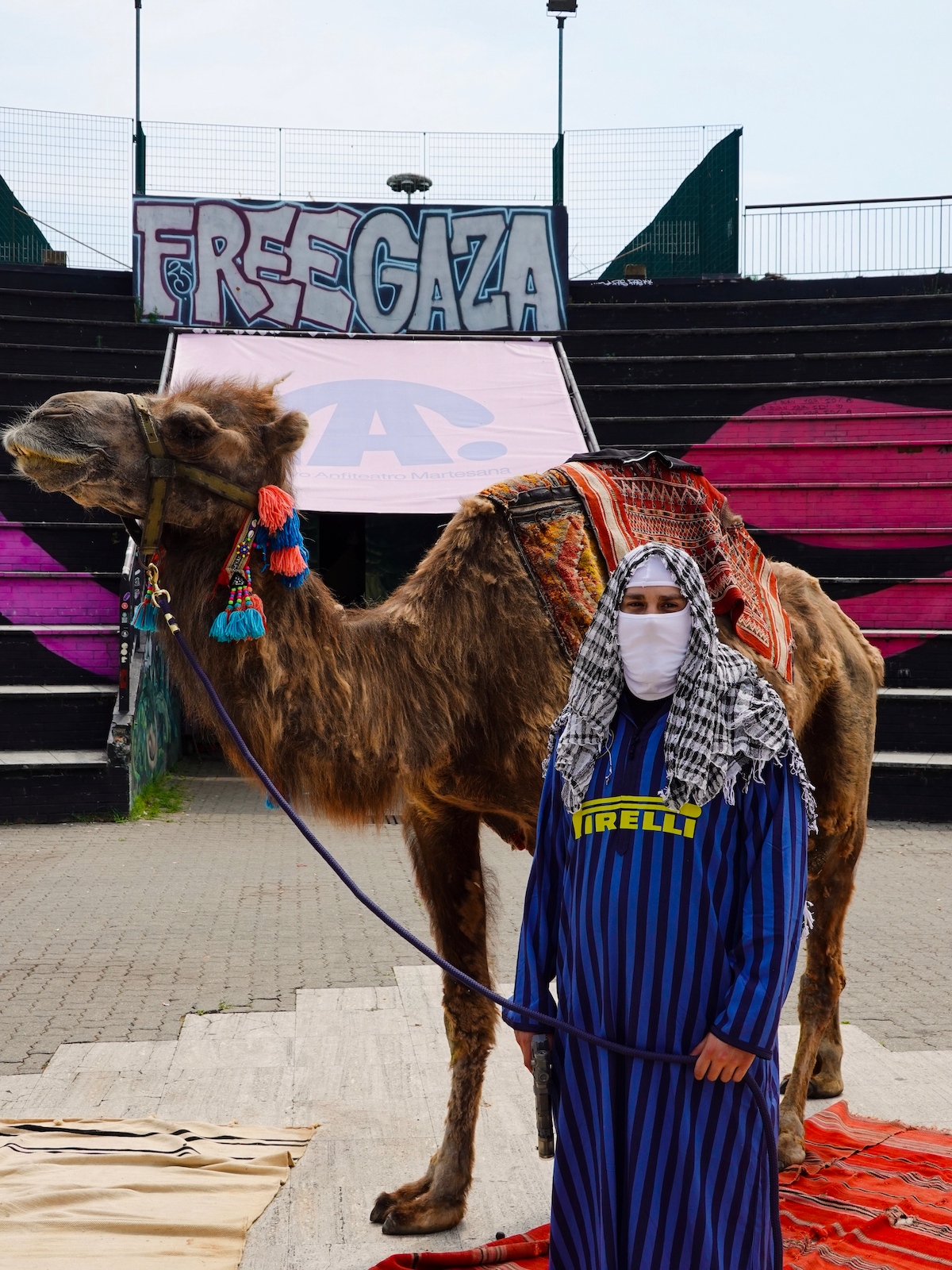
Photo: Robados
At the center of the controversy was the so-called “knife dance”, a performative practice widespread in Egyptian street culture which in recent years has also appeared in various Italian contexts. An element that part of the public debate quickly transformed into proof of the impossibility of integrating young people of foreign origin. Mowgli, on the other hand, had chosen to include it in his artistic imagination, claiming its symbolic and cultural value. “At that moment I practically said no to everything,” he says. “From the Mosquito down. Because I don't want to be turned into a freak. I speak through music and videos, that's where I can turn the game around.”
Mowgli's attention, however, is not only directed towards the outside. If on the one hand his artistic work dialogues with the public debate, on the other his main ambition is cultural: to build an imagination capable of relating Milan and Cairo. While sipping a lemonade, he tells me that he grew up listening to both Italian rap and Egyptian music. On the one hand, artists like Marracash, from whom he says he learned the importance of social criticism; on the other, Mahraganat, a genre that he jokingly defines as “Egyptian neomelodic”.
Born in the poorest neighborhoods of the Egyptian capital, Mahraganat is a music that mixes rap, electronics and neighborhood party sounds. In the space of a few years it has overcome geographical and social boundaries, becoming an important cultural reference also for the diaspora. At the same time he was long opposed by Egyptian cultural institutions, who accused him of being vulgar, dangerous and unsuitable for representing the official image of the country. A trajectory which, in Mowgli's eyes, has many similarities with that of rap. «I want to be the first to bring this stuff to Italy because it is part of our identity and we are proud of it. And the kids in Egypt are proud of us too. The beat of Dancefor example, we produced it together with Ot Kormuz, an important figure in the scene.”
His is therefore a challenge that goes beyond music and directly concerns the theme of identity. «After September 11, we Arabs and Muslims have become public enemy number one throughout the world. I remember that as a child my parents always told me to be careful about what I said, how I presented myself. As if there was something about us to hide in order to be accepted.” According to him, however, something has changed today. «Now it's different. My generation has taken back an important part of its identity. And for me the challenge is this: to tell what it means to be Egyptian in Milan.”
This encounter between rap and Mahraganat speaks to a broader trend that is sweeping through contemporary European rap. In fact, more and more often the most interesting innovations arise from the encounter between the different migrant communities that inhabit the continent's large cities. It is in these spaces of contact that new languages, new sounds and new forms of belonging develop. According to Mowgli, via Padova perfectly represents this dynamic. «Here there really are all possible communities. It's an incredible place. Of course, there are problems and always have been, but from this point of view it is a neighborhood full of life.” As he speaks he points out Davide, a 17 year old boy who spends most of his days in Mowgli's company. «Look at Davidino», he says smiling. «He is 100% Italian and speaks Arabic better than me. Only in Via Padova can things like this happen.”
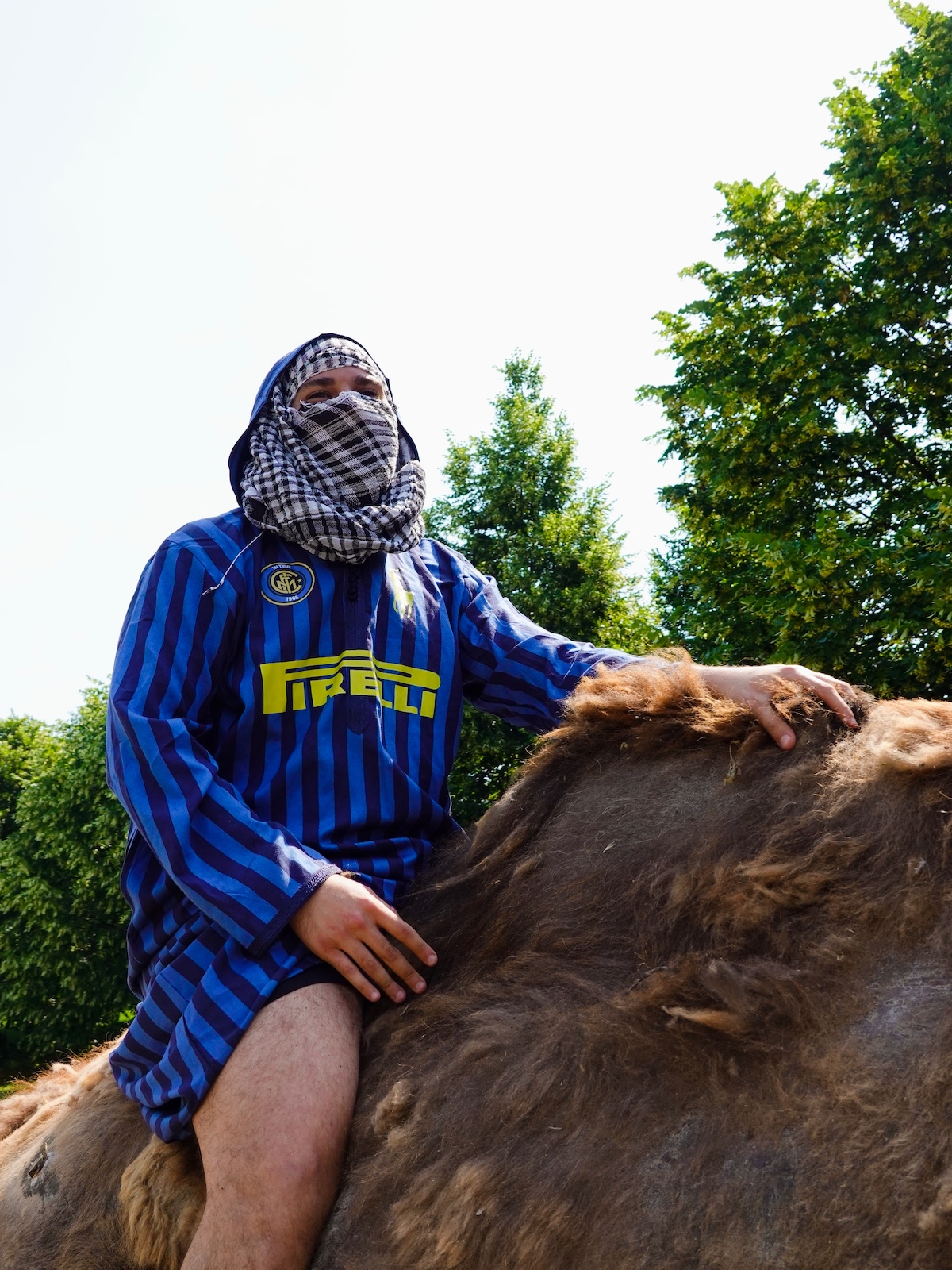
Photo: Robados
The joke tells well about the type of relationships that are built in the neighborhood. Davide, Mowgli and Alyx – the rapper's partner and close friend – met during the filming of a video by Cisco, a rapper from the area of Philippine origins. An example, among many, of how the identities that inhabit Via Padova are much more intertwined than is often told. For Mowgli, this is precisely the aspect that part of the public debate continues to not want to see. «In the end, what they don't want to accept about this area is precisely this. We are already living that multicultural reality that scares them so much.”
When rap is accused of having lost its presumed original values, of no longer speaking of contemporaneity or of having lost its critical thrust, perhaps we are looking more at form than substance. Over a hyperkinetic Mahraganat beat, with Auto-Tune taken to the extreme and a balaclava over his face, Mowgli does exactly what many argue rap no longer does: social commentary. It does this by questioning stereotypes about immigration, integration and the suburbs, restoring pride and a sense of belonging to one's community. And he does it without worrying about reassuring the adult audience. And perhaps this is precisely his greatest merit.