
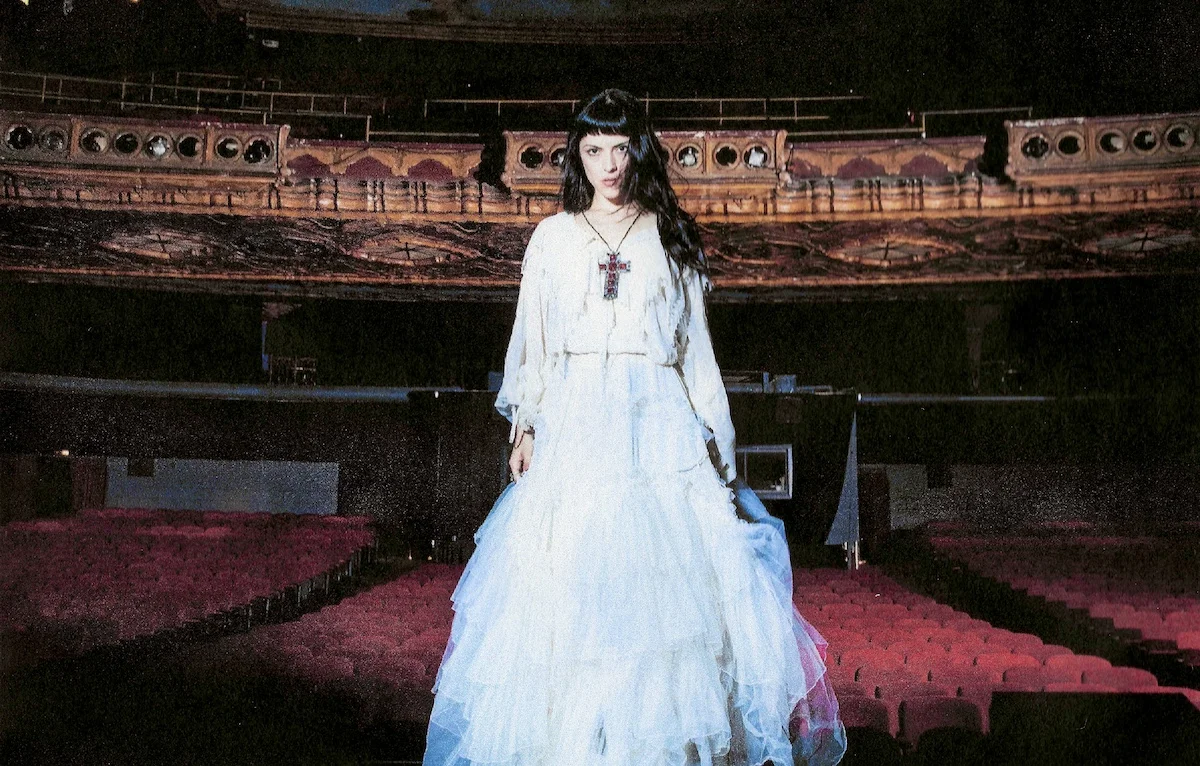
At one point during the conversation, María Zardoya uses the word “nest” to describe the process of recording Melthis first solo album under the name Not for Radio. It was just her, Gianluca Buccellati and Sam Evian recording it, far from the world, in the heart of winter, in the snow of New York State. They went out for walks in the woods, came back, recorded. The outside world did not exist. “No one else existed,” he says. Sensations that emerge in Melta record that has precisely the quality of a project born in a closed, isolated space, far from any market logic or expectations.
You know María Zardoya as the leader and voice of the Marias, the indie pop group from Los Angeles that in recent years has built a very loyal following thanks to a sound that slides effortlessly between dream pop, R&B and something that seems to have come out of a soundtrack of a film you would like to see. But in the Marias' discography there is a song that at a certain point began to circulate on TikTok uncontrollably (No One Noticed), and when something like this happens – when your sound becomes a meme, the soundtrack of millions of videos, viral matter – you have to deal with a new version of yourself. That version that stands on an arena stage and watches a huge audience sing along to every word.
We talked about it taking as an occasion the concert he will hold on April 17th at the Teatro degli Arcimboldi in Milan, his debut in our country.
Let's start with Coachella. It was Not for Radio's first show outside of a theater, right?
Yes, it was our first festival. Before Coachella we had only played theaters. Not for Radio was created precisely to be experienced in that context. People sitting, the most intimate dimension, a collected space, the sound details that emerge in the silence. Everything was different at Coachella. You can imagine it: everyone on their feet, high energy, a little chaotic.
How do you relate to an audience like that when you make such introspective music?
That was the main challenge. I wondered how to lower the energy of an excited audience without losing it completely? As a band, we wanted them to feel the richness of the instruments, the layers of the music. In our live shows we have a real piano, a real organ, vintage synthesizers that can do whatever they want at any time. It's like walking on a tightrope. And in my opinion it is precisely that tension that keeps our attention high.
Did you succeed?
Towards the end of the set, especially with our much more stripped down and quieter version of No One NoticedYes. The audience sort of… stopped. He started to really listen. It's what we wanted.
There is also a symbolic dimension in the fact that Coachella was your first exit from the theater. After all, Coachella was also the Marias' first big stage.
Exact. And on the same stage. It wasn't something I wanted, but when I realized it it was very nice. Like a circle that closes. Not for Radio performs its rite of passage in the same place where the Marias did.
And how did Coachella “officialize” Not for Radio as a serious, coherent and long-lasting project?
I think it helped clarify, even for me, that Not for Radio is not a temporary experiment or a side project. It's a part of me that exists alongside the Marias, but is just as real. The Marias and Not for Radio are two sides of the same person. Having Coachella as the first stop outside the theaters was like saying that this is a project born to stay.
Let's talk about the album. When I first listened to it it made me think of a certain tradition of 90s dream pop and shoegaze but in a way that doesn't sound nostalgic, rather contemporary and personal. Where does it come from?
I think it started as an experiment, without a precise plan. The Marias were growing a lot, No One Noticed had gone viral, and there was this part of me that on the one hand loved the idea of being on a big stage, in front of a huge audience. But there was another one on the other side who just wanted to retreat. Walking alone. Sit under a tree and listen to music. (laughs) Not for Radio is that more introverted part of me that needs silence to function.
Can we therefore say that it was born as a reaction to the growing popularity of the Marias?
In a certain sense yes. The more visible we became, the more I felt the need to create something that was completely outside of that trajectory. Not to disown the Marias, but to remind me of who I was before everything got so big. And I think the name itself, Not for Radio, gave me the freedom to actually do that. Choose a name that takes away all the pressure. It doesn't matter if it's on the radio, it doesn't matter if it's commercial, it doesn't matter what the label thinks. The only thing that matters is if I enjoy doing it.
How did you work in the studio?
There were three of us, lost in the middle of winter in upstate New York. Snow everywhere. Every day we took nature walks and then went back to recording. Nothing existed outside of the three of us. It was like being inside a nest for a month. No external interference, no other reference points. When we finished and had to share the music with other people it was very strange, almost a trauma, because we had made that music just for us. We hadn't thought about the audience even for a second.
It's a radically different way of working than what is done in the music industry today.
Yes, totally. And I think those sessions also changed the way I work with the Marias. I learned to be more present in the moment of writing, not to constantly think about how it will be perceived by others… Thinking first of all about how others will think of your music kills the song before it is even born.
How would you describe the live sound of Not for Radio to someone who hasn't seen you yet?
Unpredictable. On stage we have real instruments but a very minimal production, without backing tracks. Every evening is different. The instruments can create a sound that they have never made before, the volumes can change because there is a mixer on stage that is set differently every night. In short, we are all aware that something could go wrong at any moment.
And isn't that something that scares you?
No, that's exactly what we want. That feeling of risk keeps us and the public's attention high. And it's also the same spirit with which we recorded the album. We never knew what would come out of those tools and instead of fighting this surprise, we embraced it. Every show is different, and this in my opinion is the deepest meaning of the idea of playing live. You're not there to remake the record, you're there to do something that only exists that night.
What can people who come to Milan expect?
Open up. Don't bring specific expectations. Don't try to fit what you hear into a category. Come to feel something, to experience something that only exists that night. The theater is the perfect context for Not for Radio.
It will be your first time in Milan. The first time in Italy, even.
Yes, I've never been there. I'm completely open to everything that happens. It's nice not to have a yardstick for comparison. It's a blank page.
And in terms of setlist? Will there be surprises?
The show at the theater is much longer than the set we did at Coachella. We will play all the material from Not for Radio, without leaving anything out. And then there are four unreleased songs that aren't on the album.
Four unpublished. Not a bad promise.
(laughs) Yes, I think it will give an idea of where we are going. As I was telling you, each Not for Radio show is a little different from the other and what happens there will only be from Milan.
Last thing. You're Puerto Rican, you collaborated with Bad Bunny, you're both hugely successful Latin artists in the English-speaking market. Do you feel a responsibility towards this identity?
A little yes, but not in an oppressive sense. It's more a sense of pride. I'm Puerto Rican and I'm proud of it. I show my culture in everything I do, in music, in aesthetics, in the way I talk about myself. It is not a strategic choice. It's simply me. And Bad Bunny is simply him. But the fact that we simply are what we are, in such visible spaces, has a weight that I feel and that I don't want to ignore.