
The second season of Laverne & Shirley had just gone into production when Cindy “Shirley” Williams came down with viral pneumonia, forcing producers of the hit ABC sitcom to shut down production for two weeks. “You can bet Cindy received posies from The Fonz since she’s been hospitalized,” reads a report by Shirley Eder that ran in the Colorado Springs Gazette-Telegraph on July 22, 1976, conflating the fantasy world of the Happy Days extended universe with reality in a very odd way. “I don’t know about a romance, but they have been good friends for years.”
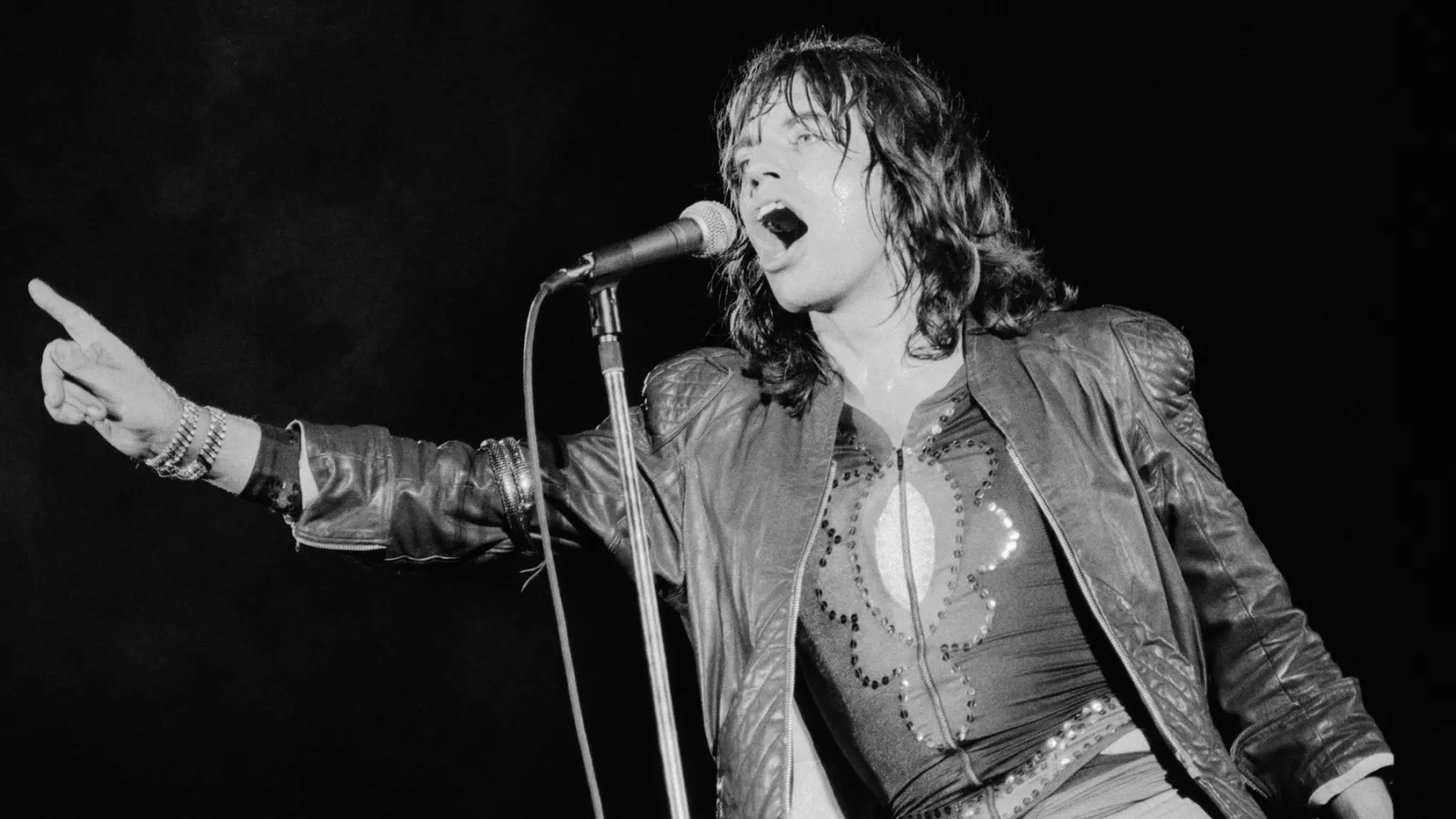
With that important update out of the way, Eder turned her attention to the music world. “The Rolling Stone will headline the Knebworth Fair August 21, and 100,000 fans are expected to attend this medieval festival 40 miles from London,” she writes. “The whole fair will be under the Stones’s direction this year – including historical sideshows from acrobats to jousting matches.”
That’s the extent of Rolling Stones info in Eder’s entertainment column, which goes on to note that Norwegian actress Liv Ullman brought Shirley MacLaine “three pounds of imported caviar” while visiting her backstage at New York’s Palace Theater, and new footage was being shot for the 1974 movie Earthquake in preparation for a three-hour TV broadcast, but there was much she didn’t mention.
Most significantly, Keith Richards lost his ten-day-old son Tara due to SIDS on June 6. Just a few weeks before the tragedy, the guitarist was detained by police in London following a car crash where they discovered cocaine in his vehicle. “Since then, the London Daily Mirror has reported the Stones as the unknowing couriers of a drug syndicate,” read a July 15, 1976, report in Rolling Stone. “Under headlines reading ‘Drug Smuggling Shock for the Stones’ and ‘Cocaine Hidden in Pop Star’s Bentley,’ news stories told of police suspicion that cocaine and cannabis had been hidden in clothing, jewelry and equipment carried by the ‘unsuspecting’ Stones and their entourage during their 9-country, 36-day tour.”
Richards somehow had the fortitude to continue a grueling European tour in the middle of all this chaos and sorrow, but a stadium run through America at the end of the summer was simply too much to ask. He was in desperate need of downtime to process the loss of Tara and deal with his growing drug problem.
But the band decided to go forward with their plan to stage a massive concert in Knebworth, England, on Aug. 21, with special guests 10cc, Lynyrd Skynyrd, Todd Rundgren, and Hot Tuna. “It may be the most memorable rock festival ever staged in Britain,” read an Aug. 19 report in the Belfast Telegraph that seems to be discounting the 1969 and 1970 incarnations of Isle of Wight. “The Stones seem certain to go on making records and they are currently asking for a large sum of money to put their signature on a recording contract, but they may have finally decided it is time to fade away from festivals and concerts after 13 years of gigging. Says Jagger (33): ‘I would hate to think I would still be singing ‘Satisfaction’ when I’m forty.’”
The ludicrous notion that the Stones were going to call it quits after the Knebworth show was all over the U.K. press, likely spread by promoters hoping to move tickets. “Some people close to the group say that, because of the magnitude of the 12-hour event, it could be the Stones’ Swan Song,” read an Aug. 21 article in the Leicester Mercury. “The stage was still being built in the early hours of the morning – a day surrounded by polythene lips in the shape of the now familiar emblem – a gaping mouth. In front of the stage is a hundred-yards-long catwalk which Mick Jagger will use during a two-and-a-half-hour concert – possibly his longest ever.”
“[The stage] is understood to have cost about £100,000 to build,” the article continues. “The 12 hour long pop concert at the stately home will be staged in an arena capable of holding up to 200,000 pop fans. Thousands of fans – who pay about £4.50 for the concert – were already camped outside in tents, wigwams, and make-shift overnight homes early today. People already camping by the site for the concert – which starts at 11:00 am – were urged not to light cooking fires because of the danger of grass fire.”
As the Stones learned the hard way seven years earlier, grass fires weren’t the only possible dangers at an enormous festival. But unlike Altamont, Knebworth was organized over several months as opposed to a matter of days. And the festival grounds held events in 1974 (Allman Brothers/Doobie Brothers/Van Morrison/Tim Buckley) and 1975 (Pink Floyd/Captain Beefheart/Monty Python/Steve Miller Band) that provided them with a framework.
That doesn’t mean everything was easy. “The British Army will come to the rescue of the Rolling Stones Knebworth Festival on August 21,” an Aug. 2 article in the Press-Telegram read, “by agreeing to install 400 portable toilets on the grounds of the Knebworth estate.”
The morning of the event, an ominous item appeared in The Daily Telegraph that surely sent the Stones’ camp into a panic: “Hundreds of Hells’s Angels are expected to descend onto site. Police can call on neighboring [police] forces if there is trouble, and all leave in the county has been cancelled.”
Unlike Altamont, the Hell’s Angels were unwelcome visitors this time rather than an unofficial security force. And a combined unit of public and private officers was brought onto the grounds to maintain order and avoid any chance of a repeat of 1969, though they apparently were unconcerned about drug use. “There was a carnival atmosphere and the usual wafts of marijuana smoke, but police said they had made no arrests by early evening,” read a report the Monroe Morning World filed midway through the show. “Marijuana, hashish, and pills were sold openly at the site, but organizations set up to deal with drug users on bad trips said there had not been much demand for their services.”
The Stones were supposed to take the stage around 9 p.m., but technical issues throughout the day delayed their set by over two hours. During the downtime, the middle portion of Pink Floyd’s “Echoes” played on a loop as rumors spread the Stones might cancel. But all was forgiven when they took the stage and burst into the song that Jagger didn’t want to still be playing at 40, but was happy to sing at 33.
It was their first live rendition of “Satisfaction” since 1972, and an early sign this was going to be a very different show than the one they brought around North America and Europe earlier in the year, even though they were once again joined by pianist/singer Billy Preston and percussionist Ollie Brown.
The surprises continued with their first cover of Chuck Berry’s “Around and Around” since 1966, their first cover of Willie Dixon’s “The Little Red Rooster” since 1965, and their first “Let’s Spend the Night Together” since 1967. They were technically supporting Black and Blue with this tour, but only played four songs (“Fool to Cry,” “Hand of Fate,” “Hey Negrita,” and “Hot Stuff”) from it to make room for standards like “You Can’t Always Get What You Want,” “Tumbling Dice,” “Wild Horses,” and “Happy.”
Near the end, Jagger handed over the mic to Preston so he could play his recent solo hits “Nothing From Nothing” and “Outa-Space,” before wrapping up the night with fierce renditions of “Midnight Rambler,” “It’s Only Rock ‘n’ Roll (But I Like It),” “Brown Sugar,” “Rip This Joint,” “Jumpin’ Jack Flash,” and “Street Fighting Man.” They played 28 songs across two-and-a-half hours, one of the longest shows of their entire career, wrapping up after 2 a.m.
The Sunday Telegraph sent an older writer, Ronald Payne, to report from the scene like an anthropologist. “Had even a good regiment of infantry been forced to wait hours in the sun in such conditions there would have been a mutiny,” Payne writes. “But they sat, the big battalions of pop in their unisex uniforms of blue jeans and T-shirts, apparently happy. Up the hillside there ever pours in reinforcements, clutching cans of beer and occasionally flags…There is something about it all of a children’s crusade, the young people look so innocent and take their pleasure so gravely. Yet over them loomed the music, which I fail to comprehend, of such a high decibel count as to make the roar of Concorde seem like the whirring of a clockwork toy.”
(It’s fortunate the music was so loud, since there were somewhere in the ballpark of 150,000 to 250,000 attendees — estimates vary wildly — and only two screens with nothing close to the fidelity we’re accustomed to at shows today, even if they were state-of-the-art by 1976 standards.)
In The Guardian, writer Robin Denselow compared the event to the Republican National Convention, which nominated Gerald Ford for his first proper term as president just a couple days earlier. “Even with the wildest stretch of the imaginations, it’s difficult to equate Jagger howling through ‘Street Fighting Man’ with Betty Ford’s victory waltz across the platform to the strains of ‘I Could Have Danced All Night,’” Denselow writes. “But in terms of style, both were vast-scale marketing exercises that drew enormous audiences, and both star attractions used old-fashioned showbiz techniques to win the lumps in the throat, wet eyes, and applause.”
Once the show was finally over, the group was happy to admit they had no plans to actually stop touring. “We are planning a tour of South America at the moment for next year,” bassist Bill Wyman told the press. “Before that we are going to the south of France to rest. If possible we should like to come back here again some time next year for concerts.”
The future didn’t unfold quite as Wyman envisioned. The Stones somehow didn’t hit South America until 1995, a couple years after Wyman quit the band. And there was no European tour in 1977. The only dates they played that year were the infamous pair of shows at Toronto’s El Mocambo, where they billed themselves as the Cockroaches.
The band spent the rest of 1977 dealing with the fallout from a second Keith drug bust, this time a much more serious incident where he was caught with heroin in Canada and faced the possibility of serious jail time, and beginning the recording of Some Girls. (With typical Stones luck, the judge was merciful and ordered Keith to play a benefit concert for the blind, when he could have locked him up for seven years.)
Today, Knebworth remains the site of the biggest concerts on the U.K. summer calendar. And while nothing has been even remotely confirmed, there are persistent rumors that Oasis might return in 2027 for a repeat of their legendary 1996 two-night stand.
And despite all the speculation that the Stones were going to call it quits after their 1976 Knebworth show, they remain an active band 50 years later. But they haven’t played in two years, and Keith has indicated he has no desire to tour again. The idea of residencies has floated around. If they stage one in England, expect it to take place at Wembley or Twickenham Stadium. Their fans no longer want to schlep out to Knebworth and deal with festival “seating,” which means no seats at all.
If the Stones ever want to revisit Knebworth, their best bet is to officially release the surviving audio and professionally shot film from 1976, about 95 minutes in total. Sadly, it appears that there’s about an hour missing from the footage that may simply not exist. That’s not too shocking since it was a chaotic day, but at least they got through it without the Hell’s Angels beating anyone to death. From that perspective alone, it was a tremendous success.
