
She's a sly one, that Emerald Fennell! The actor turned filmmaker starts off her Wuthering Heights — the gajillionth take on Emily Brontë's swooning Gothic novel, yet somehow the first one to feature Heathcliff sniffing his true love's fingers after catching her in onanistic interlude — with the sound of heavy breathing and rapid moaning. The screen is black. The average viewer imagines all sorts of carnal activities happening, titillated by what might appear onscreen once the visuals kick in. What greets us is the sight of a public hanging. That panting isn't ecstatic. It's a series of last gasps. A mass of men, women, and children watch as the hooded figure twitches and jerks on the end of a rope. Several boys point out that the convict has a “stiffy” as he prepares to shuffle off this mortal coil. A stern nun shushes them.
Once the prisoner ceases his danse macabre, the crowd goes wild. No sooner has this public execution ended than we cut to a couple getting extremely hot and heavy right by the gallows. They may be fucking around, but Fennell isn't. She's planting a flag. Two minutes in, and the dual forces of sex and death are already forever intertwined. Here, there is no petite mort or great death, just Thanatos and Eros high-fiving each other on the Yorkshire Dales. Once you've unleashed the forces of one, the film suggests, the other won't be far behind.
There are better adaptations of Wuthering Heights, and there are far, far worse adaptations of Wuthering Heights. Yet you will certainly not find a hornier version of this material than Fennell's fast-and-loose spin on the torrid tale of Heathcliff and Catherine, childhood pals turned paramours who can never truly be together and genuinely can't keep their hands off each other. It may in fact be the horniest literary adaptation ever made. (All apologies, Brokeback Mountain.) Stopping at the mark in which their doomed love story reaches its natural climax, the Saltburn writer-director excises the more ghostly attributes associated with the book's back half, while keeping all of the ghastly ones intact. The cruelty exercised by these lust-driven denizens of a crumbling country estate is the point here. So is the sense that repression, revenge, and a ridiculous amount of irony must inevitably give way to sex. Lots and lots and lots of sex.
A long time ago, young Cathy (Charlotte Mellington) lived with her wastrel of a father, Mr. Earnshaw (Martin Clunes), and her companion Nelly (Vy Nguyen) at the manor known as Wuthering Heights. One night, Earnshaw goes out for his evening's gambling and degeneracy and returns the next morning with a new resident for the household. He had been aghast to see a young boy being beaten in the street (“This isn't Liverpool!” the old man exclaims. “Or Bristol!”), and has brought the child home to live with them. This urchin (Adolescence's Owen Cooper) has no name. Cathy calls him “Heathcliff” after her late brother. Mr. Earnshaw wields his charity like a cudgel with the lad and occasionally beats him with much less metaphorical blunt instruments. But the two youngsters couldn't be closer. Until they grow up to be Margot Robbie and Jacob Elordi, at which point they'll spend the rest of the movie striving to be much, much, much closer.
Casting two of the most smoldering contemporary actors on the planet clearly stacks the deck, and carries on the long tradition of pairing a dashing figure of brooding handsomeness (Laurence Olivier, Ralph Fiennes) with a breathless screen beauty (Merle Oberon, Juliette Binoche). When filmmakers have tried to skew slightly earthier, as in Jacques Rivette's 1985 version, the result is a sort of grungy take on traditional Gothic tropes. Other versions, like Andrea Arnold's brilliant 2011 stab at adapting Brontë's parable, push the book's racial aspects and class divide to the forefront.
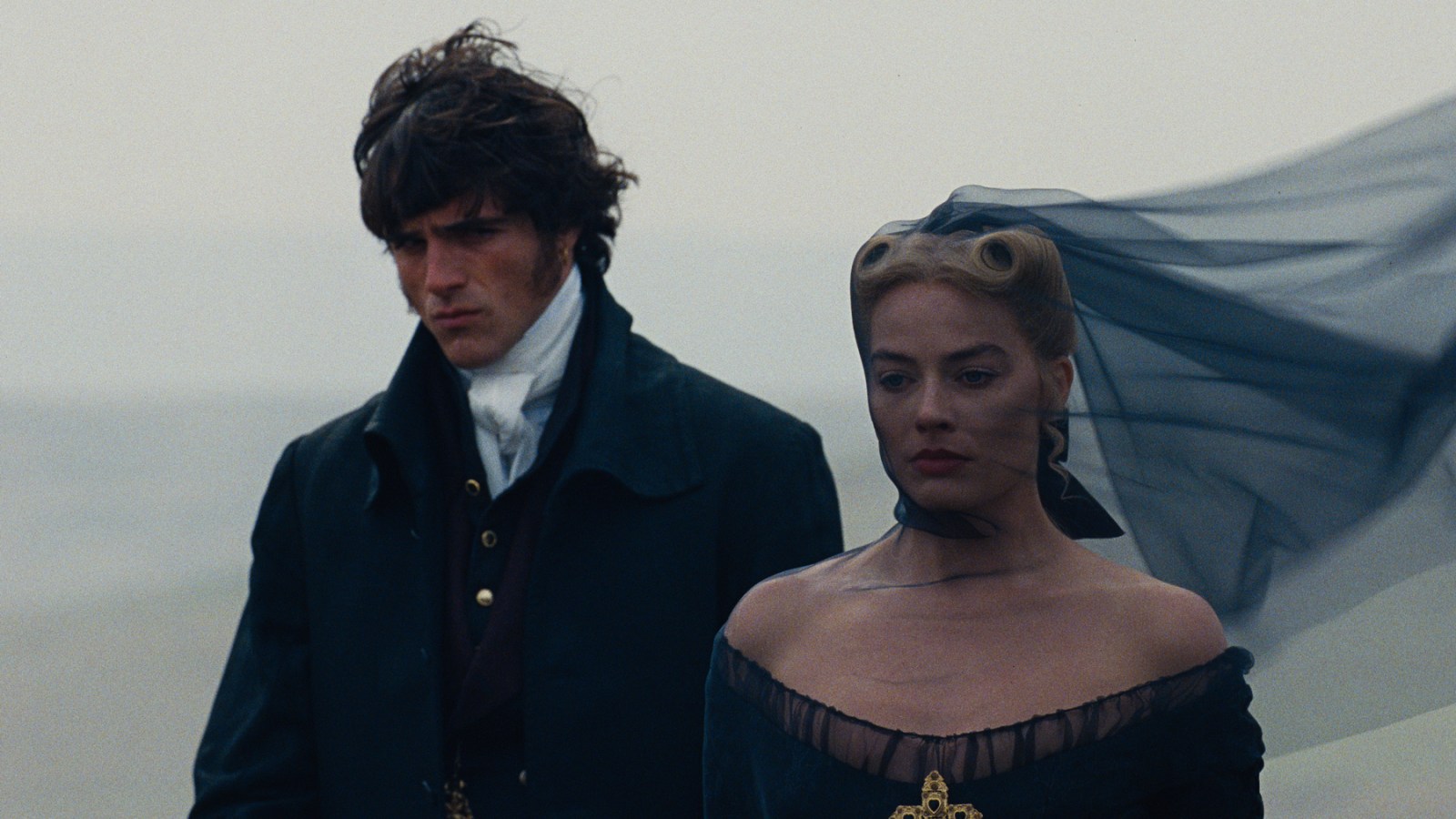
Fennell's interpretation is all about channeling pleasure — the sexual pleasure of abandoning yourself to amour fou, of course, with a strong emphasis on the fou. But aesthetic pleasure above all. So much depends on the way a red dress falls across an equally radiantly red floor, or the manner in which the billowing train of a white wedding dress trails behind Cathy as she crosses the moors. The squish of strongly kneaded dough is amplified in a way to make palms sweat. Sight and sound are all extra-ribbed for your you-know-what, but the movie is sensual in a way that aims to engage not just eyes and ears, but all of the senses at once. Broken eggs placed in bed as a prank are an excuse for Heathcliff to let the goo drip suggestively across his calloused hand. A slug symbolically leaves glistening slime on a window. Wallpaper is crafted to replicate a young woman's skin, complete with freckles. Did we mention the finger-sniffing?
It's all in the service of arousal — theirs, yours — and when Fennell and her performers mash all the right buttons at once, the effect is purposefully overwhelming. When we talk about this Wuthering Heights years from now, we may dutifully note the fleeting look that passes across Robbie's face when she hears Heathcliff joke about taking a woman in town as a wife. Or mention the manner in which Elordi somehow defies basic physics and lifts Robbie up by her corset strings. Or reference the shot in which the scruffy young man first reappears as a Harlequin romance-novel cover star emerging from the Northern mist, clad in a gentry's finery and rocking a gold tooth like he was the world's sexiest buccaneer.

Jacob Elordi and Margot Robbie in Wuthering Heights.
Warner Bros. Pictures
But what will inevitably be first in the conversation is the sequence in which two servants engage in rough role play in a barn. The stablehand puts a bridle in the housemaid's mouth, then ties her wrists. Cathy peers down at them through a hole in the floorboards. Right as they began to consummate their after-hours affair, a hand goes across Cathy's mouth. It's Heathcliff. He then uses his other hand to cover her eyes, while lying on top of her. The camera stays on a close-up of Robbie's face, as the pair listen to what's going on beneath them. You genuinely worry that the film print (or digital equivalent thereof), the screen, and perhaps the theater itself might catch on fire.
It's shortly after that standout scene of voyeurism and libidinous stirrings that Heathcliff overhears a conversation between Cathy and Nelly (now played by Hong Chau) about a marriage proposal his beloved has received from their rich neighbor, Edgar Linton (Shazad Latif). He leaves. She marries. He returns years later, having made his fortune and become the owner of Wuthering Heights. They proceed to fuck on the slopes as much as humanly possible. Edgar becomes collateral damage in this roundelay of forbidden passions. So does Isabella (Alison Oliver), a young woman living in Cathy's house who's smitten with Heathcliff. It will all end badly, as so many tales of moral trespasses in the Victorian era must.
Robbie has always been the type of actor who knows how to shift subtly in a way that lets a camera capture the alchemy of conflicting emotions, which comes in handy as a counterpoint to the big swings happening behind that camera. (See that aforementioned fleeting look of worry over losing Heathcliff to a townie.) She leaves her mark on Cathy, a role that requires no shortage of blushing cheeks and hands on feverish foreheads. This is really Elordi's movie, though. He's an ideal candidate for a “hero” characterized by mercurial moods and furrowed brows and inspiring irresistible longing, able to come off as forlorn one moment and Fuckboi of the Year the next. This is his second turn as a Gothic-lit protagonist after last year's Frankenstein, and at this juncture, he may as well start going down the list and checking off the genre's tortured souls. Do Jane Eyre's Mr. Rochester next!
Having hit the ground running with the one-two punch of Promising Young Woman (2020) and Saltburn (2023), Fennell immediately showed a knack for provocation and a willingness to poke social-issue bears, even if the aim-to-grasp ratio tended to fall short. Satire is not what you would call her strength. But overheated, hyperventilating melodrama suits her quite nicely, and though her adaptation takes more liberties with Brontë's novel than a stablehand does with a bondage-loving housemaid, she's an expert at whipping up flurries. It may not be enough to simply give folks the same old mix of shirtless chores and furtive glances, dark shadows and whipping winds — in other words, yet another prestige take on a canonized-in-amber work of fiction. Perhaps a more perverse, expressionistic route is required. Perhaps we need a dozen montages — a petulance montage, a marital-boredom montage, a hot-movie-stars-ticking-off-Kama-Sutra-positions montage — where only a few might actually be required. Go batshit or go home. Fennell chooses the former, and flawed or not, this drunk-on-pheromones take is all the better for it.