
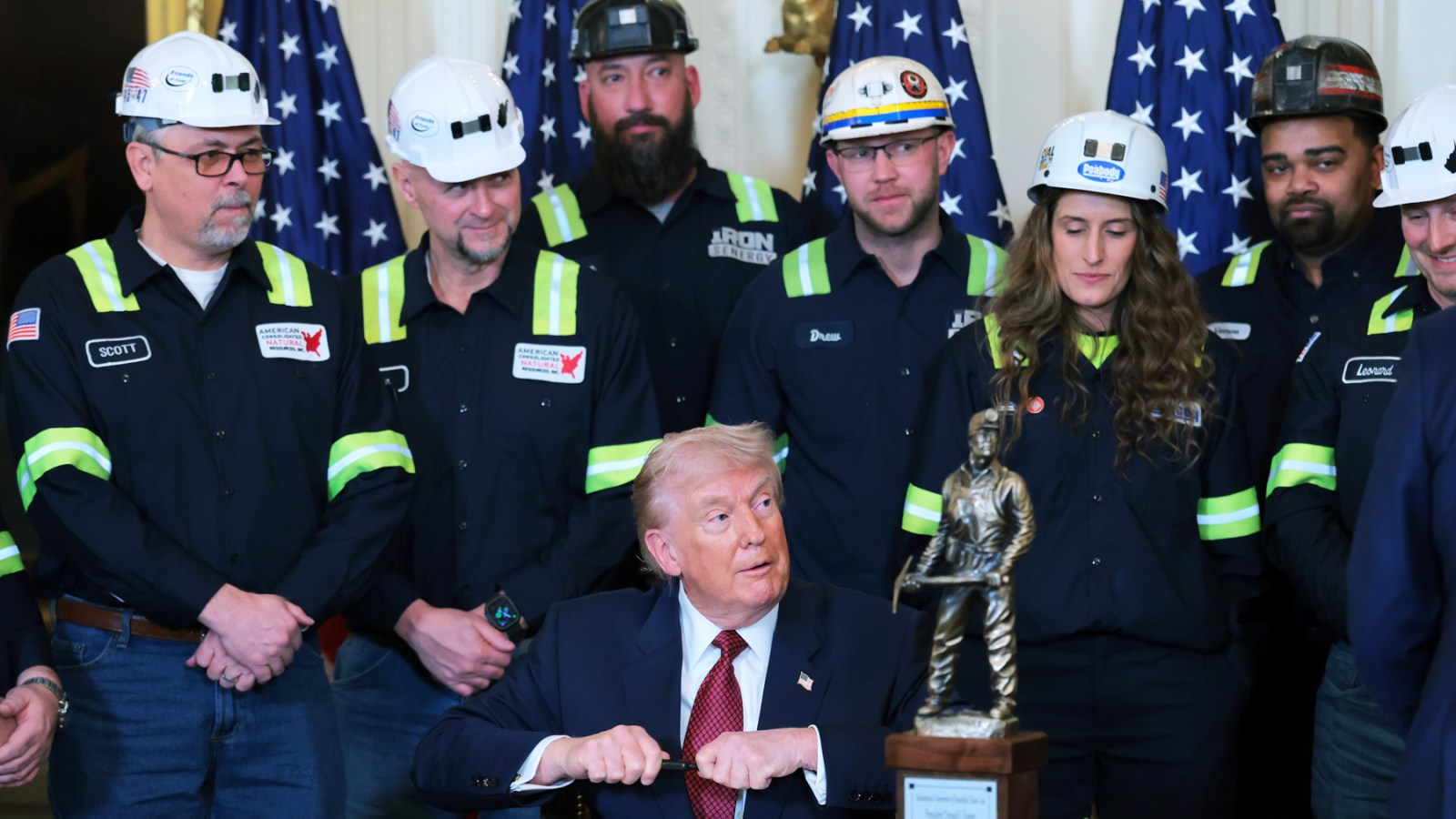
Donald Trump has been a major supporter of the coal industry since he entered American politics and donned a hard hat at his “Trump Digs Coal” rally in 2016. It's been part of his attempt to build an image as a populist, and he's repeatedly said he's going to revive the industry and bring back coal jobs. It was apparently with this goal in mind that the president last week ordered the Pentagon to purchase coal energy.
“I will sign an executive order that directs the Department of War to work directly with coal plants on the new power purchasing agreements, ensuring that we have more reliable power and stronger and more resilient grid power and we're going to be buying a lot of coal through the military now,” Trump said at a signing ceremony last Wednesday.
The coal industry has been in decline for well over a decade, partially because natural gas started out-competing coal after the fracking boom. At the same time, the cost of renewable energy has plummeted over the past 15 years, making it cheaper than coal energy. In short, coal has become one of the most expensive forms of energy in the US
Trump says he's going to bring back coal jobs, but that's pretty unlikely. Beyond the fact that coal is economically not the right choice for new energy infrastructure, many of the jobs in coal that used to be done by humans are now done by robots and machines. Automation came for the industry, and the jobs aren't coming back.
Costa Samaras, director of the Carnegie Mellon University Scott Institute for Energy Innovation, tells Rolling Stone that Trump's plan to make the Pentagon buy coal doesn't make much sense.
“On its face, this doesn't seem like a viable strategy for military installation energy resilience,” Samaras says. “It looks more like a strategy to have the government intervene in energy markets to prop up a favored fuel source that largely can't compete economically.”
Erin Sikorsky, director of the Center for Climate and Security, a climate change research institute, agrees—noting the cost of bringing new coal power to military bases “would be enormous.”
“There's nothing prohibiting the military from buying coal if it wanted to,” she says. “If it made economic sense or energy sense for them, they could do that. The fact that they're not doing it suggests the cost is too high.”
Military bases typically run on the same grid as their surrounding communities. Outside of some bases in Alaska, the military isn't getting a ton of energy straight from coal plants. Daniel Kammen, a professor of energy at the University of California, Berkeley, says Trump's plan to force them to would be “costly, backwards-looking and probably harmful,” noting that the price of coal power has remained relatively steady over the past couple of decades while the cost of natural gas and renewable energy has gotten cheaper.
Between 2010 to 2020, for example, the cost of solar energy plummeted from roughly $378 per megawatt hour of electricity to around $68. Coal remained at around $100 over the same time period.
The Department of Defense said in a statement provided to Rolling Stone that it “fully supports” Trump's executive order, and that it will “seek to procure long-term Power Purchase Agreements with coal-fired facilities where they enhance grid reliability, prevent blackouts, and ensure mission assurance for critical defense and intelligence operations.”
While Trump is working to prop up the coal industry, he's also doing what he can to kneecap the renewable energy industry. Since he returned to office last year, Trump's administration has stripped funding from renewable energy projects, and even tried to cancel renewable energy projects that are already in progress. The Environmental Protection Agency also recently revoked the “endangerment finding,” a landmark scientific conclusion that served as the basis for federal climate regulation.
Samaras says the administration is going about this all wrong.
“The top line is that the administration is restricting the growth of new clean energy supply and canceling investments in grid resilience … at the same time that artificial intelligence is spiking energy demand,” Samaras says. “We need a generational reinvestment in grid resilience to make sure our communities and our military installations have reliable and affordable power.”
Samaras says that simply because of market realities it is likely that solar, wind, and battery power will represent “90 percent or more” of any new power capacity added to the grid in coming years. The Trump administration can try to stop renewable energy, but it can't change the math.
While Trump tries to keep coal alive, the rest of the industrialized world is gradually moving away from fossil fuels. Trump and his allies love to cite that China is still building coal plants, but the nation is also building a ton of renewable energy, and coal energy use is declining in the country. China simply sees coal power as a decent backup in case of an energy emergency.
“Smarter national leaders elsewhere are investing in clean energy with more jobs, more flexibility and a lower cost,” Kammen says. “It is like having a president playing checkers while everyone else is playing chess.”