
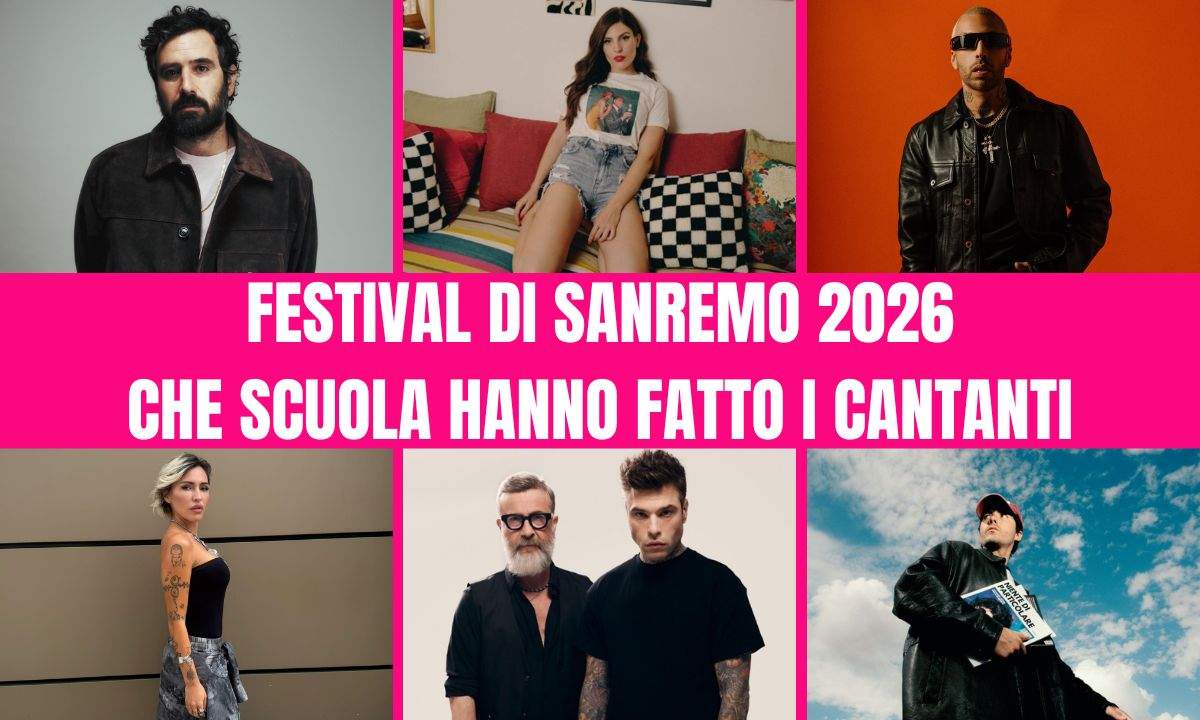
Sanremo 2026 doesn't just tell the songs, but also who sings them.
Looking at the educational paths of the artists competing at the Festival, a surprisingly coherent fact emerges: many high schools, very few technical institutes, many universities started and left, very few academic paths completed.
We rebuilt the qualifications of the singers of Sanremo 2026going beyond personal data curiosity. The result is a generational photograph that says a lot about the relationship between music, school and success.
From high school to university: how the Sanremo 2026 singers studied
The first evidence is clear: high school is the norm. Classical and scientific dominate, while technical institutes are today a minority in the Festival's cast.
Classical high school: the most frequent path
Classical high school is the most represented school among the Big 2026, often finishing with average or good grades, rarely excellent.
- Thomas Paradise – Classical high school + degree in Philosophy
- Michele Bravi – Classical high school, diploma with 100/100
- Dargen D'Amico – Parini classical high school in Milan
- Thunderbolts – Dante Alighieri classical high school in Prato
- Enrico Nigiotti – Classical high school
- Thirteen Peter – Classical high school, diploma with 60/100
- Eddie Brock – Classical high school + abandoned university
An interesting fact: classical high school almost never leads to a complete academic careerbut it often occurs among those who develop personal writing.
Scientific high school: less widespread, more pragmatic
- Luchè – Scientific high school + enrollment in Economics (no exam)
- Ermal Meta – Scientific high school + language faculty (left to an exam after graduation)
- LDA – Scientific high school
Regular paths, but almost always interrupted before graduation.
Linguistic and artistic high schools
- Malika Ayane – Language high school + business expert diploma (80/100)
- Mara Sattei – Linguistic high school
- Elettra Lamborghini – Language high school + university not finished
- Chiello – Melfi art high school (abandoned in the 4th year)
- Raf – Artistic high school + Architecture (university not finished)
Here a more direct link with creativity emerges, but once again without academic continuity.
Technical institutes: few cases, very different
- J-Ax – Molinari Industrial Technical Institute of Milan
- Samurai Jay – Technical Tourist Institute
- Sal Da Vinci – Accounting, diploma obtained at the age of 40
A generational fact: technical institutes today are marginal in the Sanremo castmuch more present in the editions of twenty or thirty years ago.
University: started yes, almost never finished
The majority of artists who enroll in university he doesn't make it to graduation.
Universities finished
- Thomas Paradise – Degree in Philosophy
- Toe in the sore – DAMS theater major (degree obtained)
- Marie Antoinette – Degree in History of Art
- Colombre – Degree in Literature
Very few cases, all linked to an authorial and conceptual approach.
Universities started and abandoned
- Ermal Meta – Languages (an exam was missing)
- Luchè – Economics (no exam)
- Raf – Architecture
- Francesco Renga – Economy and Commerce + Art Direction at IED (both abandoned)
- Levant – University not completed
- Eddie Brock – Left university immediately
Here the data is clear: the music comes before the title.
Musical studies: few, but decisive
Contrary to what one might think, academic musical studies are very rare.
- Serena Brancale – Jazz singing diploma at the Conservatory + studies at the Academy of Fine Arts
- Malika Ayane – Giuseppe Verdi Conservatory of Milan (cello)
- Patty Pravo – Benedetto Marcello Conservatory (piano, without diploma)
They are also the artists who, not surprisingly, are often recognized by the press for the technical quality of their interpretation.
What the Sanremo 2026 singers' school tells us
The photograph is clear:
- many high schools
- very few technicians
- many universities started
- very few degrees
Sanremo 2026 tells of a generation in which music does not arise from the academybut often by routes that are interrupted, diverted or left half-finished.
A fact that is not a lack, but a characteristic:
Italian song continues to form outside the classroom, even when it starts from school desks.