
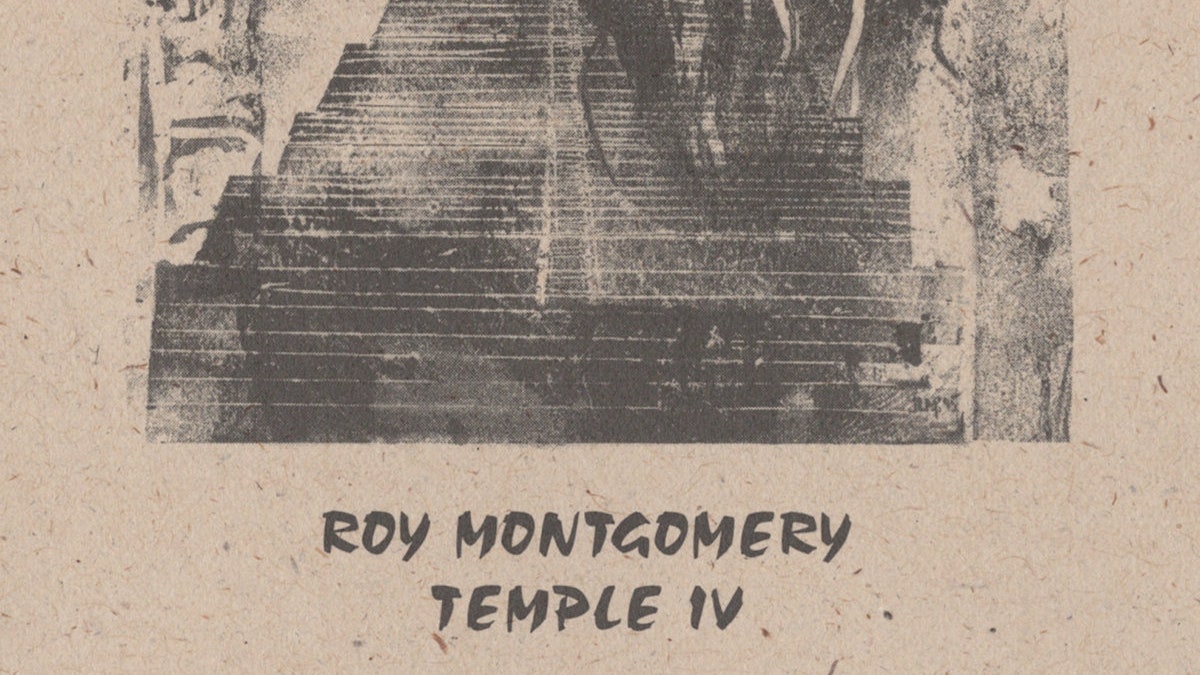
In grief, we look for signs and symbols, and often find them in nature. For Montgomery, the Mayan deities of jaguars and snakes connected to this music in a way “that I hoped wouldn’t be seen as just tourism,” he said. In Mayan culture, the jaguar was able to cross between the two worlds of day and night, but given its ease in the latter was regarded as a member of the underworld. The snake carried celestial bodies across the heavens, and with the shedding of its skin became a symbol of rebirth and renewal. Montgomery has these beings embody the bereaved’s conflict between hope and defeat in Temple IV’s most fearsome moment. “Jaguar Meets Snake” is eight minutes of white-knuckle feedback that seems to shear flesh from bone. Something about its gnashing intensity evokes the crunch point of irreconcilable pain, where nails dug furiously in palms offer a poor substitute for absolution. But the closer you listen, the more tenderness emerges: The wooly thrum below the noise suggests a safety net, one that allows the feedback to begin to jump and lurch with zip-wire glee, finding playfulness and freedom. In its most piercing blasts, there is the euphoria of being able to feel again after a long dull spell.
Even after that rebirth, Montgomery is not done with epics: The near 15-minute “Above the Canopy” is the longest but simplest song, a dense, insistent strum that seems to ring with good news, quietly triumphal and undisturbed by more than a whisper of static. The shortest, closer “Jaguar Unseen,” is almost groovy in its looseness, slipping from the scene in a swift fade-out: no grand climax or evolution. The wispy, mellowed guitars are as in sync as they were on “She Waits on Temple IV,” suggesting a cycle: another inevitable ascent up the mountain to come, and a calm readiness with which to approach it.
Decades later—after sporadic flurries of music in between completing a Ph.D., lecturing, and working as a volunteer firefighter after the 2011 New Zealand earthquakes—Montgomery would say that it was often intense life experiences, and particularly grief, that brought him back to music after long periods of inactivity. “Critical mass is reached when I’m thinking about doing a piece that acknowledges someone’s life,” he said. The Shallows’ “Suzanne Said” had memorialized Suzanne Irvine, a key figure from the Christchurch scene. In 2016, four decades after the Pin Group’s “Ambivalence,” Montgomery released four albums, collected under the title R M H Q: Headquarters, which hymned the likes of Sam Shepard and Popul Vuh’s Florian Fricke, evoked the death and destruction wrought by those earthquakes, and acknowledged the cancer that his partner and mother to their two children Kerry McCarthy had been diagnosed with in 2014. She died in 2021. The couple had been together 20 years, and Montgomery made 2022’s Camera Melancholia in the immediate aftermath: “I needed to respond while things were still raw rather than wait years, which is what happened when my partner Jo died in 1992,” he said.
Daniel D`Amico for SANREMO.FM