
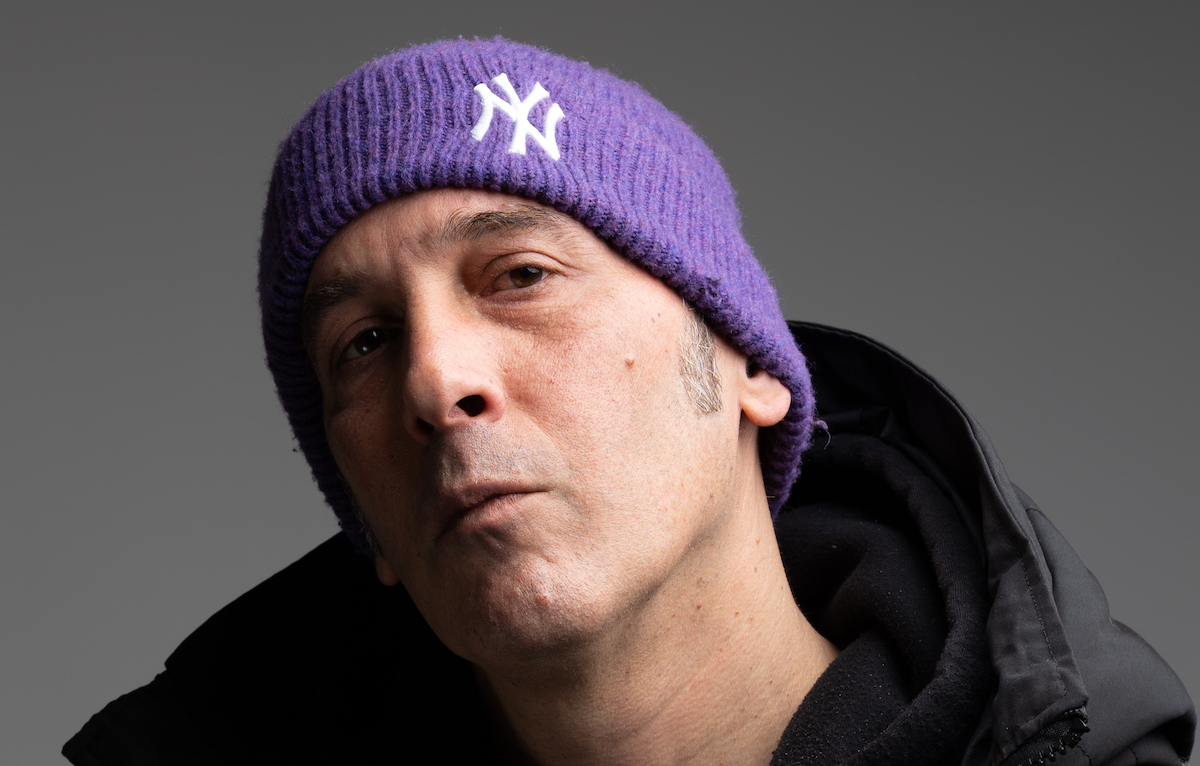
Don't call him a legend. He claims it doesn't suit him. Prefers veteran. For many, however, he is a master. Simone Eleuteri, aka Danno, is rap in Rome. And at 51 years old, and with over 30 years of career under his belt, he could only be outdone.
A story that began with a feeling of rebellion, never completely alleviated (“that combative boy remains alive and well”), in the early '90s and in the posse, from which Colle Der Fomento would then be born. Two historic albums also in the 90s with the production of Ice One; Full hatred (1996) e Science Double H (1999). Then only two more jobs: Soul and ice of 2007 and Adversus of 2018, interspersed in 2009 with Number 47the project signed Artificial Kid with Dj Craim and Stabber. But it took until 2026 to see the first solo album, Aka Danno. “I'm quite insecure, I change my mind every day,” he explains during a chat on Zoom a few days after the release, almost as if to justify himself.
He may not have published much, but his presence in freestyle and featuring competitions has always been constant, making Danno an almost sacred figure in the Italian scene. Not a holy man, however, but a fighting monk, a Shaolin of music. Or, without wanting to take away the sacredness, a soldier who “likes being in the trenches, having a microphone in his hand”. He has always felt this way: inside a personal war floating “while everything sinks, dancing in a corner and boxing with my shadow”. Or as he says in this album, “All my truths have been annihilated, now all I have left is the war in my head”.
In the 1990s he was a champion of the scene, then he understood that the same fundamentalist scene he defended was built on some incorrect interpretations. And on certain points he had to change his mind, as he says with rare humility: «I had to admit my and our ignorance. Over time I had to dismantle many beliefs. In the 1990s we had little information and dogmas were created.” One thing, however, remained with him. And on this he built his own identity. It's a phrase that, as a kid, he read on the back of the vinyl of Stop panicking. The phrase reads: “Our style versus your style”. This is Danno's war.
After over thirty years of career, your first solo album finally arrives. Let's start with the most obvious question: why now?
At a certain point I found myself with songs in my hands that I liked, that satisfied me. And feeling them together. I started to see a record in it, to hear a record in it. But I wasn't sure, I'm quite insecure and I change my mind every day. One day I want to make a record, the next day I don't.
In the end, however, that day has arrived. What had stopped you so far?
I was more interested in being on a stage, having a microphone in my hand, organizing my Roman evenings like It's The Joint. I like being in the trenches. And so my mind dedicated little space to the idea of a record. In the end, however, they convinced me.
Had there never been a moment like this in the past?
Yes, lots of ideas. Artificial Kidfor example, is already a kind of solo project, even though it's a group. I mean, I'm the only one rapping, unlike Colle. But I have a flaw: I fall so much in love with ideas, sometimes I abandon them, sometimes I take them back years later.
That's the fun side of making music, right? Even having the power to abandon them.
Absolutely.
What does it mean for you to release a solo album today?
It's a great satisfaction. But perhaps, on paper, it should have been done sooner. Maybe 20-30 years ago when I had more cock, more enthusiasm, more energy and determination. When you reach 50 you deal with other things. But I'm happy that my first solo album comes out in adulthood. I feel that I have managed to better combine my two souls: the combative, punchline one – because that combative boy remains alive and well -, and the more thoughtful, adult, perhaps even more “romantic” one.
Rap has come of age. I think of Fibra, Marracash, Neffa, Kaos, Guè. When you started, did you think rap would last this long?
No, no one believed it, especially in Italy, lacking the background that existed in America. Those who followed the music understood that it was the continuation of a certain black music, a tradition that the Last Poets followed. Here, however, it seemed like strange, alien music, destined to last a short time. But I already saw examples of artists bigger than me who were moving forward: Assali Frontali, Lou X, Speaker Dee Mo. Furthermore, I perceived an underlying seriousness in rap: it told the story of reality, it had energy but also weight. It was an unknown, but I felt like it wasn't a passing fad.
When you started there was a strong fundamentalism linked to the concept of “message” and purity in rap. But then everything opened up, taking rap from being a counterculture to a dominant culture. How did you experience that period and its overcoming?
I am someone who loves to be informed. And I had to admit my and our ignorance. Over time I had to dismantle many beliefs. In the 90s we had little information and dogmas were created. For example, the idea that you could only sample from vinyl, some even from the first pressing. Then he discovered that it wasn't like that in the United States either. I started with the posse, and there it was essential that the songs had a message. There was the piece on the mafia, the piece on the war, and so on. It was all a bit naive. But rap in Italy was not born with the posse, but in the 80s, when in discos people rapped in English to dance music. A little told story.
However, as you grow up you understand that black and white is often a convenient simplification. There are some veterans in America who have locked themselves in a cage of memories with a certain anger towards change. Others, however, have been able to understand the changes. However, returning to the previous discussion, when you are young you also need to have an enemy, a dragon to fight against: it gives you strength and identity.
And is there a dogma that has stuck with you?
A phrase that struck me behind the vinyl single of Stop Panic. It said: “Our style versus your style”. It wasn't specified which was ours and which was this phantom theirs. But it hit me. I said to myself: I want to think like this. That's why in one of Colle's first rhymes I say: “I'm not a Zulus, I'm from Rome”. I was claiming my new school. But then you have to make that effort for a moment and understand that everything goes forward. Everything changes everything. It transforms.
What relationship do you have and have you had with the generations that came later and changed the way of understanding rap?
The generation that comes after you wants war because it is right for children to want to kill their fathers. But then a generation passes, another passes, and I feel at peace, I no longer feel at war with the younger ones. If a 16 or 18 year old does something completely different than me, I look at it with curiosity. But I think that if you're really passionate, you also have to make the effort to understand what happened before. Knowing the history makes you appreciate what you hear today much more.
Is rap still a breaking genre?
It's less shocking than in the 80s, when it was considered “not music”. Today it has become pop, but it remains disruptive as long as it manages to tell reality without filters. It's no coincidence that in the songs there are machine guns every 3 seconds: the rapper on duty reminds you that if he could, he would shoot you anyway. But it's no longer a musical break – that ended with sampling, with “I'll steal what you made and reuse it however I want without asking permission”. The real revolution is now in the heads of those who write and those who listen. As the Beastie Boys said: «This genre was revolutionary. Today, in 2000, it has become pop.” Or as Ice Cube more or less says: it was a genre where reality was told when reality was scary and scared the listener. Today it has become a genre in which daydreams are told: the yacht, the Rolex, the champagne, and therefore in some ways it has paradoxically become a reassuring genre.
The language of battle, of the trenches, of war often returns on the album. And in 2004, with Cor Veleno you rapped “it's just my personal war”. Who do you feel you're fighting against today?
Not against colleagues. Maybe that happened in the beginning when they invited me for a record and I got that unpleasant feeling of saying: I have to destroy you on your record.
In that song you have a very long verse, more than 32 bars if I remember correctly.
Oh yes, I was a little competitive, but in a calm way! (laughs). When I sent back certain verses he said to me: “yeah you could have told me that you made it so long”. (laughs)
But that's okay. It's rap: competing and challenging each other to make each other better.
Anyway, yes, I'm always a bit at war. But against certain logics of the music industry. This is why I created my own label (Kill Bozo Records) where I have control over everything, from masters to editions. I understand that I'm an alien: I don't have Instagram, a person manages it for me, if I want to check it I have to ask my girlfriend. My “war” (“put four quotes in there”, he tells me ed.) today it is musical. Like when I do DJ sets and I put something on that people don't expect and they say “what the fuck are you putting on?”. I like to propose things that for me are cool things that should be listened to and that maybe are a little unknown stuff.
On the front line against the system.
Mine is a war against what is happening in the world, on how words are being used. When I see the news I have to stop, I have to turn off, because there is this truly bad faith use of words. This stuff drives me crazy, because then there's no longer any way to dialogue, and when the words fall out, you can't use them anymore. I was a naive dreamer deluded into believing that human beings, by understanding 2 or 3 things, could go in a more decent direction. There are very serious problems outside and I inevitably react with my music.
I can't interview Danno without talking about Rome. How has your relationship with the city changed in recent years?
You know, I understood one thing: there's no point in complaining. I complained a lot in the 90s. Then I understood that if there isn't something in the city, you have to start doing it yourself. And so I did with my evenings, the radio. In recent years we have seen places close and a lot of stuff die. Today it seems to me there is a bit of a desert.
But you continue to love her, even if you sing Rome burns.
My relationship with Rome is conflictual but profound, and it is inevitable that it enters more and more into my music. Rome remains alive. It's you who doesn't survive in Rome. Rome always survives.