

Something crazy comes to mind. New photos are circulating these days of the meeting between Pink Floyd and Syd Barrett at Abbey Road, during the recordings of Wish You Were Here. It has always been believed that Syd's appearance was an impromptu appearance. He had materialized, had shocked everyone with the transformation he had undergone, from a handsome and charismatic young man to a fat and bald man, and then, just as he had arrived, he had vanished, leaving everyone bitter and with a lot of guilt. Now it turns out that Barrett actually stopped in the studio, perhaps he returned several times. So one thing comes to mind: what if Pink Floyd had lied about some phases of their history? What if Syd, instead of disappearing from the radar as they always pretended, had remained to act as a mentor/adviser? After all, when he went crazy, Waters and the others had thought of confining him to the role of author behind the scenes, leaving the recordings and concerts to the band. The four most famous guitar notes in the world, those of Part 2 Of Shine On You Crazy Diamondthey are called Syd's Theme. What if this theme wasn't dedicated to Syd, but was by Syd? Clearly it's just a fantasy, but it's no secret that Barrett's presence hovers everywhere in Wish You Were Here.
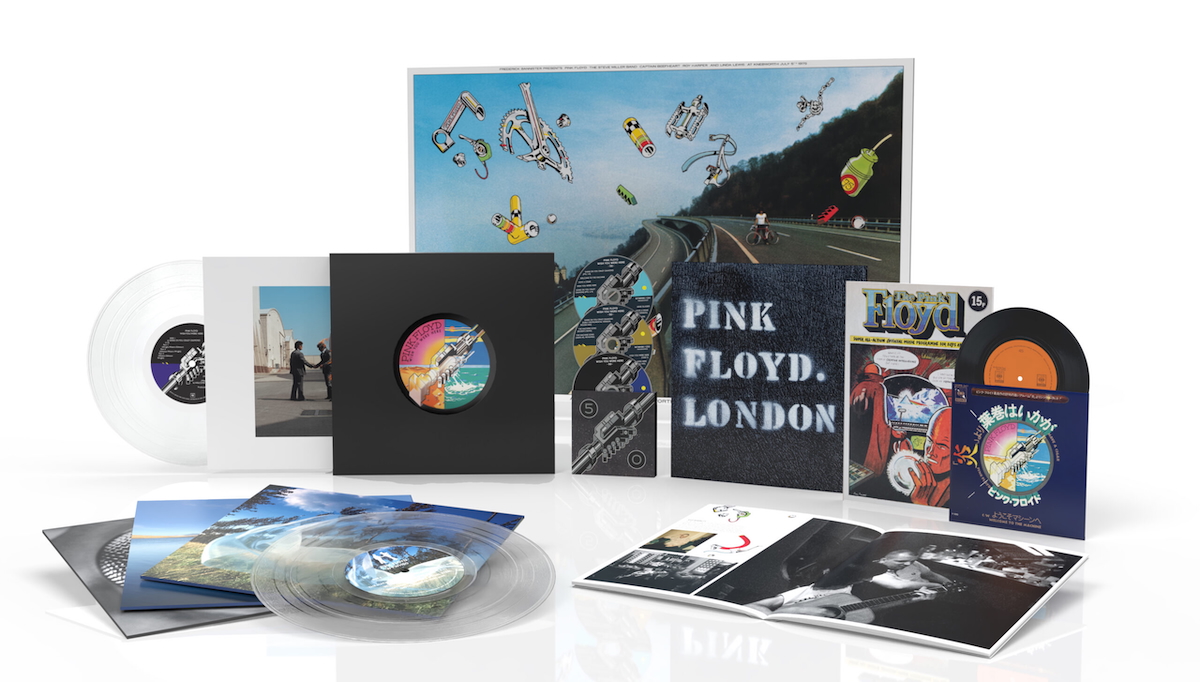
It was thought that the box Immersion of 2011 had put on the plate all the available material relating to the 1975 album, but we were wrong. For the fiftieth anniversary, unreleased auditions are about to be released, a bootleg has been created and the album has been remixed in stereo and Atmos. Not to mention the deluxe package, with all the necessary gadgets and memorabilia: a book with unpublished photos, a reproduction of the tour programmea Knebworth concert poster, a replica of the Japanese single by Have a Cigar. But all this nonsense tells us something we didn't know about Wish You Were Here? Maybe not, but upon closer inspection (listening), it's as if it brings one of the key moments in Pink Floyd's history into greater focus.
Wish You Were Here it is Pink Floyd's last album as a compact band. Then there will be those under the Waters dictatorship, followed by (alas…) those under the Gilmour dictatorship. The group as a four-headed entity ceases to exist with the album that follows the mammoth The Dark Side Of The Moona work of capital importance in the history of rock as well as a huge success that still makes its echoes heard today. Following this consensus, the band pockets rivers of money and withdraws into itself. How to proceed after an exploit like this? Waters has an idea: screw everything, let's do what no one has ever done before, an album that uses only the sounds of kitchen utensils. The group doesn't care about repeating a crazy success and chooses the path of hard and pure experimentation. Going back to what was said above, maybe one day we will discover that it was Syd's idea.
After a few weeks, however, the four get bored. Trying to come up with interesting music using pots and forks is difficult, perhaps it's better to listen to those at EMI, who already fear the worst: make another “real” record, which repeats (and perhaps surpasses) the success of the one with the prism on the cover. Backtrack, then. The ranks regroup and Pink Floyd are more Pink Floyd than ever. Wish You Were Here it is in fact the emblem of Pink Floyd's sound. As if they had decided to compile a catalog of everything that characterized them, even more than that Dark Side. Of course, that too is a perfect drink of Floyd juice, but Wish it is even more so. Less tormented, more airy, atmospheric, languid, majestic. But without exaggerating, everything is measured, rarefied. It is the work that everyone is waiting for, with what fans of the last hour (those of the psychedelic era have been turning up their noses for some time now) love: music on the wings of a dream, with large carpets of keyboards on which Gilmour's melancholy guitar moves and even more melancholy lyrics. It's a farewell album that brings together for the last time four heads who create together just when it seems that ideas are running out, that passion is over, that riding the tiger has swallowed up any desire to get involved.
While everyone enjoys the wealth, Comrade Waters feels guilty. THE Money they won, they bring happiness but also problems, they distance you from the real world. Hence the feeling of emptiness that the bassist feels and which he pours into lyrics that speak of Syd's (real or presumed) absence, of the absence of humanity in technology and the recording industry. The lyrics were so empathetic Echoes (“And I am you and what I see is me”), how disillusioned is the poetic material of Wish You Were Here. But these are all things that were already known, there was no need to wait half a century to remember them. But the digging between the sessions, the concert at the Los Angeles Sports Arena on April 26, 1975 (excellently revitalized by the increasingly sprawling Steven Wilson) and the remixes brought them into play with some new stimuli.
Having said that yet another remaster of the original album adds nothing to a sound that was already perfect (even if the recording of the drums, to my personal taste, has never been perfect), we need to understand what was still missing from Floyd 1975. That one of the compositions with household objects (glasses filled at different heights to create harmonies made to resonate with the fingers) had been used for the Part 1 Of Shine On You Crazy Diamond we had discovered it with the Immersion. And the game is revealed: every anniversary a box set is released with previously published material plus drops of unreleased material. At the 60th, others will appear. And that's fine, records have to sell somehow. Plus we now know that in Waters' demos Welcome to the Machine it was already almost defined, but the help of the others had fleshed it out on a sound level and added tempo changes (from 4/4 of the vocals to 6/8 of the instrumental). The guitarist's tense voice had also taken the place of the bassist's cavernous one. There is Shine On You Crazy Diamond without Part 1 And 9without solos and without voices that highlight the textures of the keyboards and the full-bodied bass (will it be Waters or Gilmour? For the touch and essentiality I would lean towards the former).
Wish You Were Here (the song), then, is present in the version with Stéphane Grappelli, already inImmersionwhich in the end it had been right to cancel. Even though the violinist was a monster of skill, his instrument was distracting. The song is fine as it is, bare, essential. In addition there are the unreleased versions with pedal steel guitar highlighted, with sections then cut and the vocal parts still to be fixed. They are the semi-acoustic Floyd, the ones who give Cirrus Minor to Fearless they revealed the most delicate (but not free from concerns) part of their proposal. There is Have a Cigar sung by Waters and we understand how right it was to entrust it to Roy Harper. Not that Roger couldn't do it, but Harper gave him that extra something, that cynical tone that was needed to impersonate a ruthless record company.
Another thing is to listen to us play live a few months before Wish was published. Here we realize that Pink Floyd didn't care about redoing the parts of the records in concert exactly. There are Raving and Drooling And You've Got to Be Crazy (which will then be Sheep And Dogs on Animals) and one Shine On You Crazy Diamond still to be fixed, with guitar parts appearing where they shouldn't and vice versa (but that's okay, it was still a work in progress), with Waters who at times goes out of tune, Gilmour who sings on his own but doesn't excel and a Mason who is much more nervous than on record. Finally Richard Wright: the Floyd sound rests almost entirely on him. Dark Side live he has several improvised parts, and on the encore of Echoes they put Dick Parry's saxophone there, which is real heresy. All this to say that today a group that has sold millions of copies, but is so shaky live, would have no history. But we also love them because they were like that: dirty, worn out, uninterested in perfect results. Mason recently stated that Pink Floyd's live performance improved after Waters left. Of course, with the click, the backing tracks and an army of guitars, keyboards and percussion it's easy to get a clean sound. But that smoothness did not belong to the real Floyd and the Los Angeles live show shows them in their most lively and irregular version.
From my point of view the best thing in the box set is a remix (by James Guthrie) of Shine On You Crazy Diamond. The suite shines in all its beauty in a collage that brings together all nine parts for a total of over 25 minutes. The remix gives more emphasis to the vocal parts and solo interventions of Gilmour and Wright, the drums sound better, everything is more compact. Not that the original wasn't, but here everything is more defined. And certain remix operations are welcome if they highlight new nuances and make even more comprehensible what was a little obscured in some 70s recordings (not just Floyd's). Compared to other suites – Atom Heart Mothergreatly jagged and symphonic, ed Echoes to travel in space – Shine delves into nostalgia and transforms it into sound, with the thrilling ending of the Part 9in which Richard Wright's miniog takes fragments of See Emily Play. Here finally everything comes back, everything comes together again.
Daniel D`Amico for SANREMO.FM