
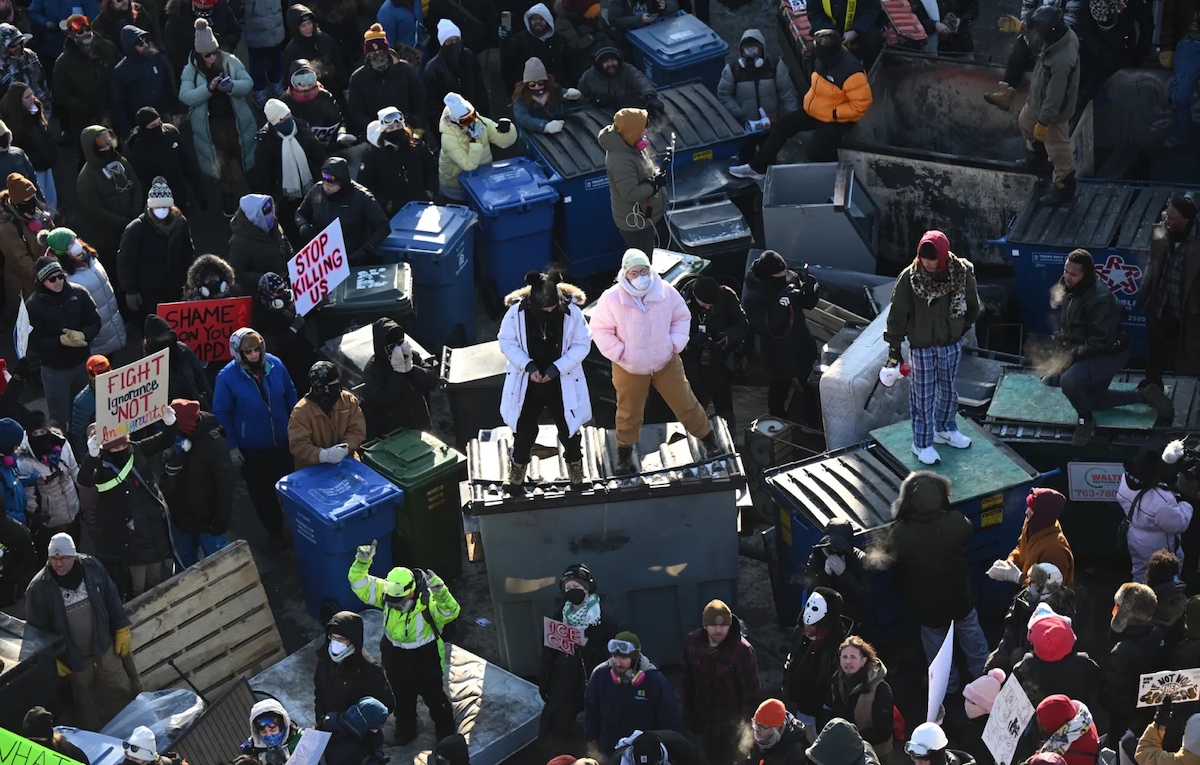
On January 24, a group chat message about ICE's moves woke Matt Jones: Someone had reported shots fired at the intersection of 26th Street and Nicollet Avenue. Jones went there within a few minutes and found Alex Pretti lifeless and with his face covered, killed by federal agents. The crowd of angry and terrified citizens grew around the body. Jones joined in their chants: “Fuck ICE!”, “ICE out!”, “murderers!”.
As he was about to leave, given that there were rumors of possible mass arrests, the officers began to press on the demonstrators, apparently to clear a passage for passing vehicles. Pushed backwards, Jones nearly fell. «I took a step forward to regain my balance and the officers interpreted it as an aggressive gesture. One of them said: “Who just pushed me? We're the ones pushing you, you don't push shit.” He grabbed me and threw me to the ground.”
Perhaps, Jones thinks, the attempt to stay upright has to do with instincts developed in the pits. He is part of the Minneapolis punk scene, plays in two hardcore bands, is the drummer in Rubberman and guitarist in Buio Omega. “Everyone I know who resists this occupation is part of the scene.” ICE agents brutalized and stopped several musicians on the street. Many are organizing themselves as best they can. In the history of Minneapolis resistance, punks have a chapter of their own.
For Jones, doing his part means observing. That's why at least four officers jumped on him, handcuffed him, crushed his legs and pushed his forehead against the frozen ground. They ripped the gloves off his hands and for over 15 minutes he remained in the freezing cold, screaming and asking for someone to put them back on. “No one listened to me.” They forced him into a Chevy Suburban along with four officers who were desperately trying to keep warm. When the vehicle began to move, protesters strewn the route with obstacles such as Lime scooters and bicycles, anything that could activate the automatic anti-collision braking system. ICE describes such actions as “attempts to vandalize and destroy government vehicles.” Jones instead defines them as “the work of splendid American heroes.” They are his fellow citizens, and they are organized.
After all, coordination and communication are two fundamental pillars of any music scene. “DIY musicians are born organizers,” says Juno Parsons, a Minneapolis musician involved in several bands. Throughout the city there is no shortage of examples of initiatives organized by artists. The punks serve free meals at the Post Modern Times restaurant and tattoo friends in exchange for mutual aid donations at the Kaleidoscope Tattoo Collective. Parsons likens it to organizing a concert: you find a space, get people involved, advertise the event, figure out who's bringing the equipment, and so on.
In this decade alone, the South Minneapolis punks who take to the streets today have experienced the riots following the murder of George Floyd and the shooting at the punk house Nudieland, which left several injured and the death of August Golden. These moments of rupture stimulated an almost instinctive community response, laying the foundation for addressing the situation today. While larger venues have hosted charity events with well-known names, the day-to-day work happens on a smaller, improvised scale, in rooms, neighborhoods, scenes. For example, there is a venue in the city, whose address we do not want to make public, which has already hosted several of these events. Once informally called The New Warehouse, it is located in the industrial area and is run by a collective of multidisciplinary artists.
On any given evening, the Warehouse can host a punk concert, a noise set or a rave. At the entrance there is a table covered with materials: personal protective equipment for ICE observers and food for those who want to stay indoors. All this is possible thanks to the work of volunteers. In addition to the concerts, there will soon be cybersecurity classes to help the community protect themselves from ICE's surveillance state.
The Pilllar Forum is an age-restricted music space, cafe and skate shop located on Central Avenue in the Northeast Arts District. In the last month the surrounding area has been affected by intense ICE activity. During a benefit concert, officers beat people and sprayed pepper spray, causing the event to be cancelled. Since ICE came to town, Pilllar has become an informal community center where people stop during neighborhood patrols. “People who are on the street every day also pass by Pilllar,” says Parsons, who works there as a production manager.
Soon after Renee Good's murder, donations started arriving at Pilllar where there is a wall full of respirators, whistles and hand warmers. A similar scene can be found to the south, at the Seward Cafe, a restaurant and venue with tables overflowing with donated clothes and shelves full of hygiene products and food. At Twin Town Guitars, however, there's a bucket of free whistles and rights brochures near the entrance. The signs posted say it, ICE is not welcome in any of these places.
It's no surprise that local businesses exercise their right to refuse those who treat the community with contempt. Jones' photo was shared by ICE with the caption: “On January 24 our agents were surrounded and attacked by these violent agitators.” Rapper Nur-D, stopped during the same protest as Jones, explained that he had been arrested for “assaulting a federal agent.” James knows what that means: “They told me the exact same bullshit when they tried to question me. It's something so absurd that you almost have to laugh: I didn't do anything violent.”
ICE began reducing its presence in Minneapolis last week, but that doesn't appear to have eased the tension. A spokesperson for the Department of Homeland Security said that “the First Amendment protects free speech and peaceful assembly, not riots. We are taking appropriate and constitutional measures to uphold the rule of law and protect our officers and the public from dangerous rioters.”
It is impossible to precisely measure the amount of work done by the music community. «I've heard people ask a lot of times: where have the punks gone?», says the manager of the Warehouse, also a musician in some bands. «In the scene we are used to initiatives like this, we just do them, we don't talk about them».
So where did the punks go? They are on the streets, raising funds, bringing food to those in need. DIY music scenes offer a very solid basis for organizing, and hardcore and punk scenes, in particular, are inherently politically charged. As Jones says, “If you're not ready to face a fascist scumbag, what the fuck are you listening to punk for?”
From Rolling Stone US.