
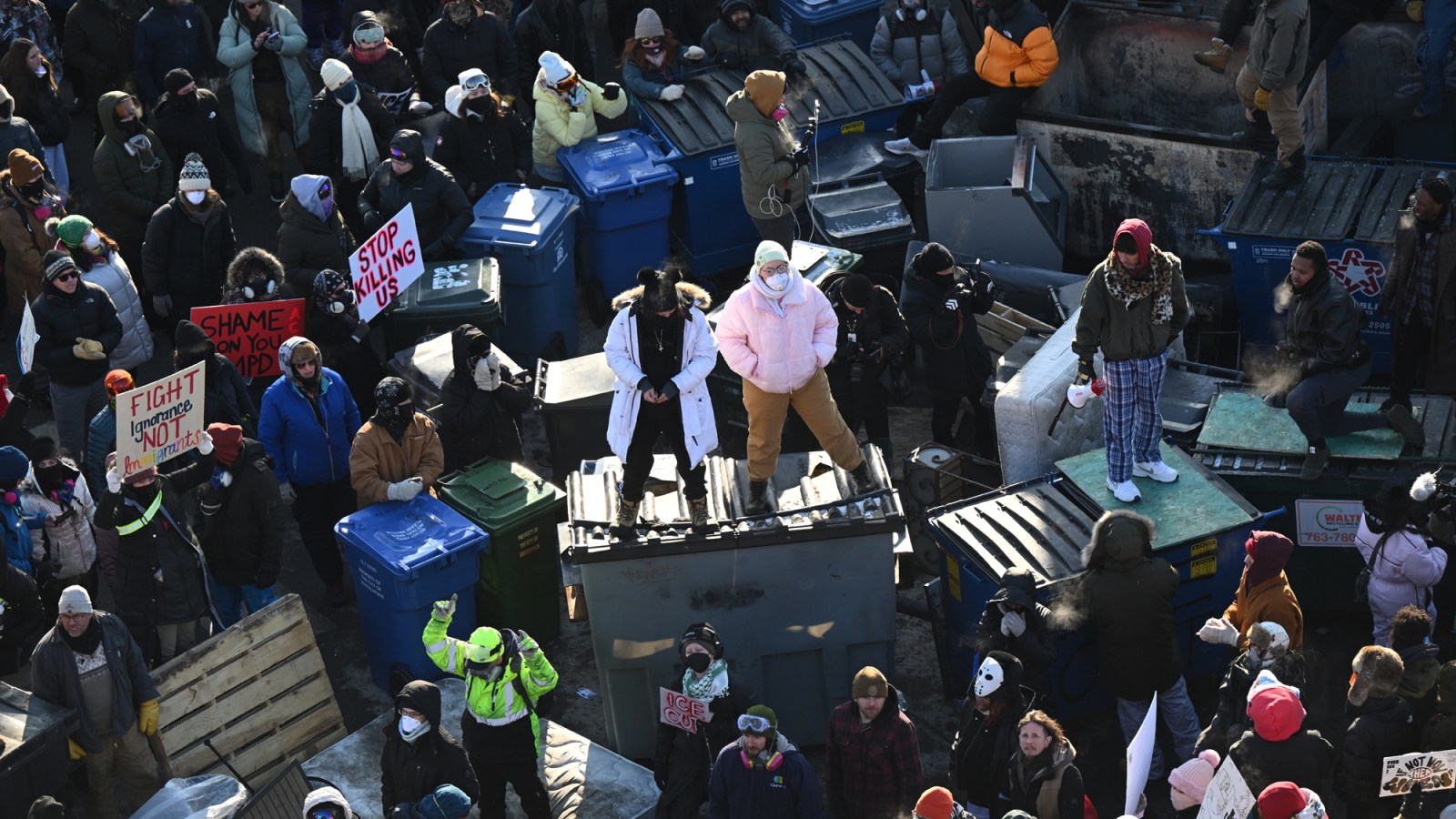
On the morning of Jan. 24, Matt Jones woke up to a message in the rapid response observers' group chat, where he and others in Minneapolis had been trading information about ICE. According to the text, there were gunshots reported at 26th and Nicollet Ave. Minutes later, Jones was there. A man who would soon be identified as 34-year-old Alex Pretti had just been shot and killed by masked federal agents, and a crowd of angry and terrified citizens was growing. Jones joined chants that have become common in the streets of South Minneapolis: “Fuck ICE,” “ICE out,” and pointedly on this occasion, “murderers.”
As Jones was getting ready to leave the scene — rumors had started to spread about the potential for mass arrests — agents began to push Jones and a group of protesters back, seemingly in an attempt to clear a path for vehicles to come through an alley. As he was pushed back, Jones says, he stumbled over some snow. “I kind of stepped forward to regain my balance, and they took that as aggression, I guess. One of them was like, 'Who just pushed me? We push you, you don't fuckin' push us.' He just grabbed me and threw me down,” Jones says.
It all happened quickly, but Jones wonders if his attempts to steady himself and stay on his feet were due to his pit instincts. As part of Minneapolis' vibrant and active punk scene, Jones plays in two of the city's most intense hardcore bands: drums in Rubberman and guitar in Buio Omega. “At least in my little corner of the world, pretty much everyone I know involved in resisting this occupation is involved in the music scene,” Jones says. ICE agents have brutalized and detained multiple musicians in the streets. Countless others in the city's many music scenes have been organizing however they can. In the greater story of resistance in Minneapolis' streets, punks have a chapter of their own.
For Jones, doing his part meant observing, which led to at least four officers jumping on his back, handcuffing him, crushing his legs, and grinding his forehead into the frozen concrete. “It felt like I had a guy on each limb of my body,” he says. His gloves got knocked off his hands, and for over 15 minutes in the dangerous cold, he yelled for someone to put them back on. “Nobody was listening.” He was then stuffed into a Chevy Suburban with four agents desperate to get warm. When the car finally got moving, protesters began throwing obstacles in its path — Lime scooters, bicycles, seemingly anything that might trigger the car's automatic anti-collision braking system. ICE describes actions like this as “efforts to vandalize and destroy government vehicles.” Jones thinks it's the work of “beautiful American heroes.” They're his neighbors, and they're organized.
Coordination and communication, after all, are cornerstones of any music scene. “DIY musicians are natural organizers,” says Juno Parsons, a Minneapolis musician in multiple bands. There are examples of organizing efforts by artists across the city. Punk rockers are serving up free meals at the restaurant Post Modern Times and asking up their friends in exchange for mutual aid donations at Kaleidoscope Tattoo Collective. Parsons likens throwing a show to caucusing — finding a room, herding people to get involved, letting people know it's happening, figuring out who's bringing the necessary equipment, and so on. This decade alone, the same South Minneapolis punks currently protesting in the streets lived through the uprising around George Floyd's murder and the Nudieland punk house shooting, which resulted in multiple injuries and the death of August Golden. These inflection points prompted community action as an instinct, laying the groundwork for this harrowing moment.
While bigger venues have used their established infrastructure to host big benefits featuring big stars, the work is happening on the smaller makeshift scale across multiple rooms, neighborhoods, scenes, sounds, and contexts. A local DIY space, which doesn't advertise its address publicly, has already hosted several of these events. At one time referred to colloquially as “the new warehouse,” it's settled in an industrial area and run by a multidisciplinary artist collective. (If you want to know where it is, follow the advice of any DIY show flyer and “ask a punk.”)
“A big part of the mission statement was that a lot of us were part of multiple different arts or music scenes that were all otherwise disconnected for no real reason other than separation of genre or medium,” says one operator of the space, who agreed to speak under the condition of anonymity.
Any given night at the warehouse could feature a punk show, a noise set, or a late night rave. When you walk in, there's a table by the entrance covered in supplies — PPE for ICE observers and groceries for neighbors sheltering in place. This is largely thanks to the efforts of volunteers. “So much of the community work we're doing now is us as a vessel and less as a pointed operation,” the warehouse's operator says. In addition to throwing shows, they'll soon host cybersecurity trainings for community members to better protect themselves and others in ICE's surveillance state.
PILLLAR FORUM IS AN ALL-AGES MUSIC venue, cafe, and skate shop located on Central Avenue in the Northeast Arts District. The surrounding area has been buzzing with ICE activity over the past month; there was an incident outside a recent mutual aid benefit show in which ICE beat and pepper sprayed attendees, forcing the show to be canceled. Since ICE came to the city, Pilllar has become a makeshift community center for people to stop in during neighborhood patrols. “The people that are in the streets every day are also in Pilllar every day,” says Parsons, who works as Pilllar's production manager.
Immediately after Renee Good was killed, donations began pouring into Pilllar. What started as a table of supplies has become a full wall of respirators, whistles, and hand warmers, all frequently refreshed. It's the same scene further South at the cooperatively owned restaurant and venue Seward Cafe, with tables overflowing with donated clothes and shelves stocked full with toiletries and food. Head over to Twin Town Guitars and you'll find a bucket of free whistles and “Know Your Rights” literature by the front door. According to posted signs, ICE are not welcome at any of those three businesses.
It's no surprise that many local businesses are exercising their right to refuse service to an organization that treats this community with contempt. Jones had his photo shared by ICE with this caption: “On January 24, our officers were swarmed and attacked by these violent agitators.” Rapper Nur-D, who was violently detained at the same protest as Jones, previously told Rolling Stone he felt “gaslit” when told he was arrested for “assaulting a federal officer.” Jones can empathize. “They said that same shit to me when they tried to interrogate me,” he says. “It's so fuckin' absurd. You just kind of laugh, like, 'OK dude, I did nothing violent at all.'” (This week, ICE began to scale back its presence in Minneapolis, though it doesn't seem to have calmed tensions in the city. Representatives for ICE and the Department of Homeland Security did not immediately respond to a request for comment.)
The full measure of quiet DIY work happening within the music community in an effort to help neighbors is impossible to assess. “I've seen an unfortunate narrative a few times of people being like, 'Where are the punks,'” says the warehouse operator, who also plays in multiple bands. “So much of the scene is so used to doing shit like this that they're just doing it and not talking about it.”
I know where the punks are? They're in the streets, they're raising funds, and they're running supplies to neighbors. DIY music scenes create a strong groundwork for organization, and hardcore and punk, in particular, can be politically galvanizing. As Jones put it: “If you aren't ready to get in the face of a fuckin' fascist, what the fuck are you doing listening to punk?”
