
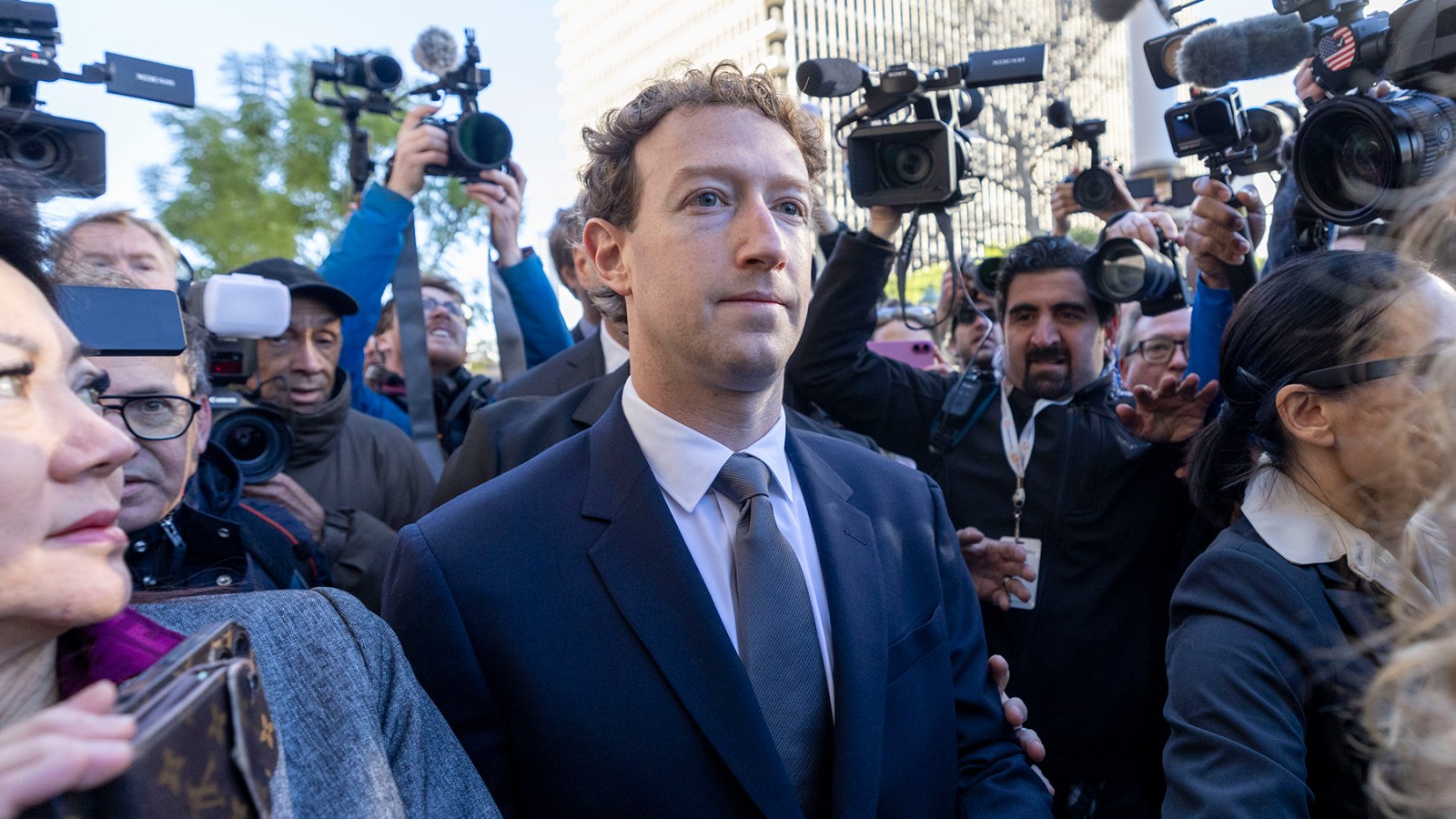
Billionaire Meta CEO Mark Zuckerberg took the witness stand Wednesday at a landmark tech-addiction trial in Los Angeles and flatly denied he ever set company-wide marching orders to juice “time spent” on Meta's platforms or lure kids under 13 as users.
Under blistering cross-examination by prosecutors' attorney Mark Lanier, the Meta chief looked visibly irritated at times, arching his eyebrows and shifting in his chair as he was confronted with a string of internal emails and slide decks. Lanier repeatedly cut him off, citing time limits, as the exchange grew tense.
One such moment centered on an email Zuckerberg sent in December 2015, writing, “What I hope we can accomplish in 2016,” which included the aim to increase “time spent” by 12 percent over a three-year arc. Lanier asked if Zuckerberg could see a copy of the email in a binder in front of him. “Did you write that goal?” Lanier pressed.
“I believe I wrote this email, if that's what you're asking,” Zuckerberg replied. “And, like I said, we used to have goals around this, and at some point, I decided to change that.” He insisted he later scrapped “time spent” targets in favor of “milestones” tied to delivering “value” to users. And he suggested the email was more brainstorm than send.
“I'm not sure if these were official goals or anything,” he said. “I wrote my thoughts on what I was hoping to see.” Lanier wasn't buying it.
“Sir, you are the decision maker for your entire company,” he shot back. “If there's an email entitled 'company goals,' and you say you want time spent to increase 12 percent in three years and 10 percent in five years, don't you think people will interpret that as company goals?”
“I don't know how it got distilled into company goals,” Zuckerberg responded flatly, maintaining he no longer runs Meta that way.
'I'm well-known to be very bad at this'
Over several hours on the stand, the 41-year-old tech titan leaned into his famously awkward persona. Asked whether he'd undergone extensive media training, he cracked, “I've done media over time, but I'm sort of well-known to be very bad at this,” drawing light laughter from the gallery.
When questioned about his staggering fortune — estimated at more than $200 billion — Zuckerberg volunteered, “It might be worth adding that I pledged to give almost all my money to charity.” He also testified that “a reasonable company” would aim to help users, not harm them, in order to keep their business.
The state-court trial zeroes in on claims that Instagram and YouTube functioned as “digital casinos,” allegedly engineered with addictive features to hook kids and keep them scrolling despite known dangers.
The protesters, a 20-year-old California woman identified as KGM because she was a minor when she allegedly became addicted to social media, says the platforms fueled anxiety, body dysmorphia, self-harm and suicidal thoughts. Her case is the first “bellwether” trial among more than a thousand coordinated personal injury suits against social media giants. KGM was in the courtroom for the first two hours of Zuckerberg's testimony but later left.
'Problematic use' or 'clinical addiction'?
Zuckerberg co-founded Facebook in 2004. The company acquired Instagram in 2012 for approximately $1 billion, and was rebranded as Meta Platforms in 2021. Last week, Instagram head Adam Mosseri testified as the second witness in the high-profile trial. Mosseri told jurors he believes there's “such a thing as using a social media platform more than you feel good about,” but he considers such behavior “problematic use,” not a “clinical addiction.”
Psychiatrist Dr. Anna Lembke offered a contrasting view when she was called as the first witness at the closely watched trial. The medical director of Stanford University's addiction medicine program and author of the bestselling book Dopamine Nation told jurors she believes social media carries the risk of clinical addiction due to “potent” features such as autoplay, notifications, and “endless scroll that never ends, with no bottom to it.” She said the risk is highest for kids because their brains aren't fully developed and lack impulse control.
“Instagram and YouTube provide 24/7, effectively limitless, frictionless access to their products, with ineffective age verification and ineffective parental controls,” Lembke told jurors. “It's clear parents, by and large, are not using them because they're difficult to navigate, and kids can get around them.”
At least a dozen bereaved parents who say their kids became addicted to social media before they died from suicide, drug overdoses, or accidental asphyxiation vied for seats in the courtroom amid fierce competition and a public lottery. When a court staff member called the ticket number for Tammy Rodriguez, the group cheered in a hallway. Rodriguez was among the first parents to bring her back in 2022. Her 11-year-old daughter Selena died by suicide on July 21, 2021, after allegedly becoming so addicted to social media, she would run away from home or turn violent when her devices were confiscated or lost power, Rodriguez says. “We busted the courtroom doors open. It's not whether we win or lose, because we're always losing children … it's to hold them accountable, just to make them sit there and have to tell their dirty secrets,” she previously told Rolling Stone.
Fellow plaintiffs parents Brandy Roberts and Joann Bogard also snagged seats and joined Rodriguez in the back row of the courtroom to watch Zuckerberg's testimony.
The role of technology in teens' lives has loomed large at the trial. Lawyers for Meta and YouTube argued in opening statements that the apps help kids combat loneliness, pursue creative expression, and access educational resources. Meanwhile, a recent survey of American kids aged 13 to 17 from Pew Research found that 48 percent of teens say social media sites have a mostly negative effect on people their age, up from 32 percent in 2022.
Alarmingly, suicide rates among young people aged 10 to 24 rose sharply between 2007 and 2021, spiking 62 percent, according to the Centers for Disease Control. Before that, the suicide rate for young people remained stable between 2001 and 2007. Health experts, including Lembke and former Surgeon General Vivek Murthy, say teens are especially susceptible to social pressures, peer opinions, and peer comparison. Risk-taking behaviors also reach their peak during adolescence, they say, and if teens already are susceptible to addiction, the risks are greater.
This is a developing story…
