
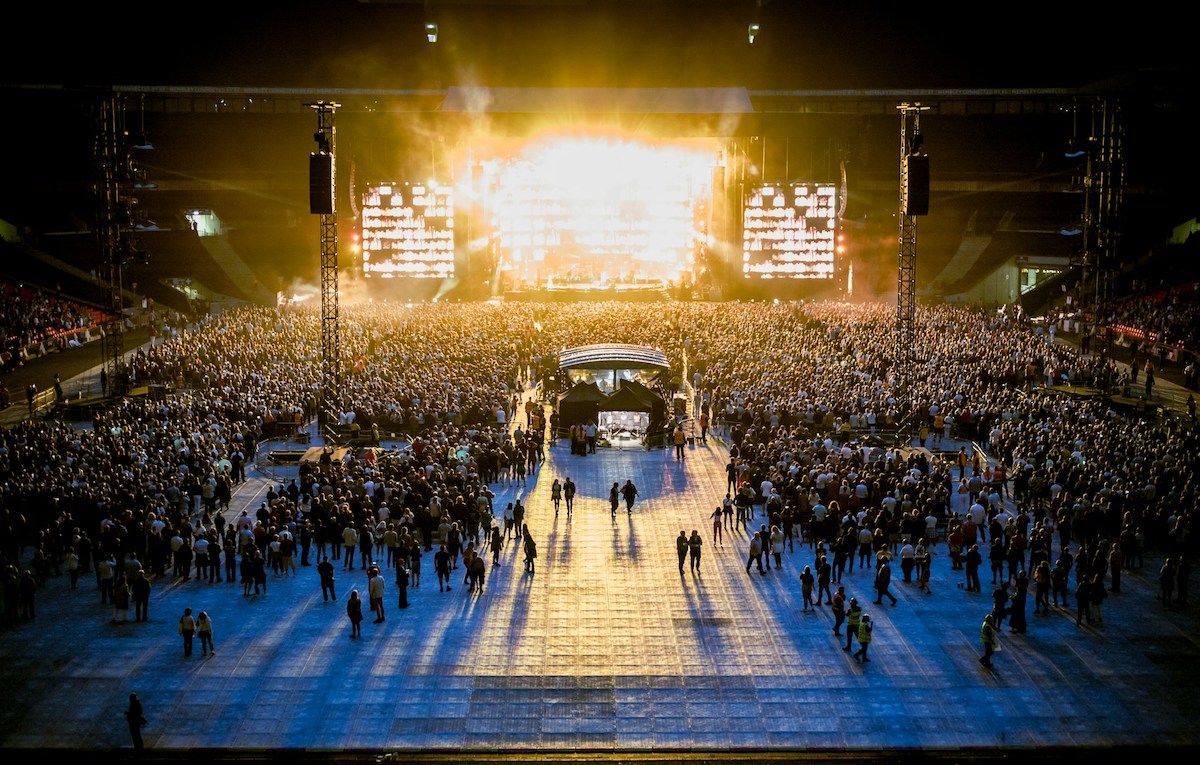
Summer, season of major events, concerts, waiting days for national and international big names, music, sweat, adrenaline and felt appeals from the stage for respect for human rights. Then here is the counterattack of the news to inform us of the rights denied, under that same stage, to those who with disabilities to be there have passed an obstacle path. “Imagine wanting to go to a concert and you are in a wheelchair,” says Sofia Righetti Nottegar, philosopher, trainer of (diversity, equity, inclusion) and activist. “The first thing you have to do is hurry up. The places are very few, very few, 0.5% on a 15% disabled population »and the reservation is carried out by e-mail only in certain dates and within pre-established time slots, always different.
We are in Rome, Palazzo Madama, in the afternoon of early July, to listen to experiences that too many we ignore and the converging requests, already reflected in amendments, of the Committee for accessible concerts and the first Italian trade association, and for artists with disabilities, al.di.qua.arters – Alternative Disability Quality Artists. But let's go back to the concert, the race for the conquest of our place has started, now we know that the pre -emption for its assignment. “To those who have the highest disability and those who first send medical documents, the certificate of disability, the identity card, other signed documents that vary according to the organizer”, explains Righetti. If you are lucky, you will receive a confirmation and you can enjoy the concert, without your friends: «It is expected that there is only one person with you, the companion, and it is not said to stay on the raised platform where you will be accompanied together with other spectators and from which the concert is seen very far, or is not seen at all. Even going for a drink or food becomes impossible, because the platform is so small that if you lose the place there will be other disabled people piled up in front of you ». Is this freedom? And without freedom, where is the equality?
From here, in Cascata, the first essential objectives of the Live for All Manifesto, the result of a collective action conceived by the Lombard lawyer and councilor Lisa Noja more than a year ago, and shared with various activists, giving life to a movement of the same name constantly growing on the platform of petitions Change.org, which has translated its purposes in amending amendments compared to the proposal of law n. 1536 on the participation of people with disabilities in shows and sporting events. This proposal, stops in the Chamber since last January, is considered by the movement absolutely insufficient with respect to the necessary dismantling of the obstacles that are among them to universal access to culture and its multiple expressions. The request to politics is therefore to resume it in question and approve it as soon as possible by assimilating the proposed changes that touch the whole process of using the live show.
It starts from transparent ticketsbookable in the same dates and through the same channels reserved for the rest of the public, with universalized methods and costs commensurate with the conditions of access and differentiated with respect to the placement of the place, as for all the others. “The numbers of the accessible places are segregating for our sociality,” says Valentina Tomirotti, journalist, expert on digital communication and activist, “we must not be obliged to choose who to share that moment of joy with, nor to feel relegated to fenced areas, with precluded views, barriers, standing people and safety rules”. In fact, it is intended to establish a maximum possible number of seats according to the structure involved and distributed in several sectors. The current locations seem to respond, rather than to security logic, to a cultural barrier common to multiple areas of society, in which it exchanges to give autonomy spaces to people with disabilities with the granting of control spaces. Participating is fine until you are in yours.
We remain at least perplexed in learning how blind people are removed the stick as a potential blunt weapon. “Safety often becomes an alibi, behind which the organizers are hidden,” says the lawyer Alessandro Gerardi of the Luca Coscioni Association, who has legally assisted, winning them, causes for discriminatory conduct against spectators with disabilities, such as the one against the Arena Foundation of Verona and Vivo Concerti. And if the noun accessibility does not identify with the mere entry into a place but with the actual use of its contents, all physical, cognitive, sensory disabilities must be taken into account. “Bruce Springsteen in San Siro made an entirely subtitled speech against Trump, then why not always subtit everything?”, Provocatively noja question. “Coldplay use the LIS in their concerts and sensory backpacks (designed to transmit sound through vibrations to deaf people and containing tools that cushion the overestimation in crowded environments, such as headphones and anti -stress balls). Even the nuclear tactical penguins have started to use the LIS, the tools today are there, not making them available means continuing to treat people as Serie B citizens ».
Several artists in cinema and music lately are exposed to the subject of accessibility. «Today to support our action for rights there are Karma B, famous drag queen to which I am grateful, they understand what it means to feel excluded, understand our battle. I appreciated a lot of Francesca Michelin who released this meeting in the Senate on her social networks, as well as Ficarra and Picone », continues Noja. «I would like more and more artists, they joined by putting their face, perhaps those with a stronger contractual power that perhaps can run the risk of discussing with their promoters or impresarios, demanding that their shows are enjoyable by everyone. After all, the struggle for the rights that costs nothing remains a proclamation and this is true in general ».
And if so far we have remained among the publicthe fifth objective of the manifesto, today signed by more than 30 thousand people, connects us straight to the transversal instances of professionals with disabilities who work on the stages, that is, the creation of infrastructures, new or in renovation, according to the principles of universal design that involves the representative associations of people with disabilities.
“I'm sorry, the dressing rooms of the theater are not accessible, you can change you in the bathroom of the bar in front or by car”, “I don't have time to adapt the choreography to your wheelchair”, “we do not foresee the economic coverage for the assistance to the person” are just some of the testimonies reported in the Senate by Giorgia Menegasso, singer, performer and activist. Here too the exclusion begins upstream of the supply chain: “From the possibility of accessing or not to a training program”, explains the artist and activist Chiara Bersani on behalf of Al.di.qua.artatists. “Most of the academies and art schools are not accessible, for architecture and for the preparation of the teaching staff, still not suitable for enhancing the expressiveness of students and students with disabilities”. A universal design for learning, therefore, radically inclusive teaching becomes binding since the first stages of artistic education.
And do we want to talk about the world of work? Public calls and selections, although inclusive in language remain in impracticable facts: “The notice requires speed, productivity, competitiveness”, continues Bersani, “projects measured mainly with quantitative indicators while our embodied experiences ask for slowness, rest times, mutual support. We therefore ask that the open calls written on our bodies are monitored and evaluated by competent experts ».
For five years, the association has opened a work table to request, in this circumstance more than ever, the establishment of a dedicated fund “which covers personal assistance costs, the accessibility of rehearsals, dressing rooms, housing and transport, in the production and tour phases. Otherwise “continues Bersani” these charges remain destined to fall or on the worker or on the production that will inevitably choose a less applicant profile “.
The asymmetry of a career path of a professional with disabilities is even more so if we consider the unsolved annual income band beyond which the right to receive the disability pension is lost, a limit that is asked loudly to re -evaluate, by virtue of the intermittent nature of artistic work. “No person should feel forced to choose between receiving support for assistance or being able to live a work experience.” In light of this, what resources do you intend to mobilize the government, for equal opportunities to those who work in the show and live with disabilities?
Experiences outside the Radar newspapers that do not leave indifferent. “Any administrator if not illuminated, at least smart, should urgently deal with these issues,” says Senator Ivan Scalfarotto. “We are talking about equality, which must be substantial and at the same time formal, otherwise it will be like bringing the cartel of Rosa Parks, which could climb the bus, but do not access the seats he wanted”.
And in all this story of realitytogether with the revolutionary potential of the amendments for a finally unequivocal law, there are those in the discomfort captures the evolutionary aspect. It is Michele Adamo, a member of the Italian Federation for the rights of people with disabilities and families and secretary of the Italian Union Fight against muscle dystrophy: “Twenty years ago, wherever I wanted to go, I presented myself and I entered, without the need for booking, without any problem. Today if I do not book risk of not finding tickets and this is fantastic, because first people with disabilities did not even consider many social activities. There is the desire to participate in cultural life and the awareness of being able to demand a constitutional right. The events help us to socialize because sociability is not innate in the human being, if we do not live some dynamics, if we do not do some experiences we do not grow “.
And if to expand the audience of the directly interested all this is not enough, Adam moves the reflection on needs: «The needs like rights are transversal, they are often common to people in situations not necessarily linked to disability, I think of a person in a late age, a mother with a stroller, an interruption even temporary of one's autonomy. I am reminded of the blue rooms of the railway stations, a service that has grown a lot because it responds to the needs of fragility ».