
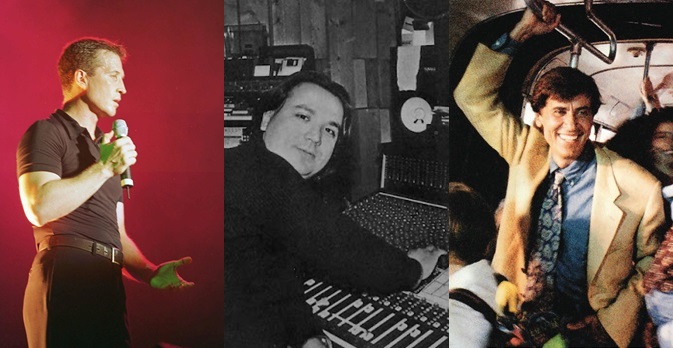

Emmanuel – “La chica de humo”
(from the album “Quisiera”, 1989)
The collaboration was desired by the Mexican branch of CBS, which always looked carefully at the Italian scene. In the summer of 1989 Emmanuel found himself in Bologna, where he had already been more than once in the immediately preceding years, to record new material in Malavasi's studios. The producer focuses in particular on a song he has just composed, characterized by an overwhelming and futuristic sound synth-funk.
It is not clear who is the signatory of the verses: on the album they are credited to the Spanish chorister and lyricist María Rosario Ovelar, aka María Lar, while in some copyright archives, including the Siae one, to Luis Gómez Escolar, a Spanish lyricist: both artists have often worked for the Mexican scene and are therefore perfectly plausible.
The song is called “La chica de humo” and talks about an unrequited love shock, with a fair amount of self-pity:
I still don't know who he is,
maybe my feet know it,
they follow her like mice
the piper of Hamelin,
and then lose it.
I don't want to talk about this topic,
but that's my biggest problem,
she's always on the cover,
full page, every morning,
in the diary of my sorrows,
Ah, he understands me, he provokes me,
ah, it lights up, flirtatious,
then it vanishes.
And what do I know where he goes, where he lives,
and everything goes wrong,
and it's always the same story,
and what do I know, I'm not a detective,
I'm like dogs,
my smoking girlfriend.
He doesn't listen to me when I talk,
his eyes say no,
and then he contradicts me
please, to do so
that one day I will blush.
I've already left my twenties behind me,
and she probably too,
we're not here to play,
it won't drive me crazy,
a living crossword
What is surprising is that the text of what could be a torch song in terms of languor and sense of loss, it is supported by an instrumental base of great rhythmic power, propelled by a rhythm section with bass glissando jazz fusion and drums that color a regular 4/4 movement thanks to passages marked by the use of sextuplets, with accents that give the illusion of an odd tempo (listen to the instrumental coda, starting from 4'59''). Malavasi then deploys his entire arsenal as a keyboard wizard: a groove of syncopated piano, a synth line that supports – and at times replaces – that of the bass, carpets that alternate pad atmospheric and digital organ, and finally a memorable riff of wind instruments imitated from the typical one presets of the Roland D-50: the latter is the winning element of the song, so much so that its melody composes the same refrain note for note.
Emmanuel shows his interpretative talent: despite not having a particularly powerful voice, he has a good variety of registers and timbres, appearing persuasive and mysterious in the verse before aggressively shooting into the chorus.
The song becomes his biggest hit and to this day is one of the anthems of Hispanic American song: at the time of publication of this article it has accumulated 618 million visits on YouTube and 475 million streams on Spotify.
Gianni Morandi – “But who are you”
(from the album “Morandi Morandi”, 1992)
In 1992 Malavasi decided to bring the song to the Italian market and entrusted it to Gianni Morandi, using the same instrumental base: the eternal boy of the local song, however, decided not to follow the imprint of the original text, but brought one with a sociopolitical edge: the language is simple and direct, as befits the artist's repertoire, but still contains some surprising traits, such as the questioning of his own reassuring character (“I almost change my face too, a life that I'm smiling, what the hell am I laughing at?”) or the insult directed at Giuliano Ferrara (“Look at that fat guy over there, they pay him to insult”), which today perhaps he would have formulated differently, rebuking the character's violent tones without bringing his physical appearance into consideration (but in 1992 public sensitivity on these issues was practically equal to zero, even for a character with positive values like Morandi).
The refrain is a small manifesto on the pain of living in Italy at the time:
But who are you, what do you do, where do you live,
are you sick too or are you no longer here?
But who are you, what do you do, what do you say,
are you okay with this or can't you take it anymore?
In the central part, an unprecedented mix of mumbling voices is inserted, among which that of Adriano Celentano can be recognised. It is not easy to follow what they say, only a few excerpts emerge clearly, such as the one in which the springer states: “This policy is not romantic”. The instrumental coda present in the original is instead cut.
Emmanuel – “La chica de humo”
(from the album “Mtv Unplugged: Con el alma desnuda”, 2017)
Meanwhile in Mexico, Emmanuel's version remains an unbreakable monolith and is periodically relaunched through his live albums, in particular when it was recorded for MTV Unplugged in 2017: the rendition in question, although not replicating the energy of the original, is very successful and refined, with a folk jazz arrangement dominated by brass section, bass and electric organ (really unplugged there is very little, but this applies to any episode of the MTV series, regardless of the title).
02/15/2026
Antonio Santini for SANREMO.FM