
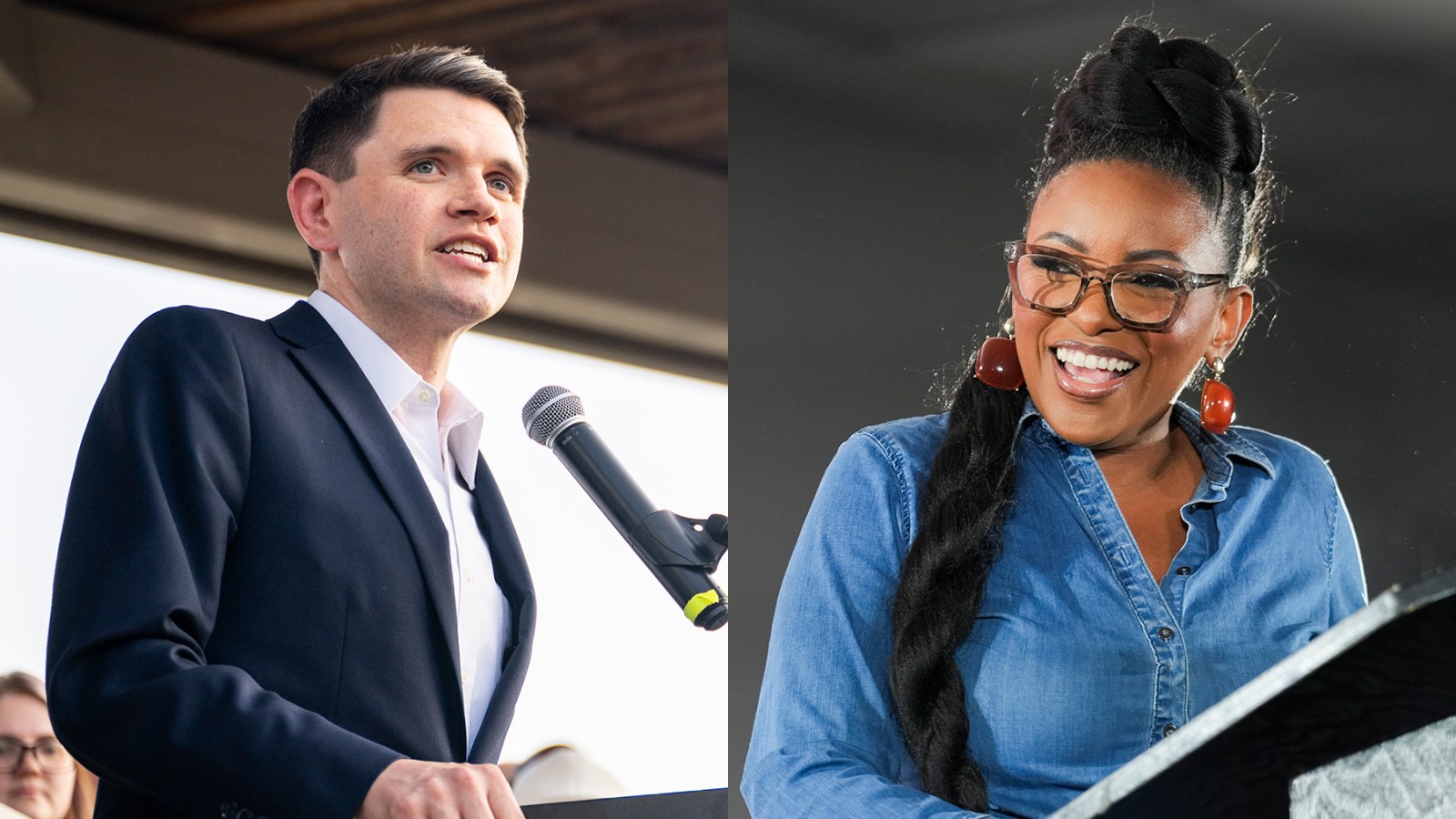
With about two weeks to go before early voting begins, the Democratic primary for a U.S. Senate seat in Texas has entered its terminal phase — and it’s getting ugly.
The 2026 midterm elections are shaping up to be a stinging rebuke of the first year and change of Donald Trump’s return to governance. As the president’s popularity craters, Democratic candidates have managed to pull off upset wins in challenging electoral battlegrounds by leaning into progressive economic policies and anti-corporatist, anti-corruption platforms. The time seems ripe to make some big plays, and none would be bigger than flipping a Senate seat in Texas
Texas has long been one of the most ambitious frontiers of Democratic electoral aspiration. The gargantuan, diverse, theoretically-purple-but-in-reality-still-red behemoth that has not elected a Democrat to statewide office in over three decades. Candidates of all stripes and backgrounds — from Barbara Ann Radnofsky, to Beto O’Rourke, to Colin Allred — have tried and failed to break the GOP’s stranglehold on the state. This year may be the party’s best chance yet.
Four-term incumbent Republican Senator John Cornyn is up for reelection, and despite historically being one of the most conservative members of the upper chamber, Cornyn has found himself an odd man out in a party that prizes loyalty to Trump above all else. Texas’ scandal-plagued, impeached, “biblically divorced,” but decidedly MAGA Attorney General Ken Paxton has leveled a primary challenge against Cornyn that will itself become a microcosm of the fight for the future of the GOP. Regardless of who wins, there are signs Texas may be cooling a little on the modern GOP. Rolling Stone reported last month on South Texas Hispanics who are having second thoughts about putting Trump back in office, and just last week a progressive union leader managed to flip a state Senate seat in the Fort Worth area that Trump won by 17 points less than two years ago. “People who are frustrated and angry? They always vote,” the winning Democrat, Taylor Rehmet, told us.
It’s in this moment that Democrats hope to peel away independents, disaffected conservatives, and flip one of the most unflippable Senate seats in the country.
They just need to get their shit together.
The primary pits progressive state legislator James Talarico against U.S. Rep. Jasmine Crockett, and after two months of relatively innocuous encounters between the candidates — including a debate with plenty of mutual praise — the race has now reached a point of combustion.
Talaraco was accused this week of making racially charged remarks against his former rival, Colin Allred, with Allred posting a video to social media on Monday claiming Talarico called him a “mediocre black man.” Allred, a former U.S. congressman from the Dallas area, announced his bid for Senate before Talarico last year, but dropped out after Crockett entered the race in December.
“I understand that James Talarico had the temerity and the audacity to say to a Black woman that he had signed up to run against a mediocre black man, meaning me, not a formidable, intelligent black woman, meaning Jasmine Crockett,” Allred said. “Go vote for Jasmine Crockett. This man should not be our nominee for United States Senate.”
The claim came from a single, unverified source, social media influencer Morgan Thompson. In a series of videos posted to TikTok, Thompson — who did not respond to a request for comment from Rolling Stone — said that the incident took place in an off-the-record meeting with Talarico and an unnamed aid, in which she expressed concerns about his campaign’s association with longtime Democratic strategist James Carville, and the prospect that Talarico would disregard the concerns of Black Texans if he managed to win. Thompson claimed that at one point, the candidate said he had “signed up to run against a mediocre Black man, not a formidable, intelligent Black woman.”
Thompson acknowledges that she does not have any record of the conversation outside of her own recollections, and while Talarico’s campaign confirmed the two had had a “private” conversation, he countered that Hudson’s recounting of it was a “mischaracterization.”
“I described Congressman Allred’s method of campaigning as mediocre — but his life and service are not,” Talarico wrote. “I would never attack him on the basis of race.” Crockett’s campaign issued a statement lamenting that “at the start of Black History Month, this is what we’re facing,” and thanking Allred for deciding to “stand for all people who have been targeted and talked about in a demeaning way as our country continues to be divided.”
The incident threw the hyper-online milieu of reporters, commentators, influencers, and politicos both in and outside of Texas into a frenzy — bloody chum in the political waters of a race that had plodded along for months with little in the way of skullduggery or bombshells.
The Republican opposition was thrilled over Allred’s video and its fallout. Paxton’s campaign shared Allred’s video with an “👀” emoji. Sen. Ted Cruz (R-Texas) gloated over “D on D” action. The National Republican Senate Committee — which helped goad Crockett into running — also boosted Allred’s video.
If the past three decades of failed attempts to flip Texas blue have taught us anything, it’s that the rules are different in the Lone Star State. National attention and enthusiasm among the Democratic base do not translate 1:1 to turnout. Beto O’Rourke — the candidate who has gotten closest — did it not through his own stated strategy of motivating dormant Democrats in Texas to actually show up to the ballot box, but by convincing about 400,000 Texas voters to split their ballots between Republican Governor Greg Abbott and Democratic candidates in downballot races.
Democrats are at an entrenched “structural disadvantage” in the state, Texas Politics Project Director James Henson tells Rolling Stone. “Once you have been shut out of executive offices and legislative minorities for a matter of time that is measured in decades […] it’s harder to raise money, it’s harder to build mobilization infrastructure, and the Democrats don’t have any real kind of political, ideological infrastructure to speak of.”
“For all the talk among Democrats of ‘we’ve just got to get the right message, or ‘our communication strategy isn’t right,’ or, ‘that candidate just used the wrong tactics’ — all of those things might be true in particular elections, but the real problem is that the Democrats are just at such a big disadvantage in the state,” he adds.
Talarico and Crockett both believe they can overcome the hurdles, and despite their similar-enough progressive politics they are vastly different candidates with vastly different theories of the case.
Talarico is a former school teacher and Presbyterian seminarian, who has made his Christian faith the foundation of his progressive politics in a time when the conservative movement tends to monopolize religion. His bid for the Senate has gained steady traction through a wonkish, digitally native campaign rebuking the current political order and emphasizing economic stratification over partisan schisms. A four-term member of the Texas House of Representatives, Talarico, like Crockett, is untested in a statewide race, and had little national name recognition up until a few months ago. His strategy seems to be to piss off the least amount of people possible while leaning into a platform relentlessly focused on kitchen table economic issues, and an opposition to corruption in Washington. The campaign is attempting to court large swaths of Texas’ Hispanic population, which swung hard for Trump in 2024. Perhaps his biggest weakness is that he’s kinda boring, a clean-cut continental breakfast of a candidate who has steadfastly shied away from controversy.
The same can’t be said for Crockett, who built a national following through made-for-social-media rhetorical face-offs with Republicans in Congress. Her description of Rep. Marjorie Taylor Greene (R-Ga.) as “bleach blonde, bad built, butch body” in response to a quip from the now-formerly MAGA congresswoman about her false eyelashes was one of the best comebacks of 2024. But her open, unrestrained manner of engaging with her colleagues, voters, and members of the media has caused the congresswoman some grief. Several incidents drew the direct ire of Texas conservatives, and key demographic groups. Last year, she referred to Texas’ wheelchair-bound governor, Greg Abbott, as “governor hot wheels.” In another, she suggested that Latinos who supported the removal of undocumented migrants had a “slave mentality,” and demonstrated “the hate that some slaves would have for themselves.”
Crockett’s take-no-prisoners, headline-grabbing approach to her time in the House has, of course, made her a target for racist and sexist attacks by the right-wing media machine, so much so that Trump has publicly derided her as an avatar for the kind of progressive politics he and his movement despise on multiple occasions.
It is precisely for that reason that the GOP egged on her late entrance into the primary. According to reporting by NOTUS, the National Republican Senatorial Committee last year worked to inject Crockett’s name into exploratory polls and surveys related to race. A source told NOTUS that the NRSC wanted to “orchestrate the pile on of these polling numbers to really drive that news cycle and that narrative that Jasmine Crockett was surging in Texas,” in order to bait her into joining the race. The hope was that the congresswoman — with her national name recognition — would sail through the primary and hand the GOP candidate a 2026 general election opponent who had already had an established reputation in the minds of Texas voters — particularly independents. Crockett would go on to say in her announcement speech that she “couldn’t ignore” the “poll results” she was seeing.
The gamble might pay off — at least to the extent that Crockett is neck-and-neck with Talarico despite running a decidedly underwhelming campaign. With Texas Democrats getting ready to cast their ballots, Crockett’s campaign has yet to present any semblance of a concise platform outline. In her January debate against Talarico, the congresswoman — famed for her agility in timed constrained public speaking as a member of the House — initially gave scattered answers and at points seemed locked in a duel not with her actual opponent, but the moderator’s 60-second time limit. In multiple instances, Crockett simply cut off her own response rather than going over by a few more seconds to close out her point. It gave the impression that Crockett had not invested the necessary time into honing down elevator pitch answers to standard campaign questions. She’s also come across as arrogant, telling CNN in December that she doesn’t think she needs to appeal to Trump voters.
Only about a million people vote in the average Texas Democratic primary, and motivating turnout for the general election can’t start early enough. Henson, who has studied and dissected Texas’s electorate for almost two decades, says an aspiring Democrat needs to maximize gains in three electoral categories: the existing base, true independents, and persuadable Republicans. “Polling thus far shows that independents are in a pretty anti-incumbent mood right now, so there’s probably a pretty good chance that the right Democratic candidate would have some kind of entree to those voters,” he says. “In terms of persuadable Republicans, it’s a little trickier. Will Republicans be able to turn out enough of their voters to make up for any attrition among the edges, among Republicans, and for an increased Democratic turnout?”
Infighting isn’t going to help Talarico or Crockett’s chances in the general election, but in the aftermath of the debacle with Allred, the dam seems to have broken.
On Thursday, the pro-Talarico Super PAC Lone Star Rising released an attack ad highlighting the RNSC’s work to get Crockett in the race. Last week, a prominent Crockett supporter hinted during a private donor call that attacks against Talarico were incoming. The Crockett campaign responded with a statement suggesting the ad was “paid for by the same millionaire mega-donors that he claims to not have,” and was an example of “hypocrisy” on par “with the Republican Playbook.”
“There are buttons to be pushed in a Democratic primary, just like there are buttons to be pushed in a Republican primary — particularly in races like this, where the candidates have money and the race is competitive,” Henson says of the race’s hostile turn.
With every attack, however, the candidates risk handing over ammunition for the much better funded, more powerful Texas GOP to use against them in the general, while potentially turning off prospective voters tired of intra-party squabbles. “There will become a point of diminishing returns,” Henson says of the back-and-forth. “In a while, it might actually be negative.”
Daniel D`Amico for SANREMO.FM