
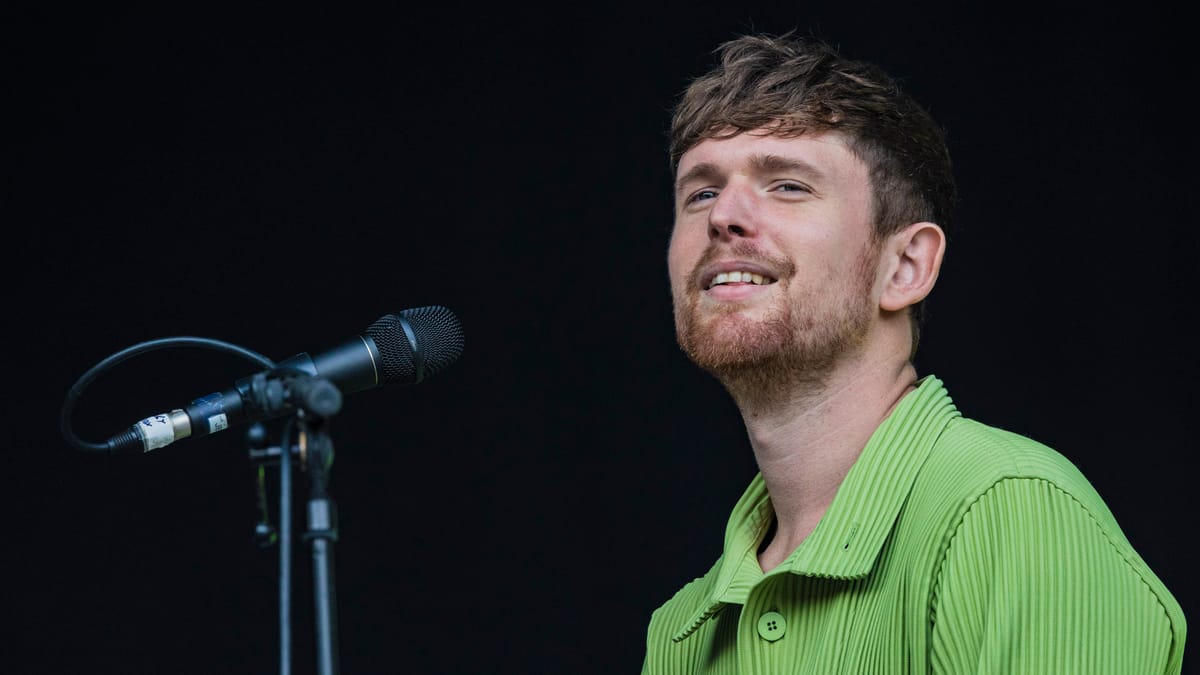
Article by Marzia Picciano
It always amazes me how we look for meanings in the works of artists, those we highly respect, that are more personal urgencies than, perhaps, the real messages that the aforementioned artist wants to communicate. So I'm not surprised by the anxious queue that precedes the listening session of the new album by James Blake, Trying Times (out on March 13 For Goodboy Records/Virgin Music Group), among other things nomen omen that more perfect for this historical moment, come here to Milan, Triennial AKA Casa Italia, Voiceguest of an attentive fan like Thomas Thomas in an intimate confrontation with a hyper-varied audience (from artists like MACE to humble adoring fans) to whom, apart from a few minutes of delay, Blake is more than willing to dispense advice, explain himself in his work, dispel myths.
After all, it must be quite a responsibility to be James Blake today. As one listener pointed out to him: have you ever thought you were one of the best musicians around today?
Of course he knows. So much so that he candidly admits it: on the one hand we must overcome the enormous expectation, the anxiety of adoration that the public reserves for him, on the other, still, we must overcome ourselves, as if we didn't all know that we are the most imaginative critics of, in fact, ourselves.
It is on this balance – of which Blake he doesn't profess to be a master, but a humble and eager researcher – who supports a career and what he himself defines with embarrassed spontaneity as his favorite album to date.
It is a concept, that of “reconcile“, he uses this very word, which is dear to him and to this album. Where we saw Blake move from the bomb of his very essential self-titled debut (perhaps one of the few albums I know by heart, which sounds and sinks in like a childhood ritual with each re-listening) to Playing Robots Into Heaven, that after the r'n'b explorations of Friends That Broke Your Heart and the minimalisms of Takes Form (I don't quote so as not to sound too pedantic Overgrown and the most dreamlike The Color In Anything) seemed a bit like a return to electronics in a broader sense, it's no surprise that Trying Times he wants to sound like his masterpiece. And he surprises, instead, in what he wants to do.

Trying Times hides a spirit, I wrongly say, “pop”: in proposing references that are continuous samples of sacred monsters of the past from Dusty Springfield (pure rework handled, like all the samples on the album, by Dom Marker Of Mount Kimbie, one of deus ex machina of Blake in this work) a Leonard Cohen (a constant and a working reference, even philosophical, for ours, thanks also to the impulse of our partner Jamila Jameel); in stringing together tracks that assert in an ever stronger way, the desire to make a record with a recognisable, almost predictable, universal flavour. My mother would love what is now the title track, yet 7 years ago it was her and my sister who dragged me away from the Sziget tent where she was performing because they were full and wanted to leave (why my mother was at Sziget is another story).
But Blake doesn't want to pamper us or even reassure us. The vision of Trying Times it's tormented enough by click, skip, restart to make it seem like an impossible sequence shot from Black Mirror, if one were ever possible. It's like watching an old film that we know very well and penetrating the dark cracks that it can no longer hide, with the pervasiveness of synthetic music. Apart Walk Out Musicwhich operates a kind of slide from Trying Robots inside the new disk dimension, from Death Of Love And I Had A Dream She Took My Hand there is all the beauty of a double narrative: of the colors of the light of the references to fanfare rhythms to the register changes in the bridges or in the codas of the same pieces.
Didn't Come To Arguea piece that features the singer from the American tradition Monica Martin, it turns completely upside down at the end, like in those thrillers in which the story ends with the third party's point of view which completely changes the meaning of the film. Same goes for Doesn't Just Happen in feat. with the English rapper Davein which Blake really tries to sign a piece that has the characteristics of classic hip hop: musically solid, rhythmic enough, lines scary (and he does not shy away from underlining how enlightened he considers his colleague and how important it is to have the possibility of working with texts of a certain level).

There are notes of color that remain radiant and a little un unique on the record like Make Something Up: in my ears there are the Eels repeated endlessly, in a loop that turns off only because the volume is lowered, and in reality it is still in perpetual motion. And there are explicitly dark notes, which break the story to bring it back to Blake's typical narrative: the Dusty Springfield, in fact, of Rest Of Your Life which turns into the true clubbing moment of the album, preceded by the essential and sick interlude of Obsession.
On all these notes, where the piano returns yes, but this time in a highly orchestrated environment, full of strings, Blake installs words that aim to guide listening. This album tries, he says, to reconcile the uncertainty we have in defining expectations of growth, joy, love, anything that we could have in the course of our lives with the inhospitality of the earth that acts as an aquarium. Trying Timesdifficult times, he says, in English is a great understatement, it poorly conceals the ironic charge which is the basis of humor across the Channel. It's a truce, first of all for him. And in the end this reconciliation also seems a bit like the escape route James Blake he had to find himself in order not to make up for what is a very human perfectionism towards his own art.

Challenging oneself: making this album cost money, from those who pushed him to get back into it, or from advice such as: put yourself in the least comfortable of conditions and then amplify it. He can't stand trashy music, he doesn't share, even if he is fascinated by how social media can bring any piece of music to maximum effectiveness, often the most unlikely, and he looks to the emerging ones: there are those who are happy with it, looking not for the widest audience, but for the one that can understand what you are doing.
I understand why for James Blake this is an important, significant album: it exudes a controlled and balanced symbolic intensity, very lucid emotions collected in very dense spheres perfect for the synapses of the audience. And for these difficult times, indeed.
Daniel D`Amico for SANREMO.FM