
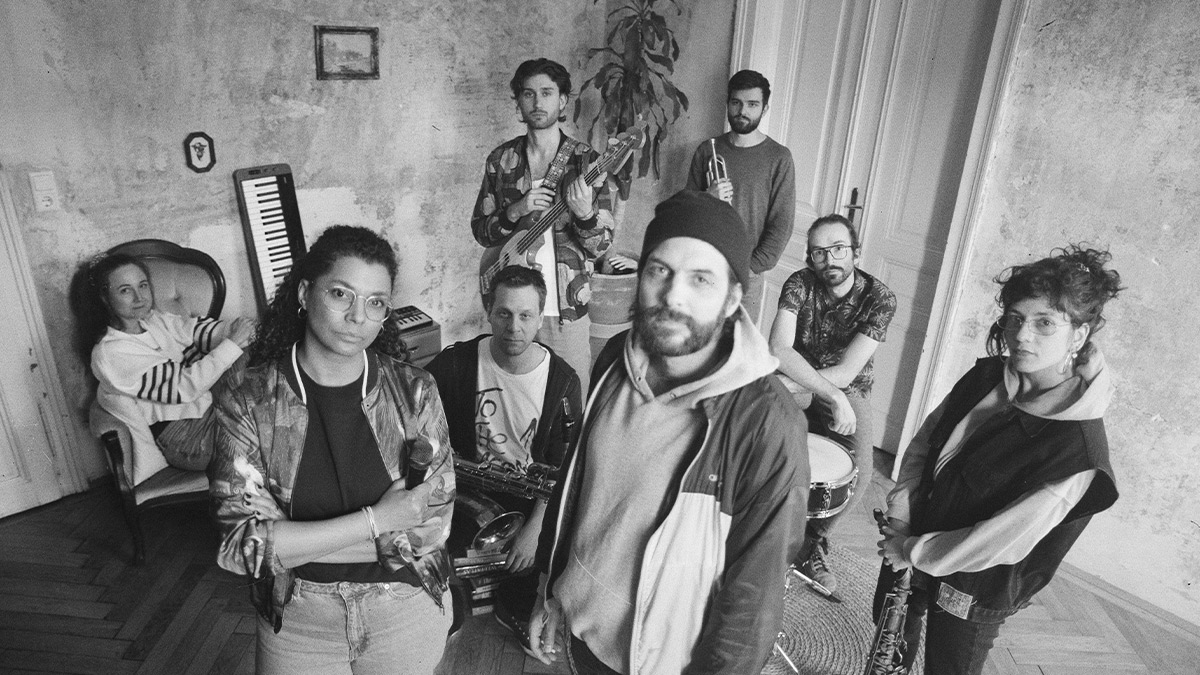
Niko Back with the album “Hallo & Hello“And he chooses the bravest way: to remain faithful to himself. The group overlooks the Italian and Austrian scene by embracing bilingualism, creating the disc thanks to a successful crowdfunding and rediscovering blazing sounds of the 80s.
In addition, it takes a clear position by renouncing streaming platforms, as a sign of protest against those who invest in war technologies and do not properly protect musicians. The sound is that of an alternative pop veined funk and soul, in which synths and acoustic instruments meet in a playful balance.
Author, multi -instrumentalist and Viennese actor, Nikolai Selikovsky Debutta in 2009 in the cast of the film “Sturmfrei”, and then assert themselves in Austria and Germany as rapper, with the album “Dechter der Großstadt” (2010). In 2013 he moved to Italy to study at the Dams of the Roma Tre University. Upon his return, he transforms the solo project Niko into a band, with which he performs throughout Europe. He collaborates with producers such as Andreas Lettner and Tebo, which allow the birth of successes as “Unter Strom”. In 2018, he moved to Rome again. It is in the cast of “The last time we were children” by Claudio Bisio (2023), “A love” (2024, Sky) and the series “The Decameron” (2024, Netflix). In 2023/2024 he started a new creative phase, collaborating with the multi -instrumentalist and composer of soundtracks Federico Torri and with the drummer Lukas Fellner.
1. In Hallo & Hello Italian and German coexist without forcing. How does this linguistic choice reflect your life?
Thank you, because it was really important for us that everything would come naturally. At this moment these are the two languages I use every day, so they represent me perfectly. The more the time that I live in Italy passes, the less I care if every now and then I run away with words in German: in the end everything flows fluidly. What matters is to remain authentic.
2. You have decided not to release the album on traditional platforms. What was the reaction of the people around you and in Austria?
Before making this final decision we made a meeting with the band. There was a lot of fear of not being considered, but fortunately the opposite happened. I think we are experiencing a very important period, in which we have to choose following what the heart says, not just the need to immediately fill the wallet. As Denzel Washington recalls: “Don't Aspire to make a living, aspire to make a different.”
Some friends shared our choice and immediately canceled the subscription to Spotify. In Vienna, in general, there is a lot of awareness regarding privacy, workers' rights and other similar issues: not surprisingly many use only Signal to text.
3. The disc is crossed by retro sounds which however do not want to be revivalistic. How did you work to make 80s influences dialogue with your current language?
At the beginning the imprint came mainly from Mahir Jahmal, our guitarist and co-composer, who unfortunately left us in 2022. He was deeply immersed in the structures of the songs and in the only 1980s, and also had the courage to start a composition in that style. I remember once he came to my house for a jam session: we pulled out my old Yamaha keyboard, the one with which as a child I had started studying piano. Without hesitation, he began to create a base with those super-trash sounds typical of the time, yet he worked immediately.
During the production of the album, we were always looking for sounds capable of heating the heart: the imperfect oscillation of a cassette, the boom-bag battery of the 90s or, more simply, a certain reverberation of the voice.
4 What does it mean for you to make music in this way?
For me it was a real liberation. Already years ago I tried to produce, but I never could: both for technical limits and for lack of trust in myself. After years of music and “mental cleaning”, I said to myself: do you know what is there? I don't care more than what others think. Thanks to the members of the band and my album co-producers, Federico Torri and Lukas Fellner, we managed to dedicate ourselves with time and love to the project, working together on Zoom or in the studies that we had put up in Rome and Vienna. I believe that more craftsmen of music are needed, rather than people who tell you which algorithm follow.
5. Your career is divided between film sets and musical stages. How much the two arts contaminate each other in your creative process, and is there a direct link between your experience as an actor and the writing of Hallo's songs & hello?
In performance yes, absolutely: my goal is always to transmit something, an emotion, a message. In the composition and in writing, however, I would compare it to the script or direction: in the end it is always about expressing itself as an author. The passage to which I am most attached, compared to this theme, is Lady Godardbecause it was born precisely from a teacher of mine who sent me great teachings on cinema.
6. What is the song of the album you are most attached to and why?
I would say Just a Viennese, Because it tells my life from Viennese in Rome in recent years. And then, of course, Reconciliationthat every time I sound it deeply moves me: reflects love and bond with a person with whom I feel a special connection.
7. What would you like for the future of this album?
Our desire is to come to Italy to embark on a tour and play in the festivals.
Daniel D`Amico for SANREMO.FM
